

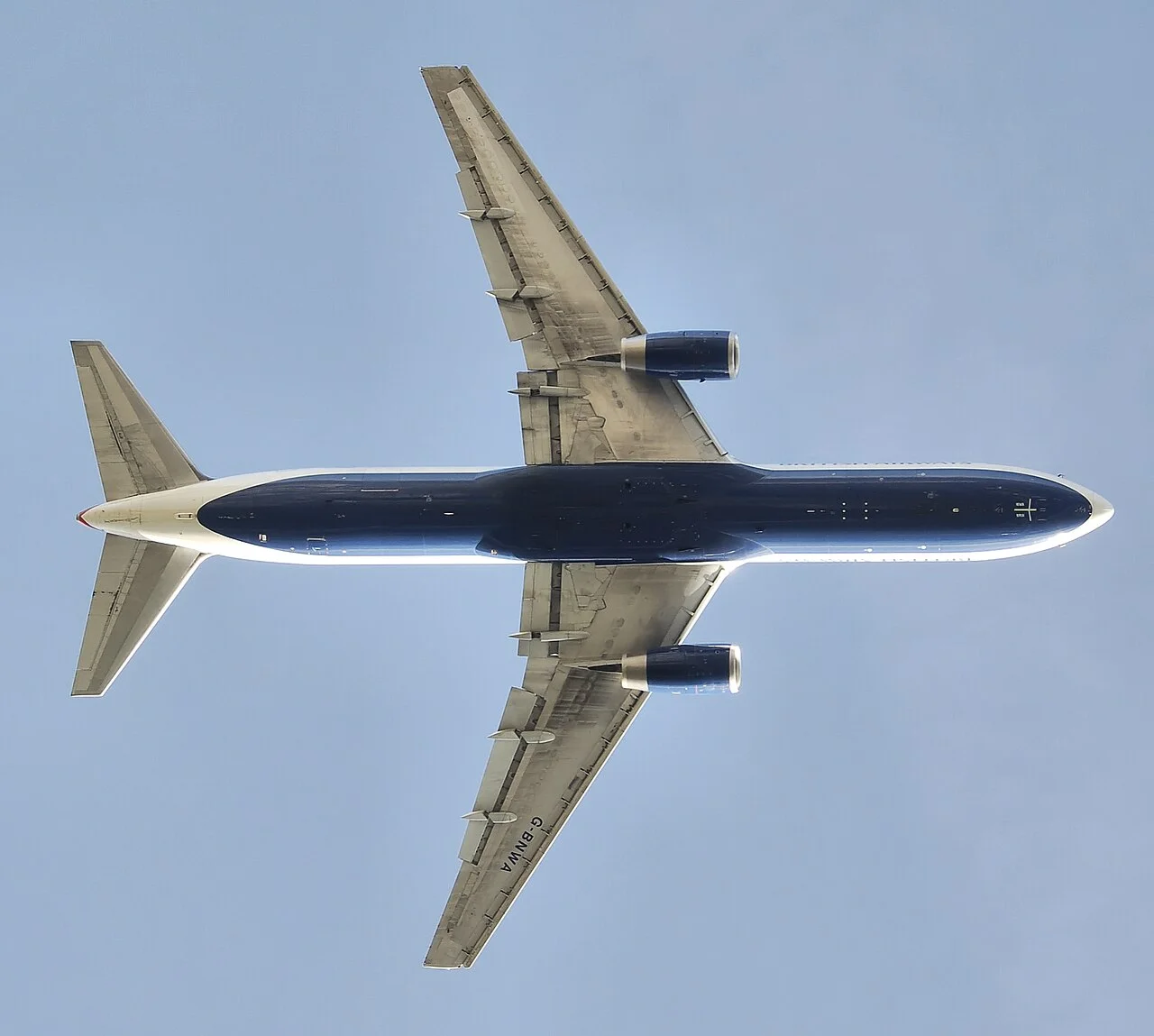


Key facts
The Boeing 767 is the twin-aisle jet that opened the North Atlantic to twin-engine airliners [1] [4]. It first flew in 1981 [1], and more than four decades later it is still being built, though these days as a freighter or a military tanker rather than an airliner [3].
Born alongside the 757
Boeing developed the 767 in parallel with the single-aisle Boeing 757, and tried to treat the two as one programme [3]. United Airlines launched the 767 on 14 July 1978 with an order for 30 [2] [16]. The first one flew on 26 September 1981 [1] [2], and United put it into service on 8 September 1982, between Chicago and Denver [2] [16].
The shared programme shows up in the cockpit. The 767 and the 757 share a common type rating, so when the 767-400ER arrived in 2000, pilots already qualified on the 757 or earlier 767s could fly it with minimal extra instruction [15]. The cabin has two aisles [3], and most airlines seat seven across in economy, arranged 2-3-2 [2] [17].
First across the Atlantic under ETOPS
Twin-engine airliners flying far from land work under rules known as ETOPS, which set how many minutes of flying time the aircraft may be from the nearest airport [4]. In 1985 the 767 was certified for extended flights that made it the first commercial twin jet to fly regular routes across the Atlantic [1]. Trans World Airlines was the first airline given permission, flying its 767s from Boston to Paris under a 120-minute rating [4]. In 1988 the FAA raised the limit from 120 to 180 minutes [4].
A long family
The 767 has three ICAO type codes, one for each fuselage length [7]:
- 767-200 (B762). The original, in service with United from 1982. The longer-range 767-200ER followed in 1984 with El Al [3].
- 767-300 (B763). A stretch that entered service with Japan Airlines in 1986. The 767-300ER arrived in 1988 with American Airlines and became the most popular version [3].
- 767-400ER (B764). The longest, launched by Delta Air Lines in 1997, with raked wingtips [14]. Delta and Continental Airlines took their first ones in August 2000 [15].
Boeing counts five passenger models in all, plus the 767 Freighter [1]. Boeing staff celebrated the 1,000th 767 on 2 February 2011 [1], and Flightradar24 put the total built at more than 1,270 in February 2026 [3]. Delta was the largest operator, with 79, when Flightradar24 last updated its count in February 2026 [3].
Freighters and tankers
Passenger production has ended, and the line now builds only freighters and military versions [3]. The 767 Freighter, based on the 767-300ER fuselage, was first delivered in October 1995 [1]. By February 2026 FedEx had 60 767s and UPS 59, making them the second and third largest operators [3]. In September 2026, Reuters reported that Congress had passed legislation letting Boeing keep building the 767 freighter through 2033, beyond 1 January 2028, when new emissions rules take effect [6].
The tanker story began in 2000, when Boeing launched an international 767 tanker and transport [1]. In February 2011 the US Air Force awarded Boeing a contract for a tanker to replace its ageing KC-135s: the KC-46 Pegasus, based on the 767-2C, a freighter version of the 767-200ER [1]. The Air Force accepted its first KC-46A on 10 January 2019 [5]. It is derived from the commercial 767 airframe and built at Boeing's Everett factory [5].
How to spot one
- The shape. A widebody with a distinctly rounded nose [8]. It is wider than a 757 [8] but much smaller than a 777 [12], which gives it a short, plump look beside either.
- The wheels. Four wheels on each main landing gear, in two pairs. Once the aircraft leaves the ground the bogies tilt forward, which no other Boeing widebody does [8] [9].
- The tail cone. Rounded and slightly pointed [8].
- The wingtips. The 767-200 has plain square tips and never had winglets [8]. Some 767s carry tall blended winglets [9]. The 767-400ER has pointed, raked wingtips [8], as a 777-300ER does [13], so check the wheels [8] [9].
- Freighters. A large cargo door at the front on the left side, and no cabin windows, or metal plugs where the windows used to be on converted aircraft [8].
Telling it from its neighbours:
- A Boeing 757 has a narrower, single-aisle fuselage and its main gear does not tilt forward [8]. The two share the shape of their cockpit windows, tail cone and fin, so look at the width [8].
- An Airbus A330 is a similar size, but its main gear bogies tilt backward in flight, not forward, and its cockpit windows differ [8].
- A Boeing 777 has six wheels on each main gear and a flat, square tail cone [8].
- A Boeing 787 has four cockpit windows to the 767's six, and serrated engine exhausts [10].
Over Ireland
Shannon sees the 767 on the transatlantic run. For summer 2025, Delta flew a 216-seat Boeing 767-300ER between New York JFK and Shannon, from the week of 19 May until 20 September [11].
Airline schedules change from season to season, so treat that as an example rather than a timetable. The live map is the better guide to what is overhead tonight.
From the archive
Everett’s 1,000th widebody delivery was a 767-300ER for Scandinavian Airlines on 14 August 1989. [18]
The 767 shares Everett’s production story with the 747 and 777: Boeing counted those three families together when it celebrated the factory’s 3,000th widebody in 2007. [18]
In photographs
Look closer at the shapes, details and liveries. Every photograph links to its original and credits its creator.
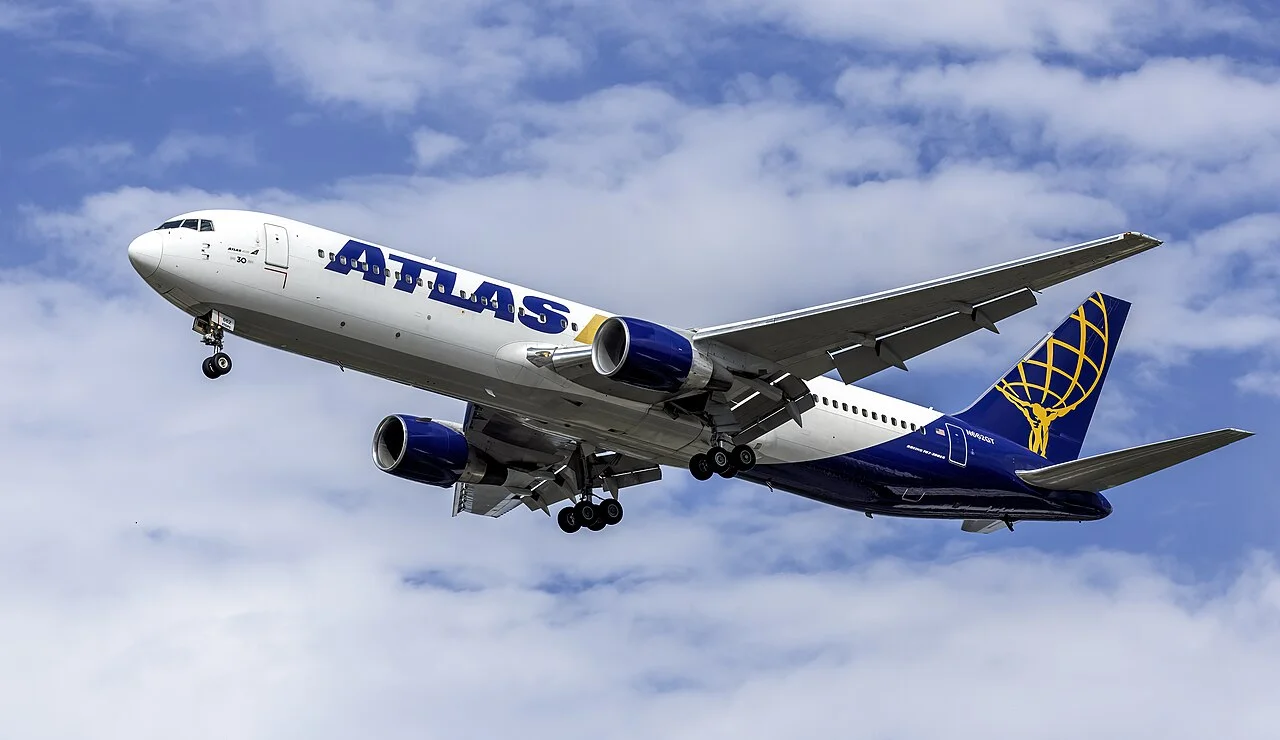
Atlas Air 767-300ER N662GT on approach.
Acroterion · CC BY-SA 4.0 · Source and credits · 2025-09-25

View full-size · Original imageResized WebP display copy.

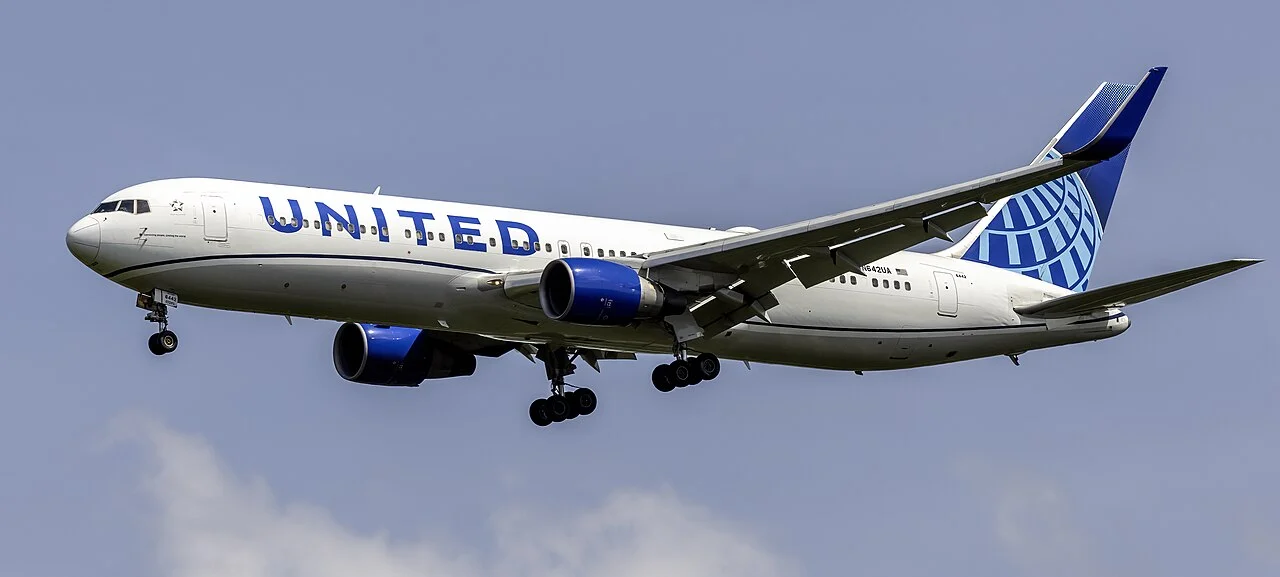
United 767-300 N642UA in flight.
Acroterion · CC BY-SA 4.0 · Source and credits · 2025-04-30

View full-size · Original imageResized WebP display copy.

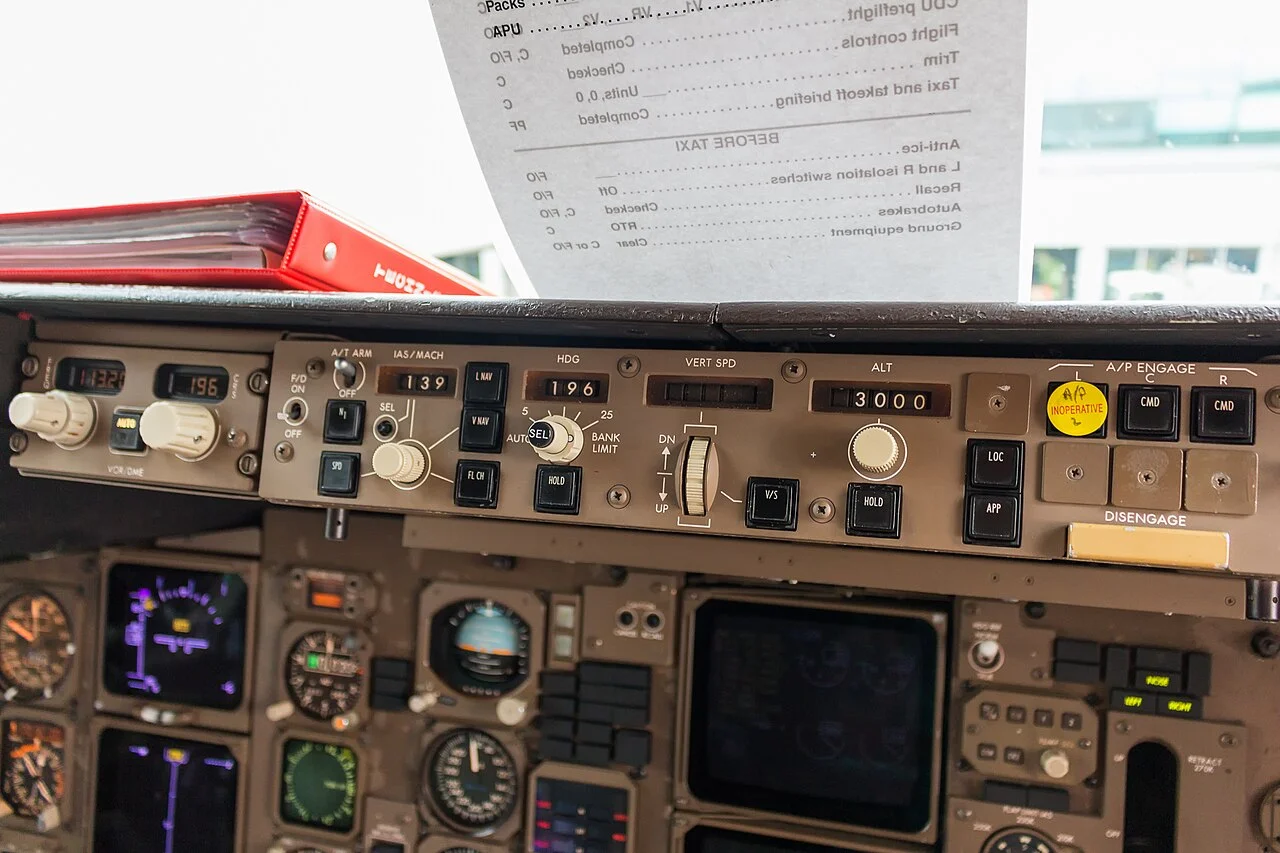
Inside a real 767 cockpit, with its traditional yokes and instrument displays.
Stirling Day · CC BY-SA 4.0 · Source and credits · 2014-12-27 15:00:08

View full-size · Original imageResized WebP display copy.

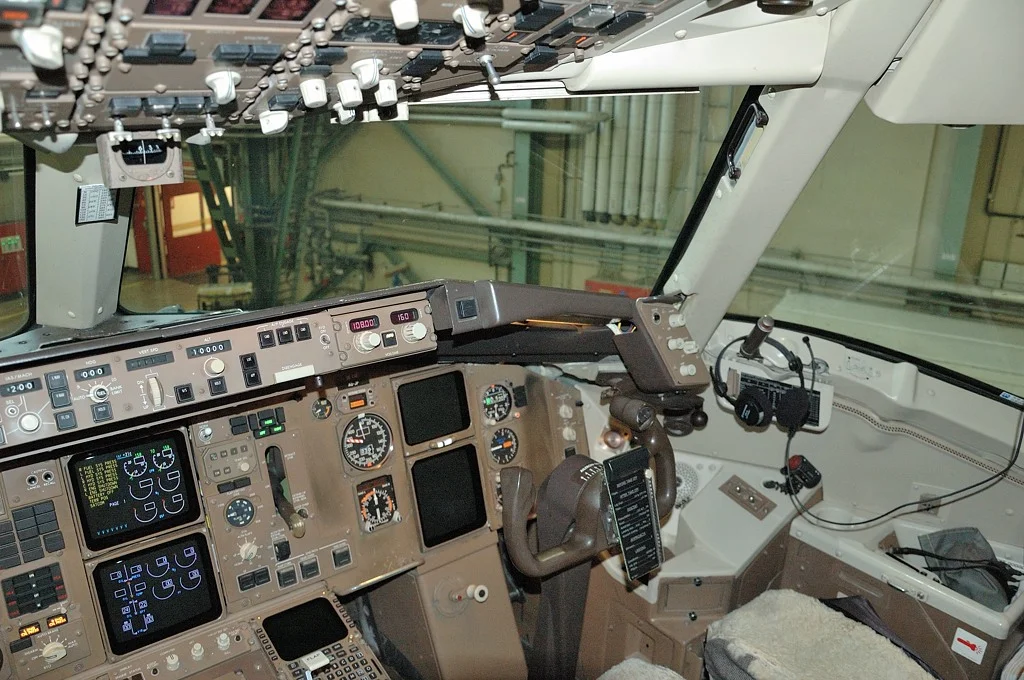
A wider view of a 767-300ER flight deck.
Doronenko · CC BY-SA 4.0 · Source and credits · 2014-10-08 10:16:48

View full-size · Original imageResized WebP display copy.

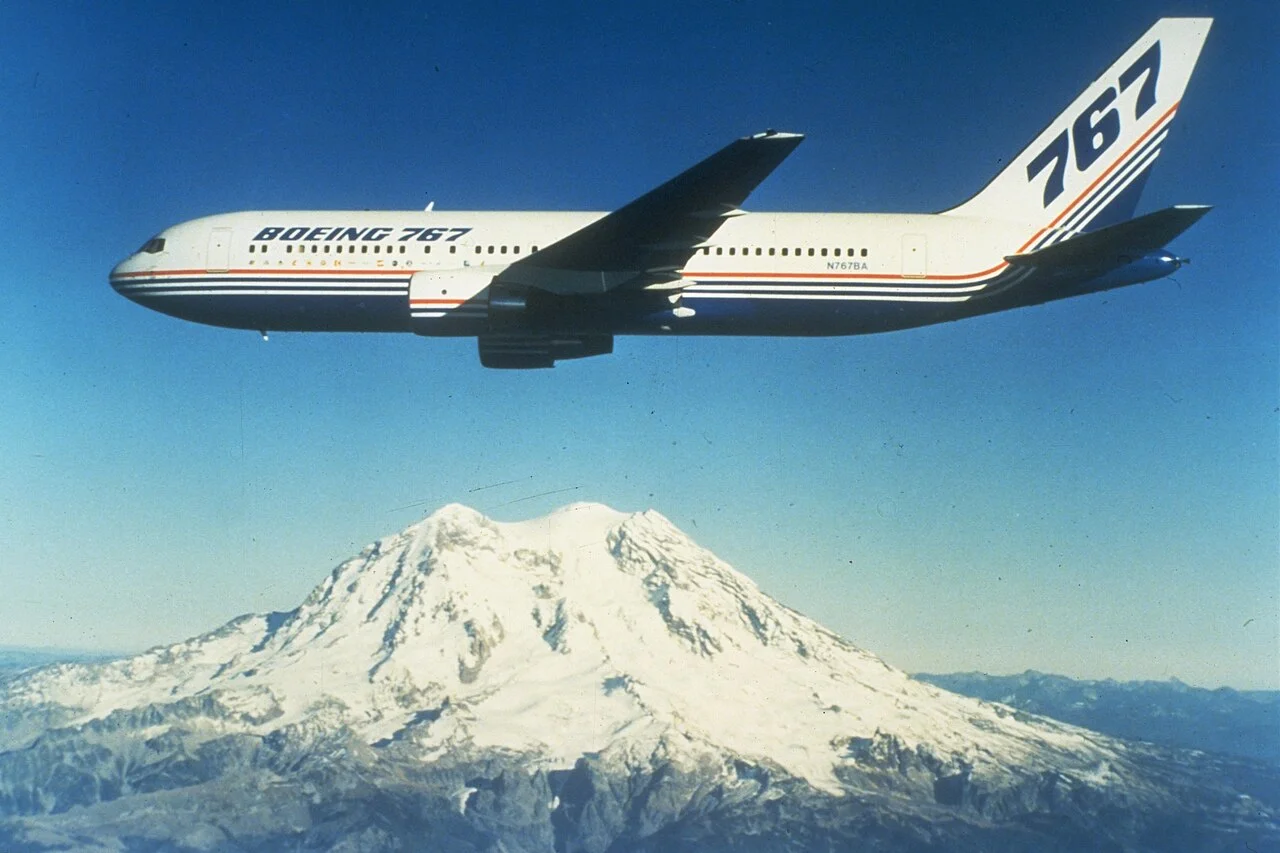
An archival Boeing 767 photograph over Mount Rainier, dated to the 1980s by its source.
Seattle Municipal Archives · CC BY 2.0 · Source and credits · circa 1982date QS:P,+1982-00-00T00:00:00Z/9,P1480,Q5727902

View full-size · Original imageResized WebP display copy.

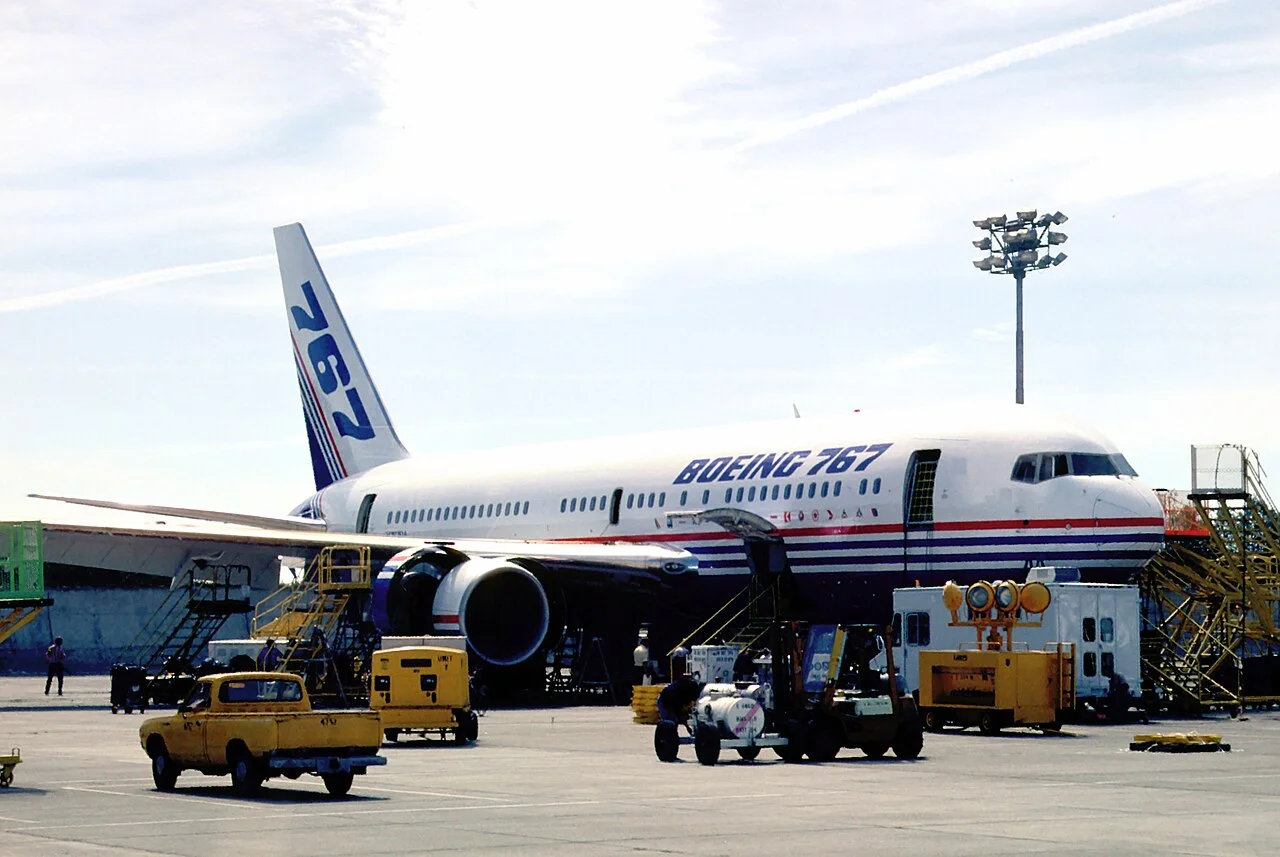
Boeing’s early 767-200 N767BA photographed in September 1981.
Aero Icarus from Zürich, Switzerland · CC BY-SA 2.0 · Source and credits · 2010-12-22 12:03

View full-size · Original imageResized WebP display copy.

Drawings and original documents
Existing published drawings are credited below. These are reference illustrations, not manufacturing blueprints.
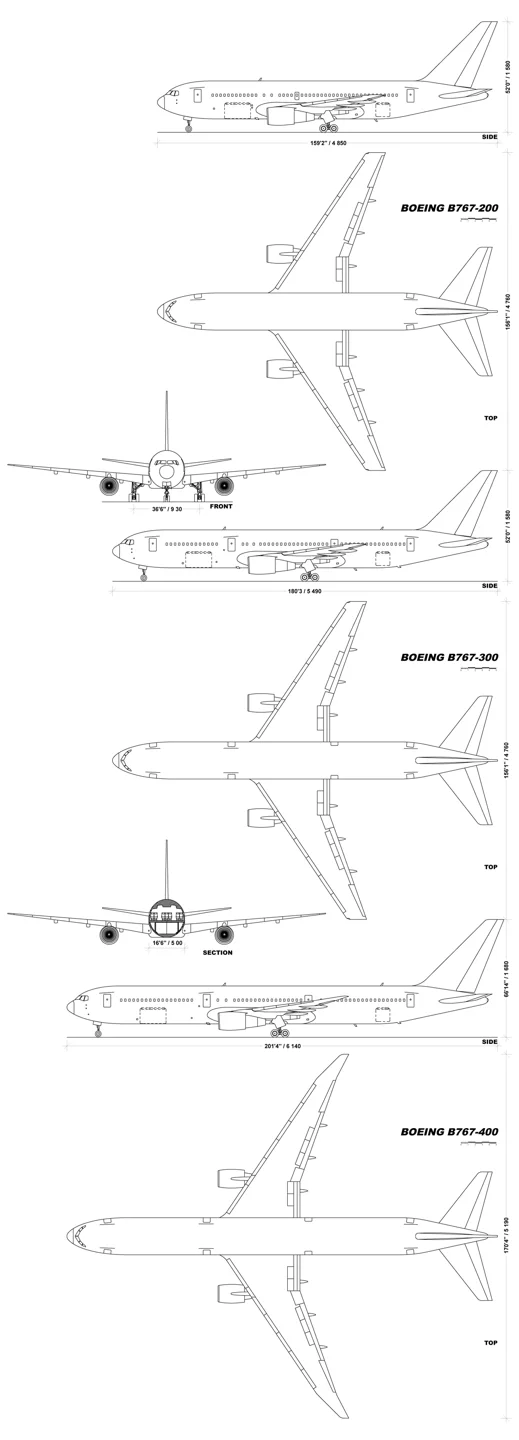
Julien Scavini’s published family drawing compares the 767-200, -300 and -400. Use Boeing’s manual below for official dimensioned plans.
Julien.scavini · CC BY-SA 3.0 · Source and credits · 2011-11-07

View full-size · Original imageResized WebP display copy.

- 767 airport planning drawings, December 2024
Boeing’s manual compares the -200, -300 and -400 family through dimensioned views, cabin layouts, cargo and ground manoeuvring information.
- Everett’s 3,000th widebody, August 2007
A Boeing archive report looks back at production milestones across the 747, 767 and 777 lines, including the 767 that marked Everett’s 1,000th delivery.
See one for yourself
Skylark shows what is flying over Ireland right now, and the iPhone app points you at it. Next time you hear engines, look for the B762 or B763 or B764 code.
Sources
Facts checked against these sources on 28 September 2026. Numbers that change over time, such as orders and fleet sizes, are as of the date given beside them.
- Select products in Boeing historyBoeing
- Boeing 767Wikipedia
- Boeing 767Flightradar24
- ETOPS: history, evolution, current applicationsAirways Magazine
- U.S. Air Force accepts first Boeing KC-46A Pegasus tanker aircraftBoeing
- FAA waives emissions rules to let Boeing sell 35 additional 777F freightersReuters, via Business Standard
- Order JO 7360.1, Aircraft type designatorsFAA
- Boeing 767Aircraft Recognition Guide
- Spotting the difference: the Boeing long-haulersFlightradar24
- Boeing 787Aircraft Recognition Guide
- Shannon welcomes return of Delta and United summer flights to New York and ChicagoShannon Airport Group
- Planespotting: Boeing 767, 777 and Airbus A330 differencesSFGATE
- Boeing 777Aircraft Recognition Guide
- Boeing 767, 1982 to presentDelta Flight Museum
- Boeing 767-400ER receives common type rating from FAABoeing
- 8/19/1982: Boeing hands over first 767 to UnitedAirways Magazine
- Boeing's 767, 777, 787: Which one is best in economy?SFGATE
- Boeing Delivers 3,000th Everett-built Widebody AirplaneBoeing
How often does Skylark see it?
Read the existing Ireland observation log to see the days each type appeared. This is what Skylark recorded, with the coverage its receivers and providers supplied; it is not a census of Irish aircraft or a prediction of your next sighting.
One aircraft seen on three different days contributes three airframe-days. Repeated reports on the same day count once. Codes are shown separately, without adding them into a family total. A logged day does not mean continuous coverage throughout that day.
Observations load when you request them.