



Key facts
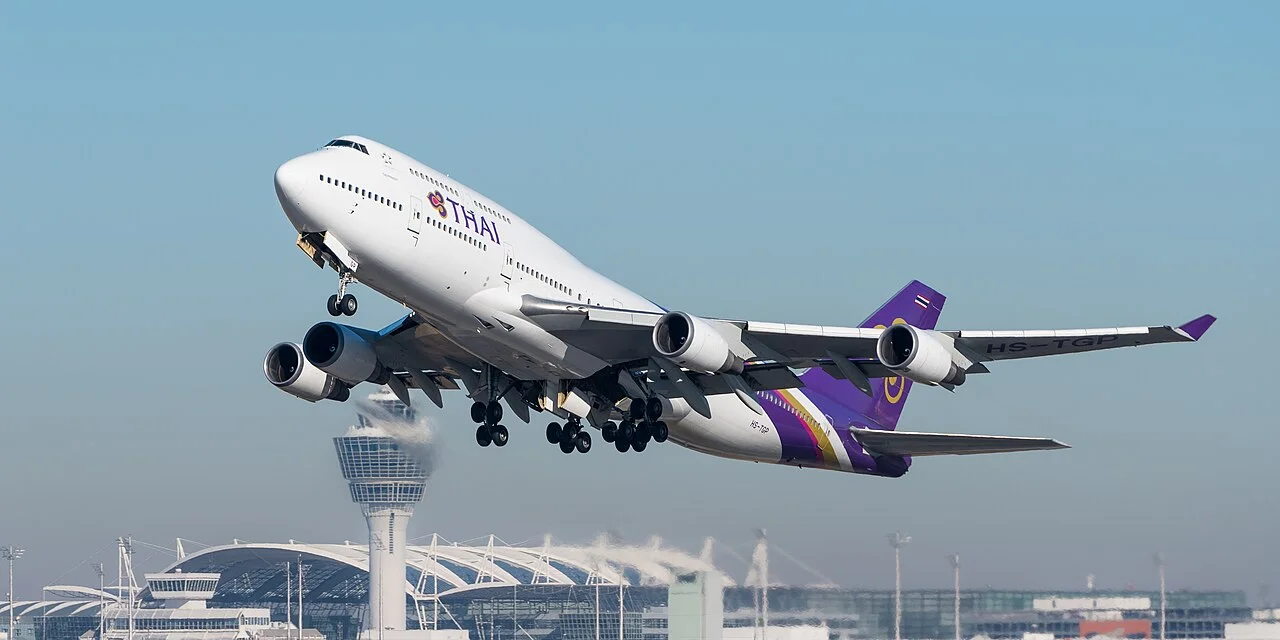
The Boeing 747 is the original jumbo jet. Boeing calls it the first twin-aisle airliner, and singles out its distinctive hump with seats on the upper deck [1]. Production has finished, but hundreds still fly, and most of them now carry cargo rather than people [10].
A bet on a bigger aeroplane
Pan Am launched the programme with an order for 25 aircraft at $20 million each, finalised in April 1966 [2]. The first 747 took off from Paine Field on 9 February 1969, flown by Jack Waddell with Brien Wygle as co-pilot and Jess Wallick as flight engineer [2] [3]. On 22 January 1970 Pan Am flew the first commercial service, from New York's JFK to London Heathrow, with 335 passengers and 20 crew on board Clipper Young America [2].
The hump is the 747's signature, and it exists because of a guess about the future. Boeing expected supersonic airliners to take over long-haul passenger flying, leaving the 747 to finish its career as a freighter [3]. A freighter needed a nose that hinged upward so cargo could be loaded straight into the full length of the hold, so the flight deck went up above the main deck, out of the way [3] [4]. The space behind the cockpit was first planned as a crew rest area, but after Pan Am's Juan Trippe was consulted it became a first class lounge [2].
Five decades of variants
The 747 was stretched, shrunk and rebuilt many times over its life [5]:
- 747-100 and 747-200: the originals, with the -200 bringing more powerful engines and a heavier take-off weight [5].
- 747SP: a shortened version with longer range, which Pan Am took into service in 1976 [5] [17].
- 747-300: a stretched upper deck [5].
- 747-400: the prototype first flew on 29 April 1988, and Northwest Airlines was the launch customer [8]. It brought a glass cockpit flown by two pilots with no flight engineer, and winglets [3] [5] [7].
- 747-8: the last version, launched in 2005 [1]. The freighter first flew from Paine Field on 8 February 2010, on four General Electric GEnx-2B engines [6]. At 76.3 m it is 5.6 m longer than the 747-400 Freighter [6]. Cargolux took the first 747-8F in October 2011 [15], and Lufthansa the first airline 747-8 Intercontinental, the passenger version, in April 2012 [16].
The 747 was the world's largest passenger aircraft until the Airbus A380 entered service in 2007 [3] [5]. Boeing delivered the last one, a 747-8 Freighter, to Atlas Air on 31 January 2023, bringing the total to 1,574, every one built at its Everett factory [1].
Still flying, mostly with boxes
The passenger 747 has largely retired [10]. British Airways, then the largest 747 operator, retired all 31 of its jumbos in July 2020, blaming the downturn in travel caused by Covid-19 [9]. It had planned to phase them out by 2024 [9].
Freighters keep the type busy. By October 2025 more than 300 747s were still in active service, according to Planespotters.net data reported by Aviation A2Z [10]. Atlas Air had 65, UPS 43, Cargolux 29, Kalitta Air 22 and Cathay Pacific 20 [10]. Lufthansa remained the biggest passenger operator, with 27 active aircraft: 19 747-8s and eight 747-400s [10]. Korean Air and Air China also still flew 747-8Is with passengers [10].
Over Ireland
Ireland had its own jumbos. The first Aer Lingus 747, St Colmcille, arrived at Dublin in March 1971, the first of two the airline had ordered, for its transatlantic route [11] [13]. RTÉ's report on the inaugural Dublin to New York service in April 1971 quoted Captain Pete Little: walking down its corridors was "almost like a stroll down Grafton Street" [12]. Aer Lingus flew three 747-100s in all, often leasing them to other airlines to keep them busy, and brought in the Airbus A330 from 1994 [13]. The last scheduled Aer Lingus 747 service flew on 2 October 1995 [13].
Shannon met the type even earlier. On 11 August 1970 a Pan Am 747 with 311 passengers made the first scheduled jumbo jet landing there before flying on to London; earlier jumbo visits had been for training [14].
Today, with most of the world's 747s working as freighters [10], a 747 you spot is more likely to be carrying cargo than passengers.
How to spot one
The hump gives it away [7]. The A380 is the other double-decker, but its two passenger decks run the full length of the fuselage [4]. Then count the engines. The 747 has four, and it is the only Boeing widebody still flying with four [7].
Which 747?
- 747-8 or 747-400? Look at the wingtips. The 747-400 has canted winglets that jut out at an angle; the 747-8 has a raked wingtip that sweeps back without turning up [7]. The 747-8I's upper deck is longer, with more windows, and the 747-8's engine nacelles have serrated chevrons at the back [7].
- 747-300 or earlier? The -300 stretched the upper deck of the -100 and -200 [5], and the 747SP is a shortened version [5].
747 or A380? The Airbus A380 has a full second deck from nose to tail, where the 747's upper deck stops partway along [4].
747 or 777? If you count two engines, it is not a 747. A Boeing 777 has its own tells: six wheels on each main landing gear leg and an angular tail cone [7].
From the archive
Boeing’s archive preserves a photograph of the 747 fuselage mock-up, alongside the first aircraft’s rollout from Everett on 30 September 1968. [18]
The short-bodied 747SP was designed to fly higher, faster and farther without stopping than the other 747s of its time; Boeing’s gallery shows it beside a full-length jumbo. [18]
In photographs
Look closer at the shapes, details and liveries. Every photograph links to its original and credits its creator.

A Qantas 747-400 seen from below, with condensation trails behind its four engines.
Sergey Kustov · CC BY-SA 3.0 · Source and credits · Taken on 22 May 2010

View full-size · Original imageResized WebP display copy.

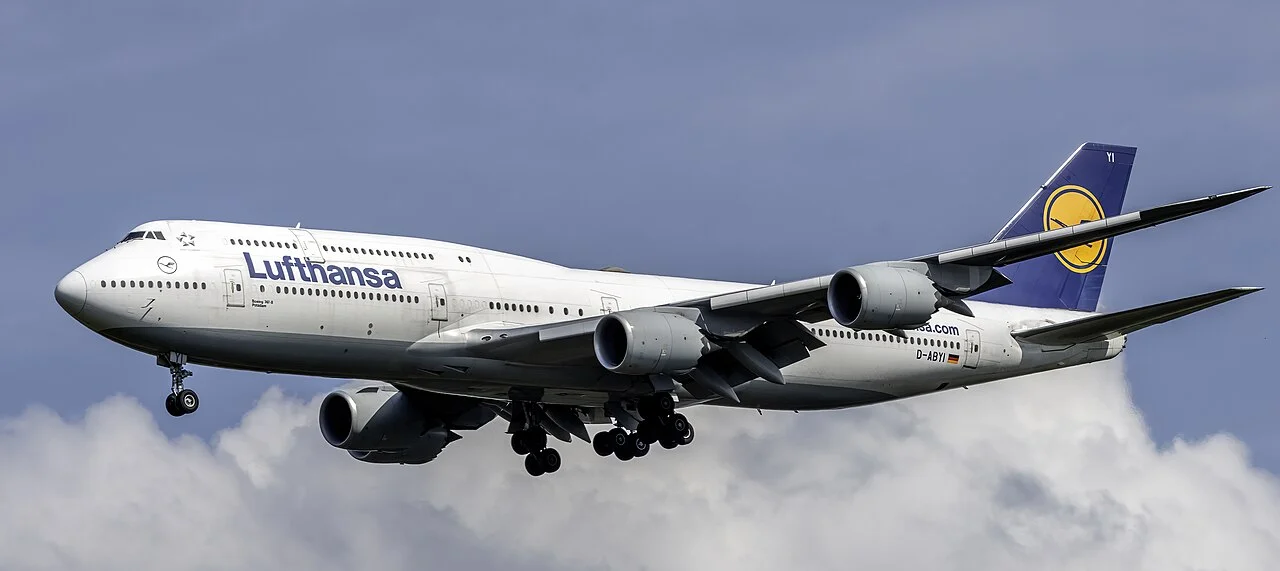
Lufthansa 747-8 D-ABYI on approach. Compare its stretched upper deck with older jumbos.
Acroterion · CC BY-SA 4.0 · Source and credits · 2025-04-30

View full-size · Original imageResized WebP display copy.

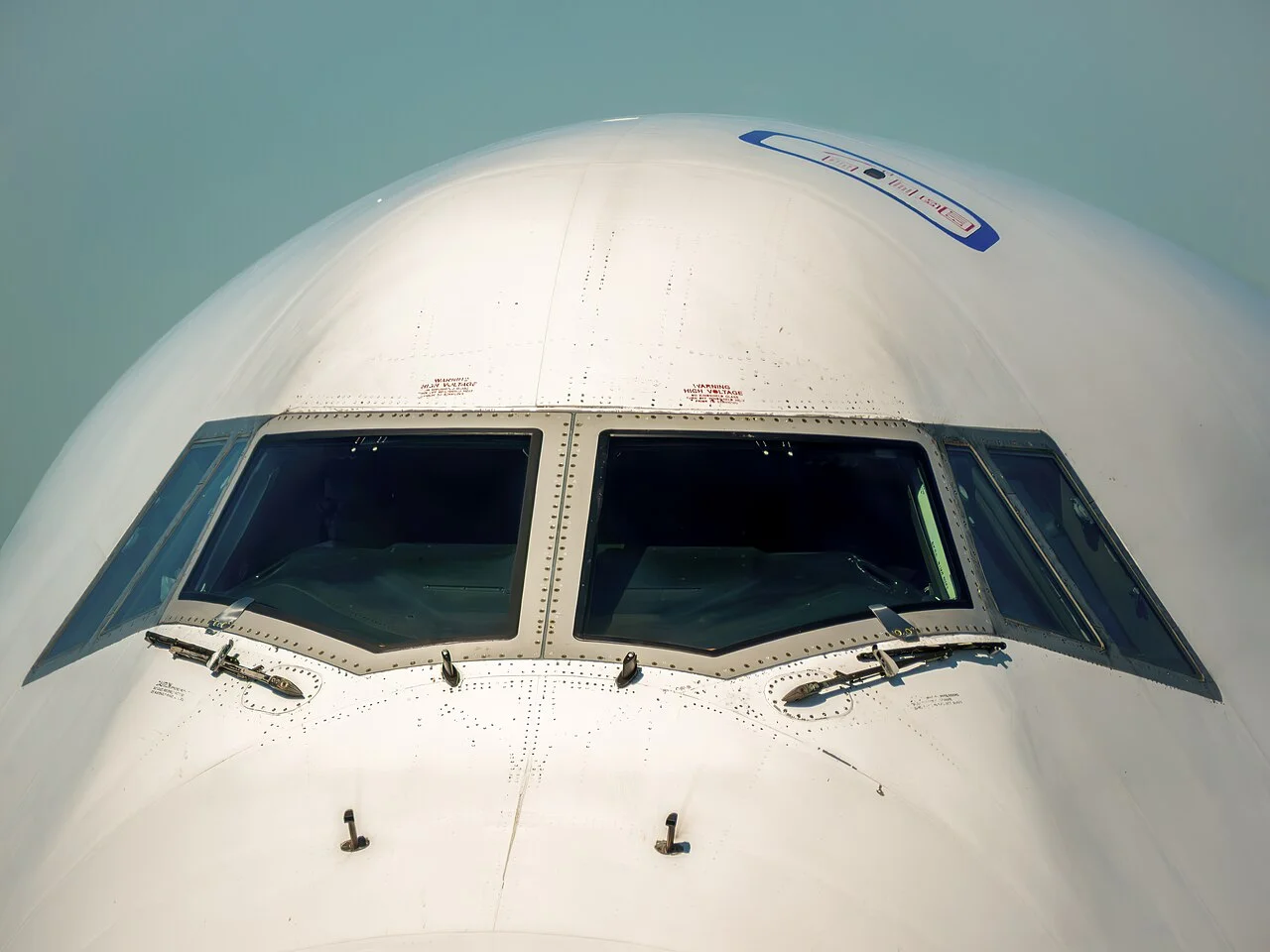
The 747 nose and cockpit windows, with the flight deck above the main cabin.
Ermell · CC BY-SA 4.0 · Source and credits · Taken on 11 October 2009, 11:03:03

View full-size · Original imageResized WebP display copy.

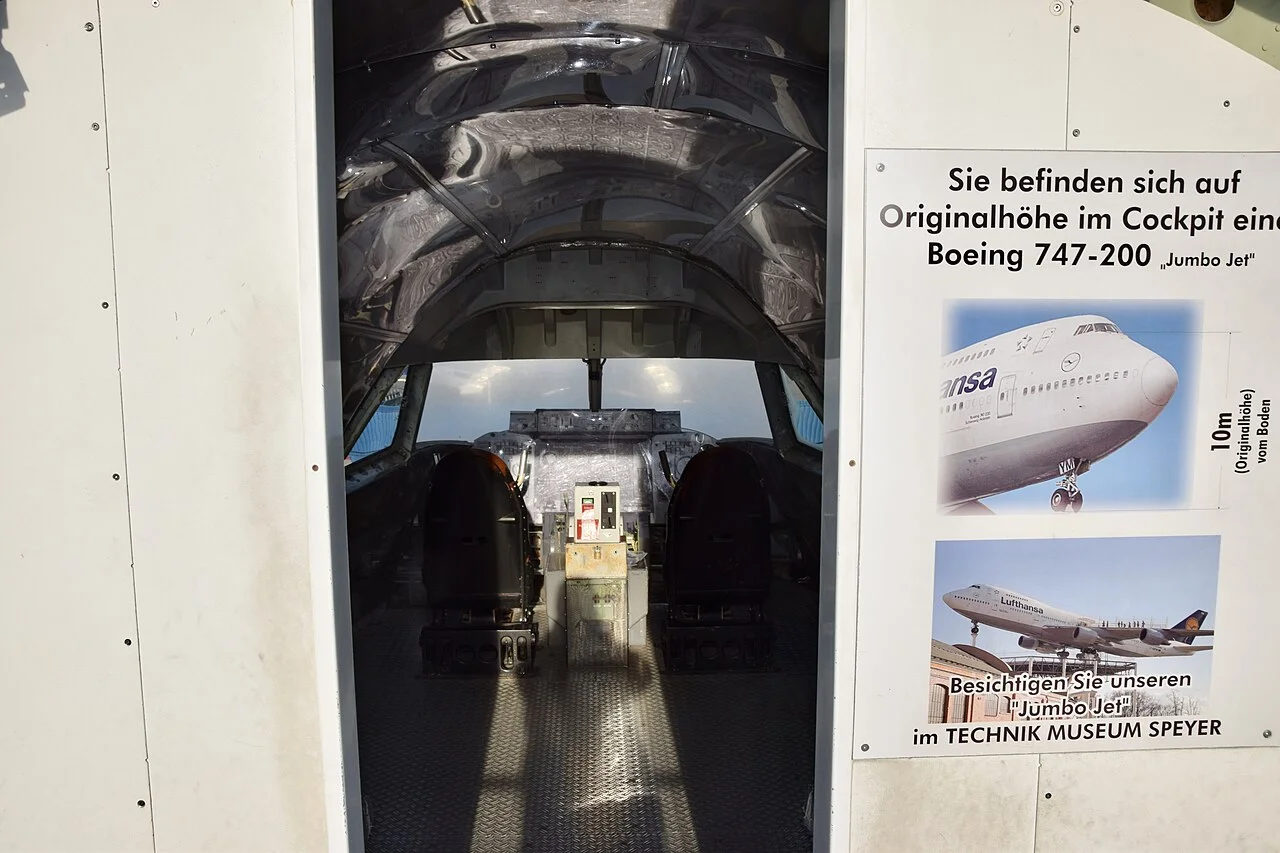
A preserved Lufthansa 747-200 cockpit at Sinsheim, showing an earlier instrument-panel layout.
Ank Kumar · CC BY-SA 4.0 · Source and credits · 2015-11-16 15:23:44

View full-size · Original imageResized WebP display copy.

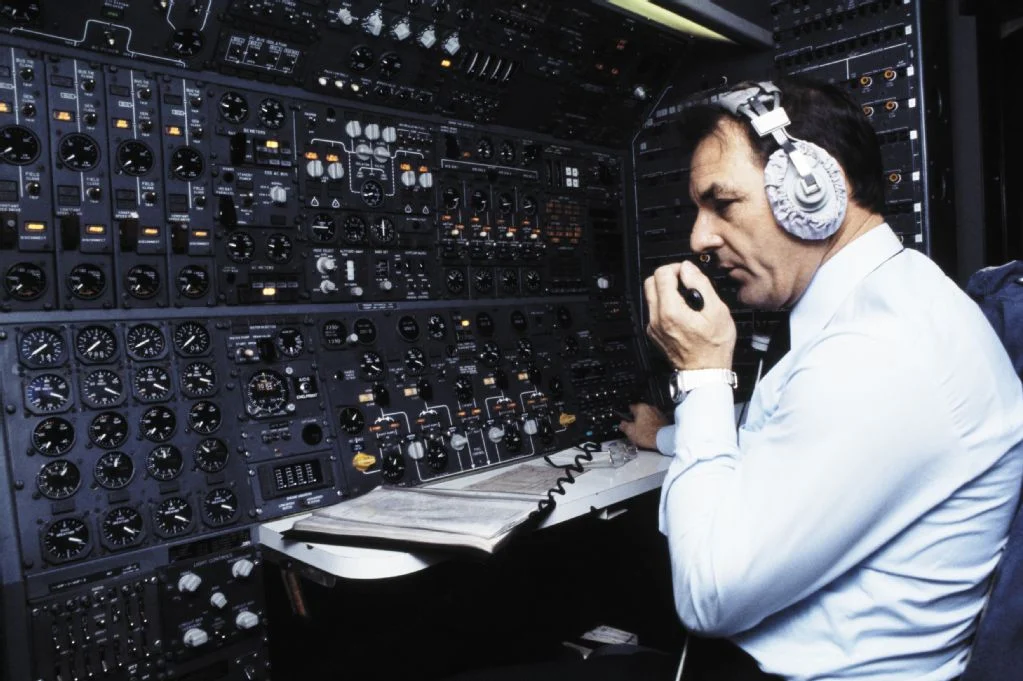
Swissair flight engineer Jakob Kübler at work in a 747-257B cockpit, preserved by the ETH Zürich image archive.
Swissair · CC BY-SA 4.0 · Source and credits · Between 1971 and 1984

View full-size · Original imageResized WebP display copy.

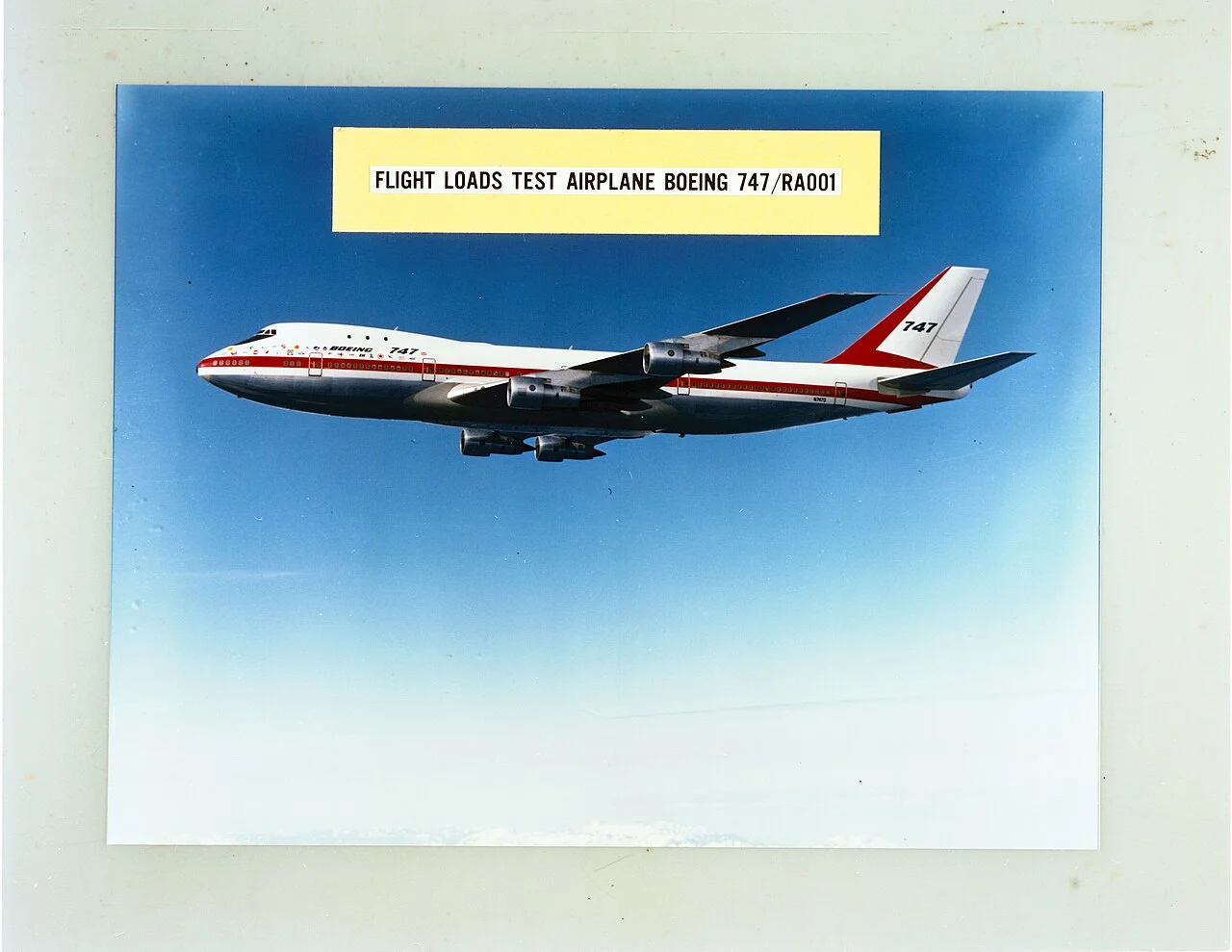
An archival photograph of the prototype 747 in flight, preserved in the US National Archives.
Unknown photographer / US National Archives · Public domain · Source and credits · Photograph date not recorded

View full-size · Original imageResized WebP display copy.

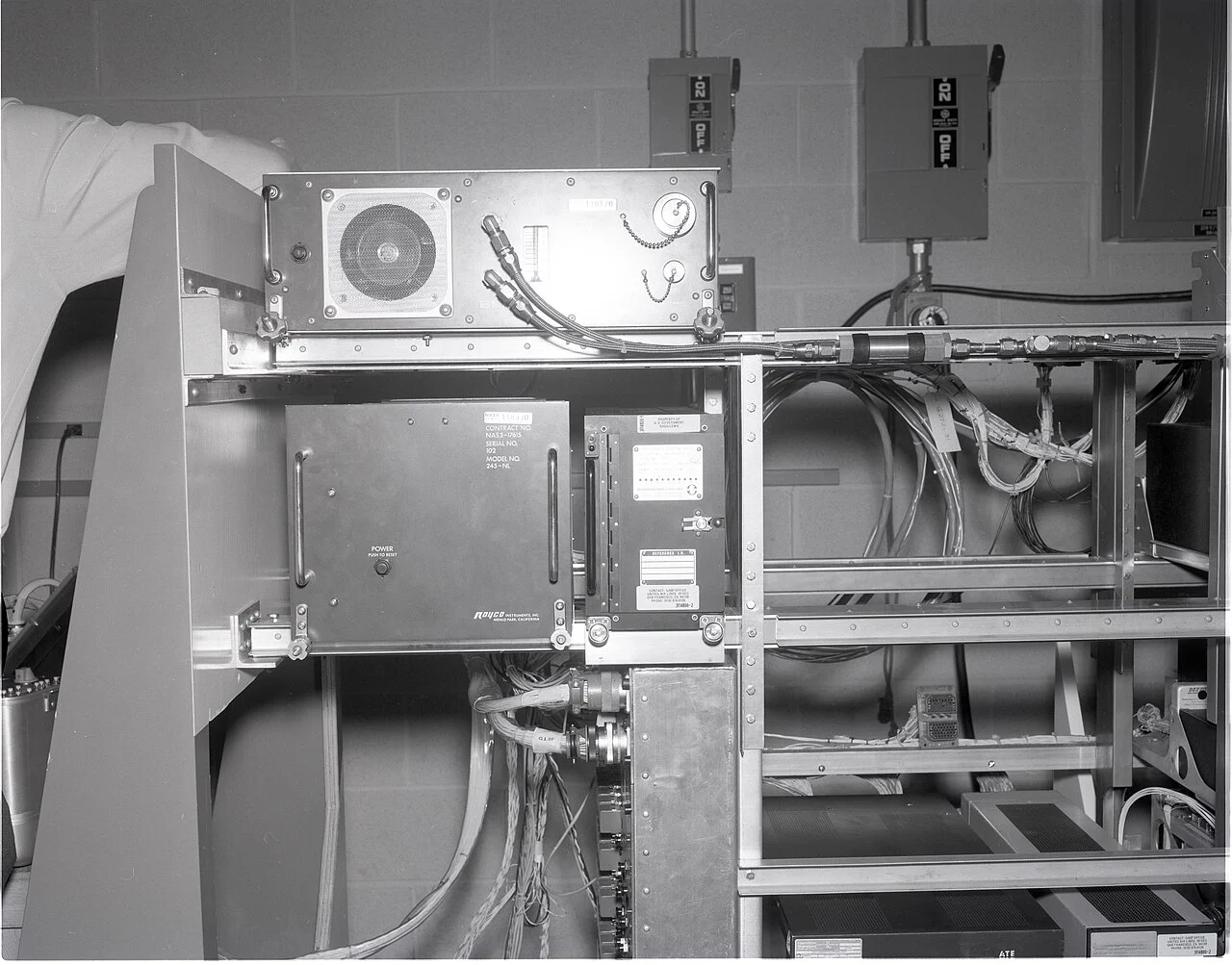
Donald Huebler’s photograph of atmospheric-sampling equipment installed in a 747 on 19 September 1974, preserved by NASA and the US National Archives.
Donald Huebler / NASA / US National Archives · Public domain · Source and credits · 1974-09-19

View full-size · Original imageResized WebP display copy.

Drawings and original documents
Existing published drawings are credited below. These are reference illustrations, not manufacturing blueprints.
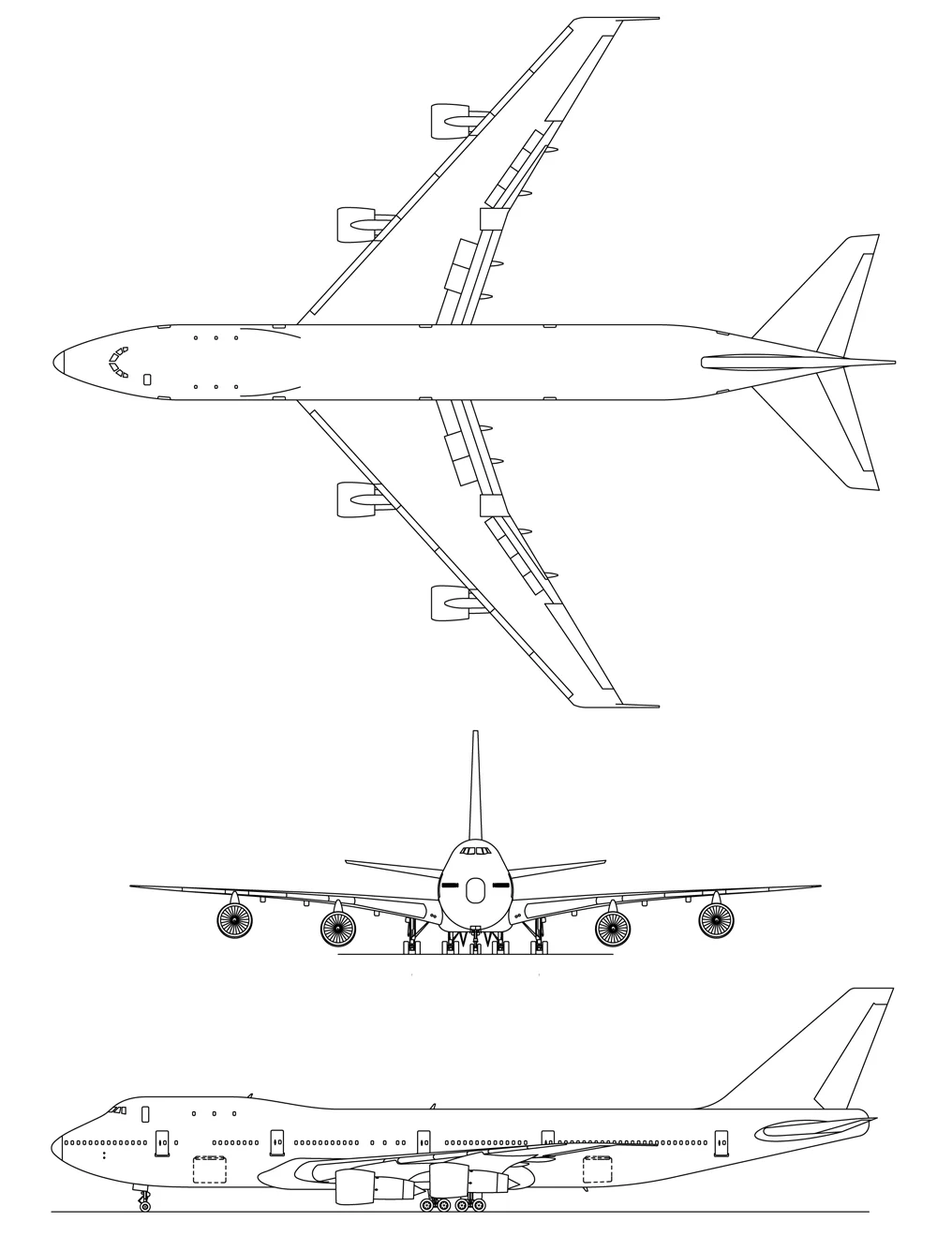
A published three-view reference drawing of the short-upper-deck 747-100, derived from Julien Scavini’s family drawing.
Boeing 747 family v1.0.png: Julien.scavini derivative work: MLWatts · CC BY-SA 3.0 · Source and credits · 2011-12-07

View full-size · Original imageResized WebP display copy.

- 747 Classics airport planning drawings
Boeing’s planning manual compares the 747-100, -200, -300 and short-bodied SP through dimensioned plans, cabin arrangements and airport geometry.
- Boeing’s 747 history and archive gallery
A manufacturer gallery with the original 1968 rollout, fuselage mock-up, 1969 first flight, Paris debut and later jumbo generations.
See one for yourself
Skylark shows what is flying over Ireland right now, and the iPhone app points you at it. Next time you hear engines, look for the B741 or B742 or B743 or B744 or B748 or B74S code.
Sources
Facts checked against these sources on 28 September 2026. Numbers that change over time, such as orders and fleet sizes, are as of the date given beside them.
- Boeing, Atlas Air celebrate delivery of final 747, an airplane that transformed aviation and global air travelBoeing
- 747 anniversary: the 747 takes offNorthwestern University
- BackgroundBoeing-747.com
- Double-deck aircraftWikipedia
- Boeing 747Wikipedia
- Boeing 747-8 Freighter successfully completes first flightBoeing
- Spotting the difference: the Boeing long-haulersFlightradar24
- 4/29/1988: the prototype Boeing 747-400 takes flightAirways Magazine
- British Airways retires its entire fleet of Boeing 747 jetsCNBC
- Boeing ended 747 production in 2023 but over 300 still flying in the worldAviation A2Z
- First Aer Lingus Boeing 747RTÉ Archives
- Inaugural Aer Lingus Boeing 747 from Dublin to JFKRTÉ Archives
- Ireland's forgotten jumbo jets: the rise and fall of Aer Lingus 747sAerospace Global News
- Jumbo jet first for ShannonRTÉ Archives
- Boeing delivers first 747-8 Freighter to CargoluxBoeing
- Boeing delivers first Lufthansa 747-8 IntercontinentalBoeing
- 1 to 3 May 1976This Day in Aviation
- Boeing 747 history and galleryBoeing
How often does Skylark see it?
Read the existing Ireland observation log to see the days each type appeared. This is what Skylark recorded, with the coverage its receivers and providers supplied; it is not a census of Irish aircraft or a prediction of your next sighting.
One aircraft seen on three different days contributes three airframe-days. Repeated reports on the same day count once. Codes are shown separately, without adding them into a family total. A logged day does not mean continuous coverage throughout that day.
Observations load when you request them.