

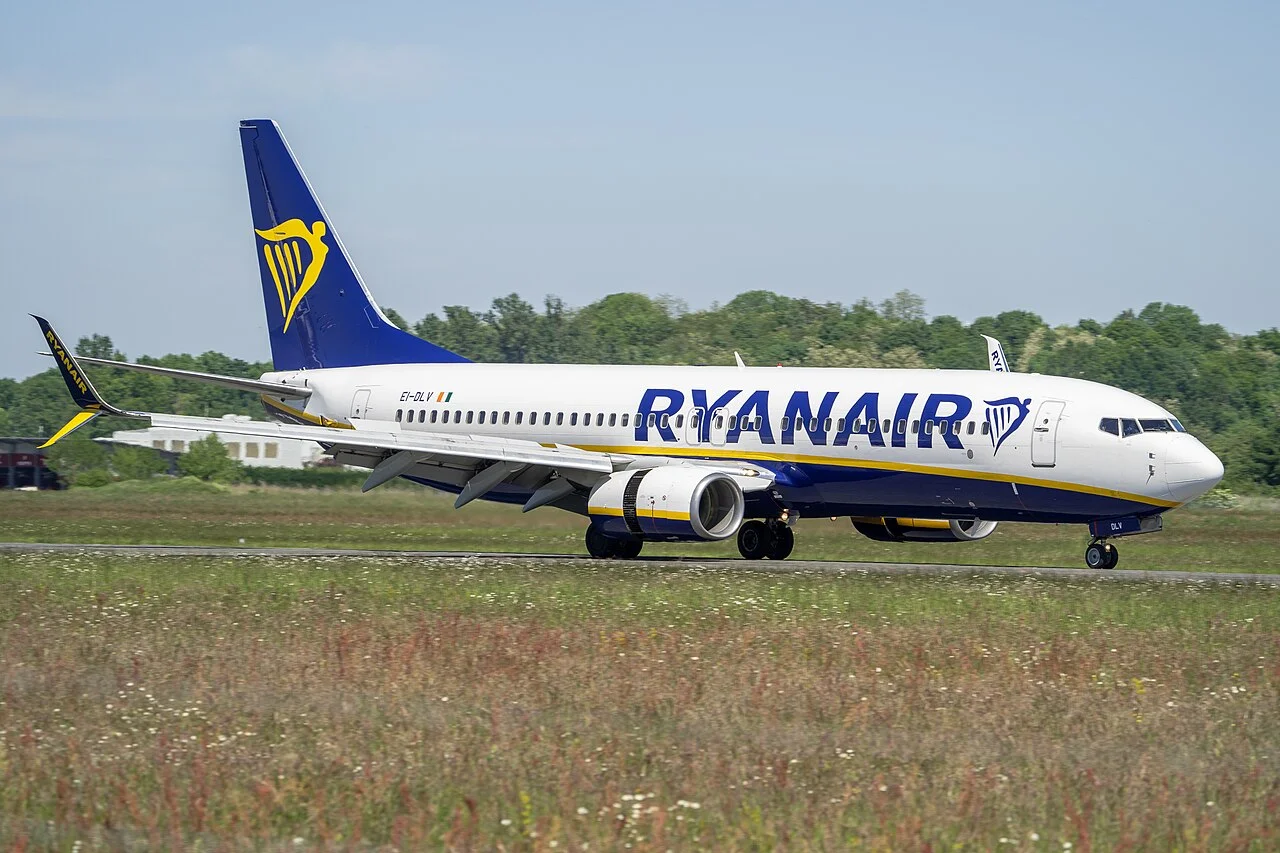


Recognise it overhead
Recognition clues checked 30 September 2026
- Engine intake
- The flattened underside of the intake helps distinguish this 737 generation from an A320. [9]
- Wingtip
- If fitted, blended winglets sweep upward; split scimitars add a smaller lower fin with pointed tips. [7]
- Against the MAX
- MAX engines are wider, sit further ahead of the wing and have sawtooth rear edges. Check these together. [7]
- Landing lights
- On the Next Generation 737, deployed outboard landing lights extend beneath the fuselage. [7]
Use several visible clues together. If a detail is too far away to see, leave it uncertain.
Could also be: Boeing 737 MAX, Airbus A320
Key facts
Ryanair flies more Next Generation 737s than any other type in its fleet [11], so this is a familiar shape over Ireland. The 737-800 is the stretched member of Boeing's Next Generation 737 family, and when it first flew in 1997 Boeing billed it as the longest 737 yet [1]. It is the aircraft this library files the whole Next Generation family under: the 737-600, -700, -800, -900 and -900ER [3].
Where it came from
Boeing launched the -800 at the Farnborough Air Show on 5 September 1994, with commitments from customers for more than 40 aircraft [1]. It was one of three models in the new 737-600/-700/-800 family [1]. The smaller 737-600 had been launched by SAS in March 1995, and the 737-700 had made its first flight on 9 February 1997 [1].
The first -800 took off from Renton Municipal Airport in Washington state at 9 a.m. on 31 July 1997. Boeing captains Mike Hewett and Jim McRoberts flew it for three hours and five minutes before landing at Boeing Field [1]. It was the 2,906th 737 Boeing had built [1]. The German carrier Hapag-Lloyd was lined up as the first customer, with delivery planned for March 1998 [1].
Boeing quoted 160 to 189 seats [1], and 189 is the most passengers the European type certificate approves for emergency evacuation [3]. That upper figure matters in Ireland: it is exactly how many seats Ryanair fits in its Next Generation 737s [11].
What changed from the older 737s
The headline change was under the wing. The Next Generation 737s use the CFM56-7 engine, which Boeing said would have 10 per cent more thrust capability than the CFM56-3C of the earlier 737s. Together with a new, larger wing, Boeing listed improvements in noise and fuel burn, a higher cruising speed and more range [1]. The European noise certificate for the -800 lists a string of CFM56-7B variants, among them the -7B24 and the -7B26 [2].
The upturned wingtips came later: Aviation Partners Boeing received its supplemental type certificate for 737-800 blended winglets on 23 March 2001, and Hapag-Lloyd became the first airline to fly a -800 with them fitted as a retrofit [5]. The next step was the split scimitar winglet, which adds a second, smaller, upside-down fin below the wingtip [7]. The FAA approved it for the -800 on 6 February 2014, and United Airlines flew it in service for the first time on 18 February 2014, from Houston to Los Angeles [5]. As of September 2026, Aviation Partners' website said split scimitars fly on about 1,700 Next Generation 737s [6].
Boeing handed its last two commercial Next Generation 737s, both -800s, to China Eastern Airlines in January 2020, ending a production run that began in late 1997 [4].
How to spot one
Some things to look for:
- Count the overwing exits. A -800 has two cabin doors and two emergency exits over the wing on each side. The -700 and -600 have only one overwing exit a side, and the -900ER adds an extra exit door behind the wing [8].
- Look at the engine intakes. They are not quite round. The bottom is flattened to keep the engine clear of the ground, a shape spotters call the hamster pouch [8].
- Check the wingtips. Next Generation 737s carry either blended winglets, a single smooth upward sweep, or split scimitars, which end in small points at both the top and the bottom [7].
- Watch the landing lights. On the Next Generation 737, the outboard landing lights are retractable and come down from the underside of the fuselage [7].
Not a MAX
The 737 MAX is the easiest aircraft to confuse with a -800, because it is essentially a Next Generation 737 with new engines [7]. The MAX's engines are much wider and sit further in front of the wing, with small sawtooth ridges, called chevrons, around the back of the engine [7]. Its split winglets have top and bottom parts of roughly equal size, where the -800's version is pointed [7]. The tail cone also gives it away: the MAX's is pointed and extends further behind the tail, while the -800's is shorter and blunter [10].
Not an Airbus
The Airbus A320 family is the other shape to rule out. On an Airbus, the rearmost cockpit side window has a distinctive missing corner, while the 737's side windows are more angular with sloping bottom edges [9]. The Airbus has round engine housings rather than the 737's flattened nacelle bottom, and the A320neo carries sharklets, wingtip fins that stand vertically [9]. The newer Airbus has its own article, the A320neo.
Over Ireland
As of 2 September 2026, Ryanair listed 411 Next Generation 737s in its fleet, each with 189 seats, alongside 210 of the newer 737-8200s and 26 Airbus A320s [11].
From the archive
The prototype 737-800 was already the 2,906th 737 built: a new aircraft variant launched from a production line with three decades of history. [1]
Its first flight lasted three hours and five minutes, travelling from Renton over the Strait of Juan de Fuca before landing at Boeing Field. [1]
In photographs
Look closer at the shapes, details and liveries. Every photograph links to its original and credits its creator.
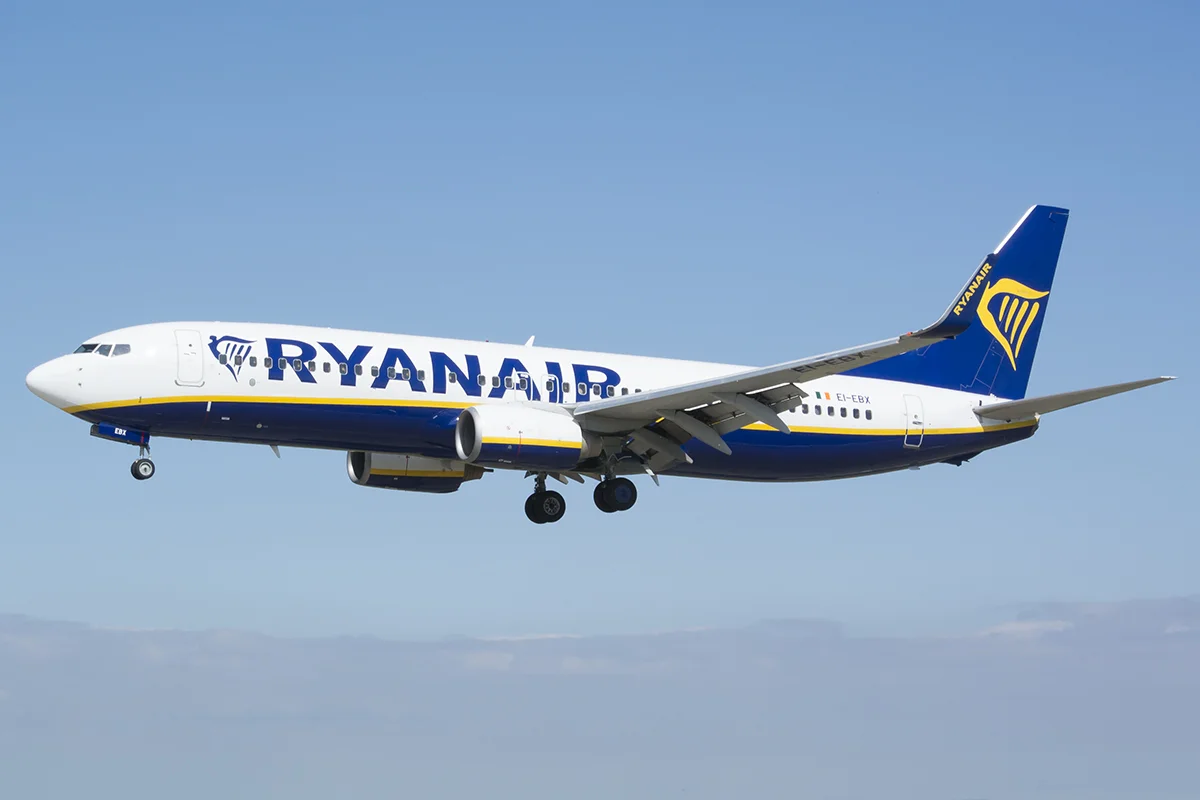
Ryanair 737-800 EI-EBX in flight. Compare the nose and engine shapes with an A320.
Michael Oldfield · CC BY-SA 4.0 · Source and credits · 2018-07-22 14:49:24

View full-size · Original imageResized WebP display copy.

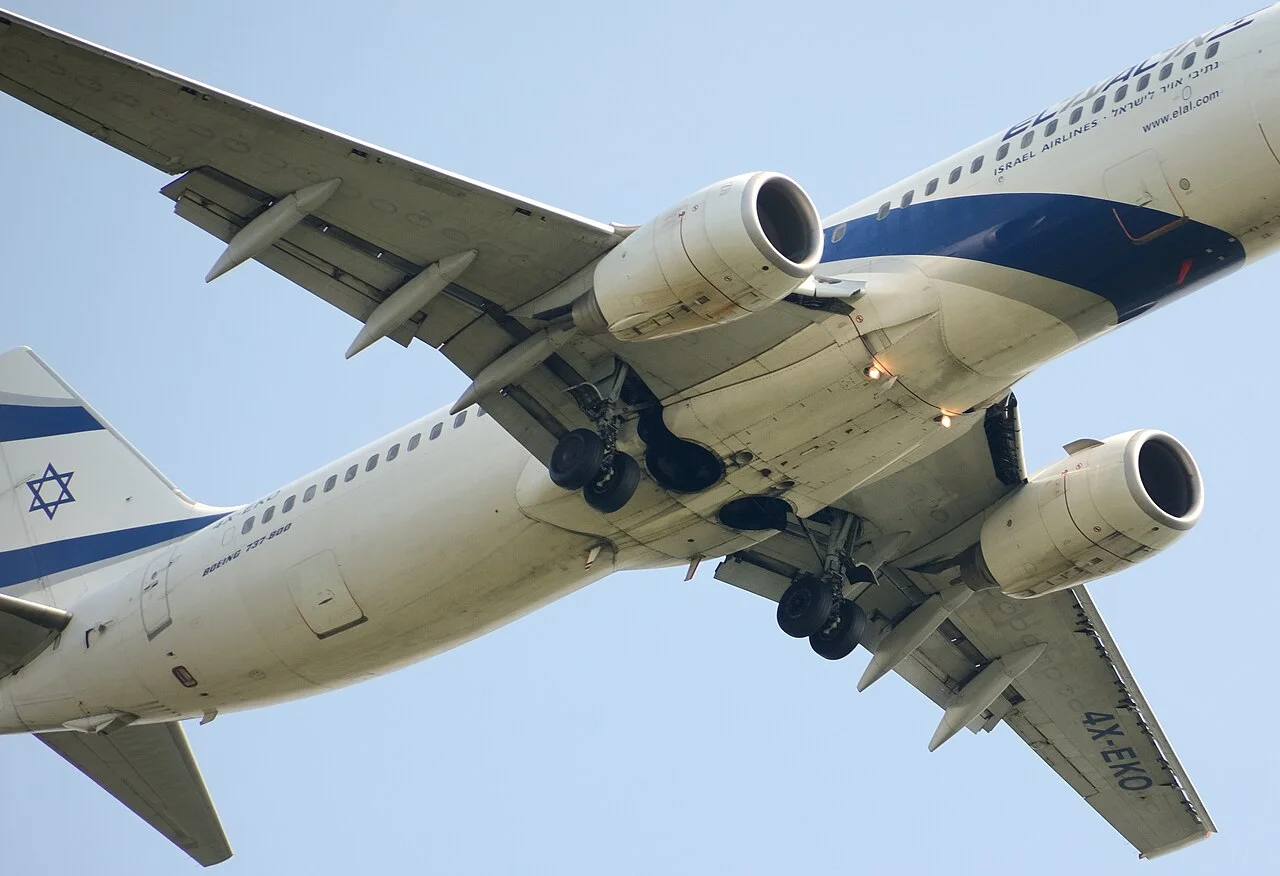
A 737-800 on approach with its landing gear extended, revealing the wheels, nacelles and wing underside.
Peter Haas · CC BY-SA 3.0 · Source and credits · 2013-08-23

View full-size · Original imageResized WebP display copy.

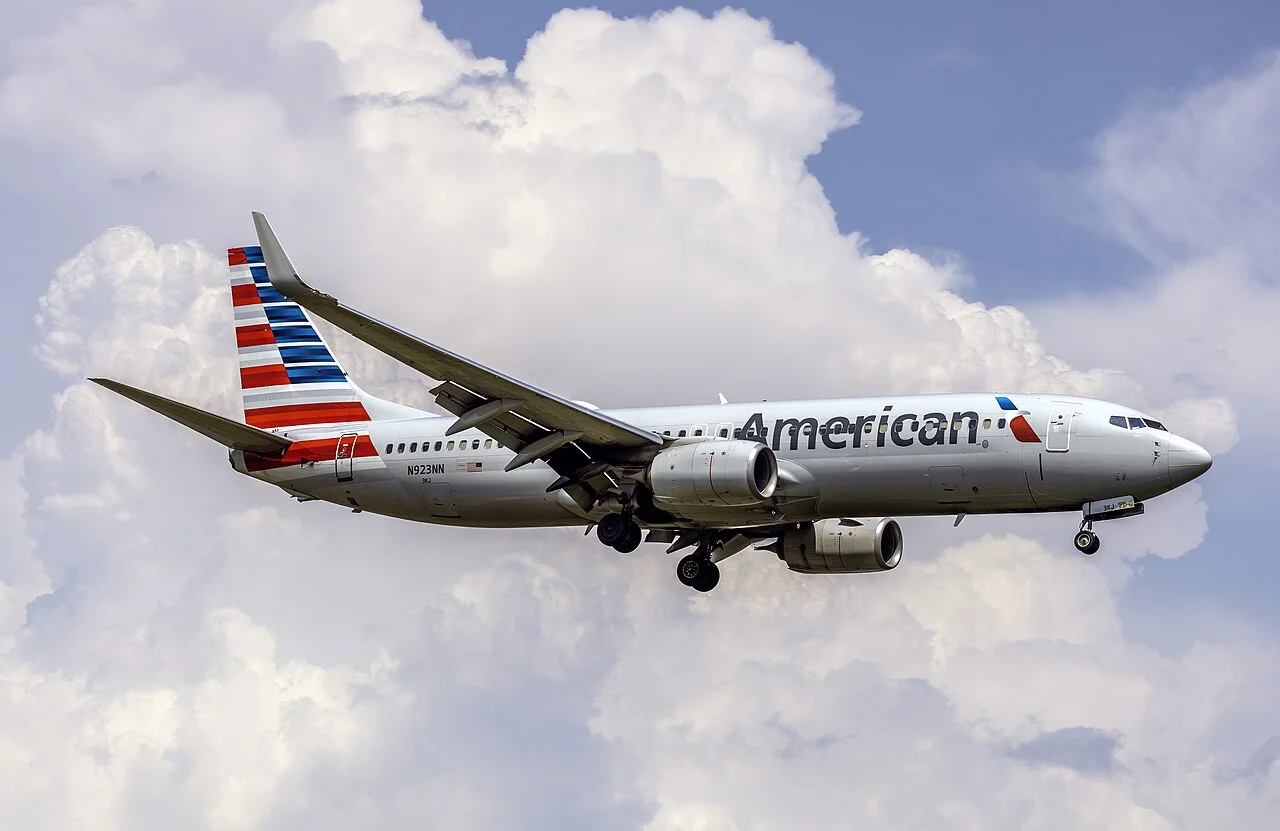
American Airlines 737-800 N923NN approaching Washington National.
Acroterion · CC BY-SA 4.0 · Source and credits · 2024-07-31

View full-size · Original imageResized WebP display copy.

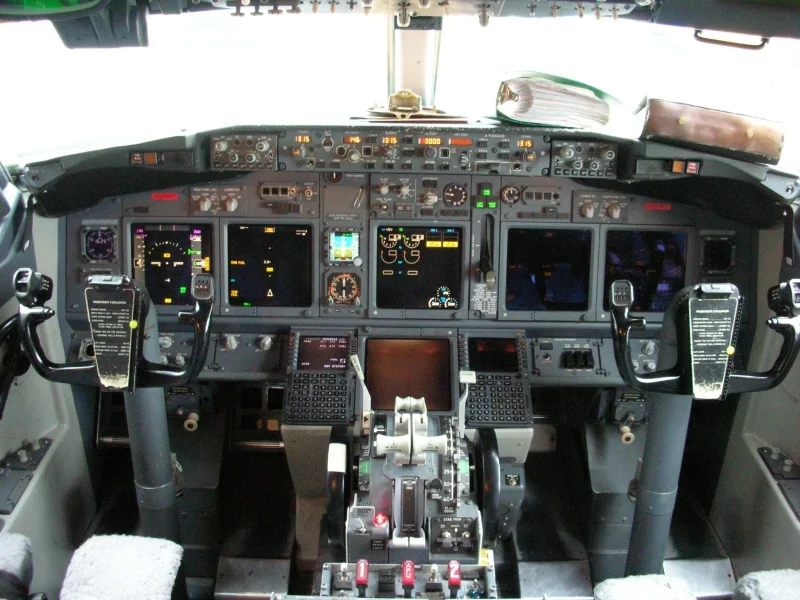
The cockpit of an ATA Airlines 737-800, showing the traditional control yokes.
Photographer: Nick Bartolotta (en:User:NickBartolotta) · CC BY-SA 3.0 · Source and credits · 2006-11-16

View full-size · Original imageResized WebP display copy.

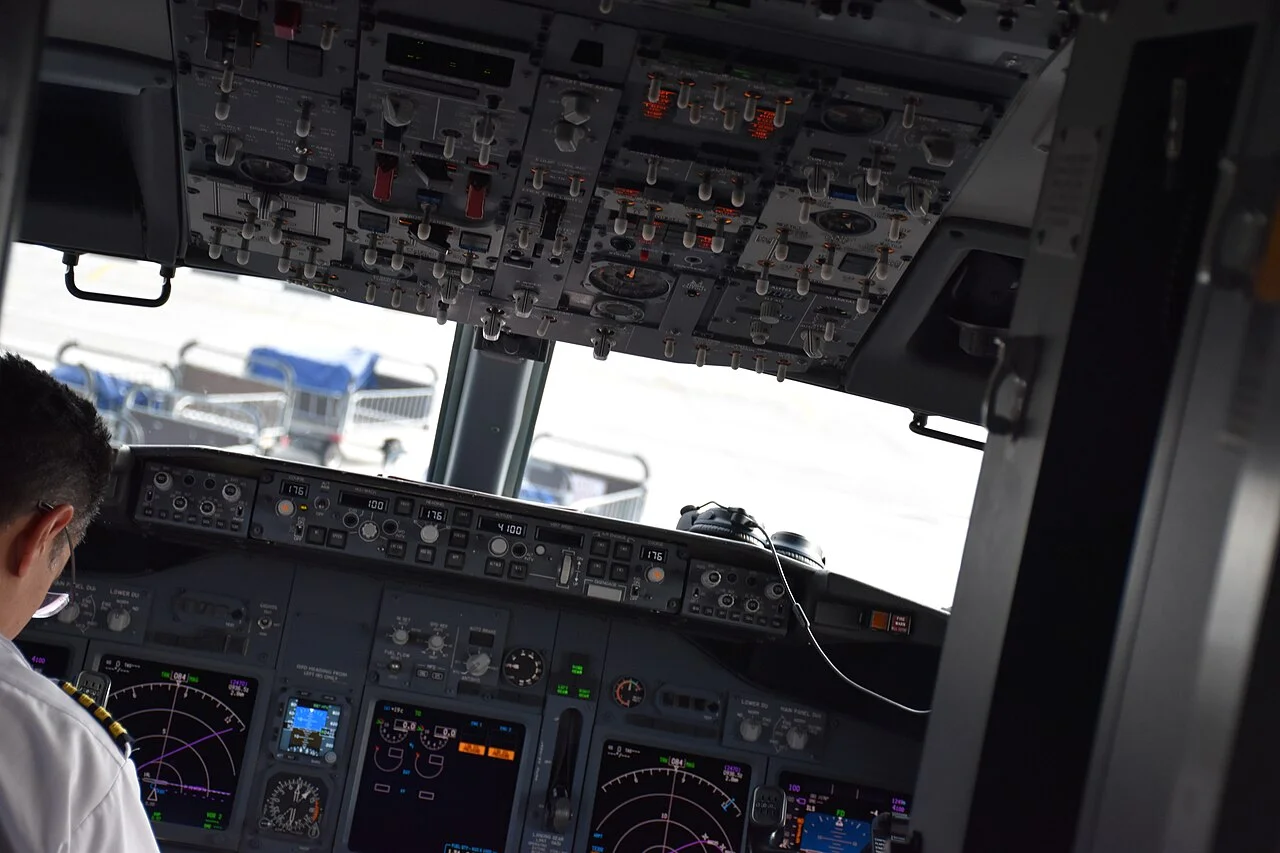
The flight deck of Buzz 737-800 SP-RSX.
Vasyatka1 · CC BY-SA 4.0 · Source and credits · 2020-02-26 11:36:35

View full-size · Original imageResized WebP display copy.

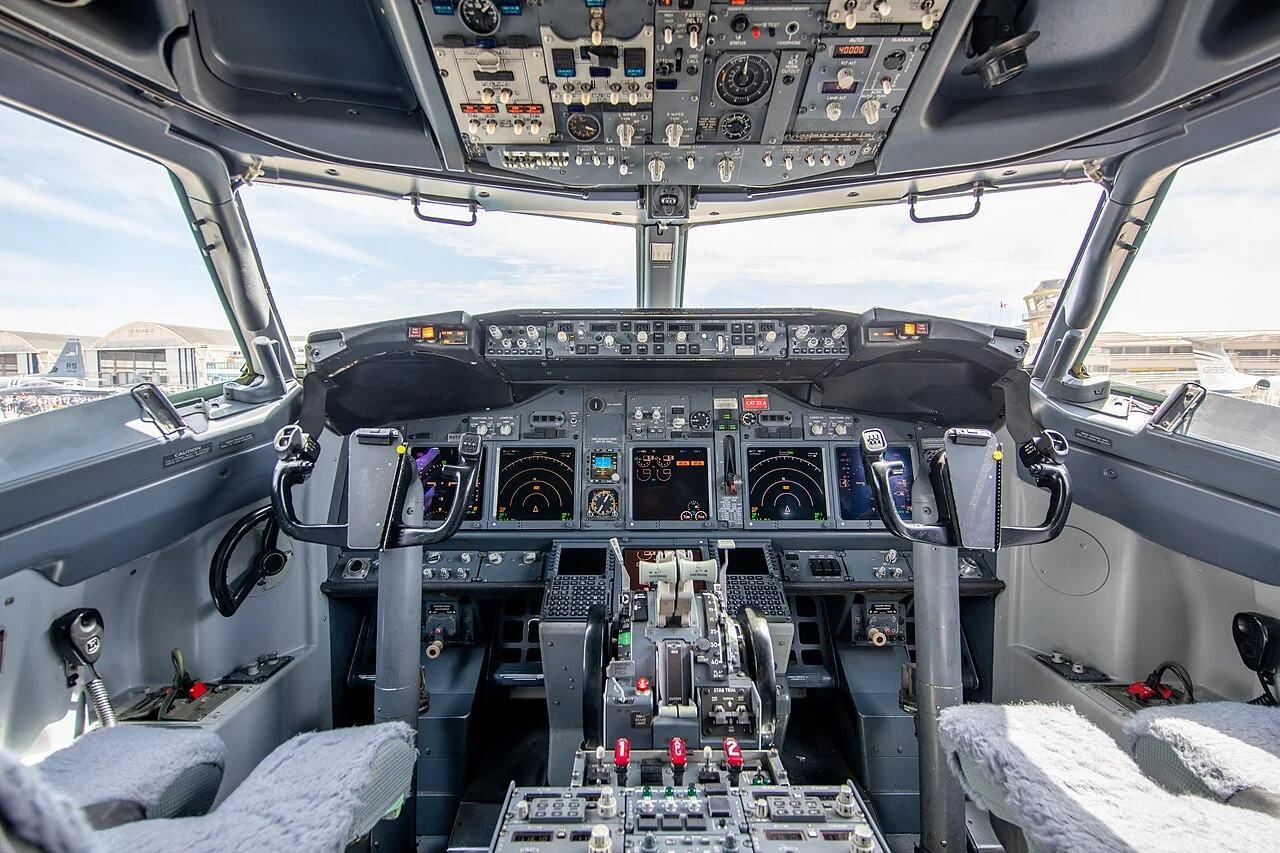
Inside a converted 737-800 freighter at the Paris Air Show in 2019.
Matti Blume · CC BY-SA 4.0 · Source and credits · 2019-06-18

View full-size · Original imageResized WebP display copy.

Drawings and original documents
Existing published drawings are credited below. These are reference illustrations, not manufacturing blueprints.
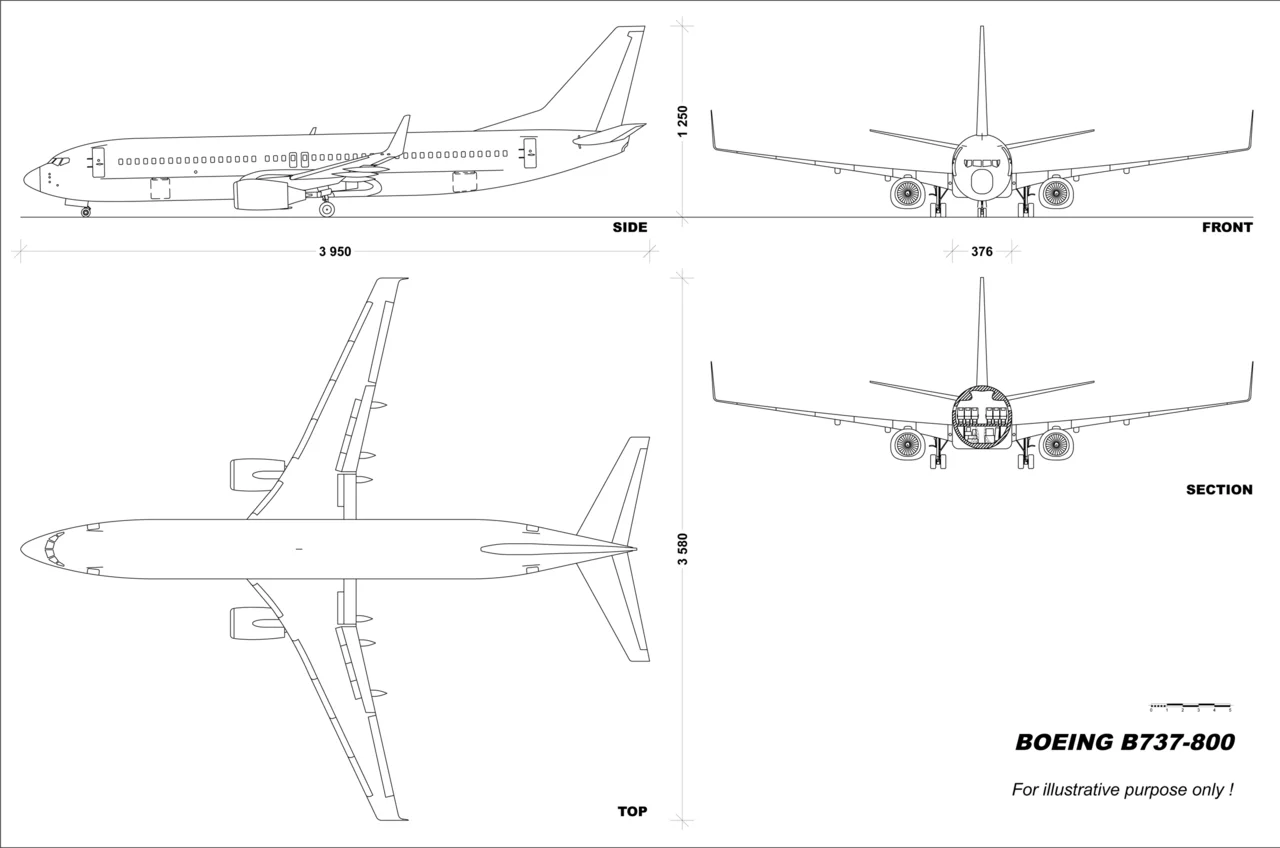
Julien Scavini’s 737-800 reference drawing shows side, front, overhead and fuselage-section views. Published in 2011; not a factory blueprint.
Julien.scavini · CC BY-SA 3.0 · Source and credits · 2011-10-30

View full-size · Original imageResized WebP display copy.

- 737 Next Generation airport planning drawings, October 2025
Boeing’s dimensioned plans cover the 737-600 through 737-900, including the -800’s cabin, doors, ground clearances and turning geometry.
- The 737-800’s first flight, 31 July 1997
Read Boeing’s original launch-era report, with its route, test crew, fleet position and the planned Next Generation test programme.
See one for yourself
Skylark shows what is flying over Ireland right now, and the iPhone app points you at it. Next time you hear engines, look for the B738 or B737 or B739 or B736 code.
Sources
Facts checked against these sources on 28 September 2026. Numbers that change over time, such as orders and fleet sizes, are as of the date given beside them.
- Longest Boeing 737 makes first flight (31 July 1997)Boeing
- Type certificate data sheet for noise EASA.IM.A.120, volume 4, Boeing 737-800 (12 December 2013)EASA
- Type certificate data sheet IM.A.120, Boeing 737, issue 29 (16 December 2025)EASA
- Boeing delivered final commercial 737NG in January, ending 23 years of production (14 April 2020)FlightGlobal
- Company history timelineAviation Partners Boeing
- Winglet types: blended and split scimitarAviation Partners
- Spotting the difference: Boeing narrow-bodies (15 May 2025)Flightradar24
- Boeing 737 spotting guideAirliner Spotter
- How to tell the difference between Airbus and Boeing aircraft: the basics (9 May 2024)Flightradar24
- 5 ways to tell a Boeing 737 MAX from other 737sThe Window Flyer
- Our fleetRyanair
How often does Skylark see it?
Read the existing Ireland observation log to see the days each type appeared. This is what Skylark recorded, with the coverage its receivers and providers supplied; it is not a census of Irish aircraft or a prediction of your next sighting.
One aircraft seen on three different days contributes three airframe-days. Repeated reports on the same day count once. Codes are shown separately, without adding them into a family total. A logged day does not mean continuous coverage throughout that day.
Observations load when you request them.