




Key facts
The 757 is a long, slim twin-engined jet with a single aisle [3] [5], and it has outlived its own production line. Boeing built 1,050 of them and delivered the last in April 2005 [1], yet United Airlines scheduled 757s across the Atlantic to Ireland for summer 2026 [10].
Where it came from
The prototype, registered N757A, was rolled out on 13 January 1982 and first flew from Renton Municipal Airport in Washington state on 19 February 1982, with John Armstrong and Lew Wallick at the controls [2]. The flight was not entirely smooth: the right engine showed low oil pressure and was shut down, and the crew restarted it successfully [2]. N757A was the first of five prototypes in the certification programme, and its maiden flight was also the first flight of Boeing's new two-person cockpit [2]. The FAA certified the 757-200 on 21 December 1982 [3].
Airlines could choose their engines. The 757-200 is certificated with Rolls-Royce RB211-535 engines or with Pratt & Whitney's PW2037 or PW2040 [3]. A dedicated freighter, the 757-200PF, was certified on 3 September 1987 [3].
The 757 shares more than a family name with the 767. In 2000, Boeing noted that the 757 and 767 were the first, and still the only, airliners to share a common type rating [6].
The stretch
The 757-300 was rolled out on 31 May 1998. At 54.5 m long by Boeing's figure it was 7.1 m longer than the -200 and held 20 per cent more passengers, between 240 and 289 depending on the layout [4]. The German charter airline Condor launched it with an order for 12 at the 1996 Farnborough Air Show [4]. It first flew on 2 August 1998 and Condor took the first one in March 1999 [5]. FlightGlobal called it the longest single-aisle aircraft Boeing had ever built at Renton [5].
At the rollout, Boeing was aiming for 27 months between firming up the configuration in November 1996 and a first delivery in January 1999, which it said would be the shortest design-to-delivery cycle of any Boeing derivative programme [4]. The extra length brought practical changes: FlightGlobal counted eight main passenger doors and four overwing exits, and a tail skid with a crushable cartridge borrowed from the 777-300 design [5]. It kept the Rolls-Royce and Pratt & Whitney engine choice, with the RB211-535E4 family or the PW2037, PW2040 or PW2043 [3].
The end of the line
Boeing decided to end production in late 2003, and the last 757 rolled off the line in October 2004 [1]. Shanghai Airlines, which had received its first 757 in August 1989, took delivery of it in April 2005 as its 13th [1]. That final aircraft was also the first 757 certified to the Chapter 4 noise limits [1]. At the time, Boeing counted 55 customers, more than 1,030 757s still in service, and more than 35 million hours flown by the fleet [1].
Some 757s picked up winglets later in life: Aviation Partners Boeing received its supplemental type certificate for blended winglets on the 757-200 on 23 May 2005, and for the 757-300 on 16 August 2009 [7].
A wake of its own
The 757 has one more distinction that you cannot see. The FAA's consolidated wake turbulence standards, which set how far apart air traffic controllers keep aircraft, sort types into lettered categories, and the 757 has one to itself: the 2021 order defines Category E simply as B757 aircraft [8].
How to spot one
- Proportions. The 757-200 is 47.32 m long with a wingspan of 38.02 m, so it is noticeably longer than it is wide. The -300 stretches to 54.4 m on the same wing [3].
- Landing gear. Each main leg carries four wheels on a bogie that tilts slightly backwards. That sets it apart from the Airbus A321neo, a long single-aisle jet in the A320 family [9].
- Overwing exits on the -300. The 757-300 has two extra emergency exits above the wing on each side [9].
- Wingtips. Some 757s wear blended winglets, added after delivery under Aviation Partners Boeing's supplemental type certificates; the rest have plain wingtips [7].
Its sibling, the 767, shares its type rating [6]; see that article for how to tell the two apart.
Over Ireland
United Airlines planned 757 flights to Ireland for 2026. Its schedules, as filed with Cirium by 14 October 2025, had 757-200s flying from Newark to Dublin and Shannon, from Chicago O'Hare to Shannon daily, and twice daily between Washington Dulles and Dublin in July 2026 [10]. Schedules change, so check the live map before you head out with binoculars.
From the archive
Only 55 examples of the long 757-300 were ordered by seven customers; the last rolled out of Renton on 23 March 2004. [11]
The 757-200 was built with different exit arrangements. Boeing’s planning manual provides separate cabin drawings for the overwing-exit and four-door versions. [12]
In photographs
Look closer at the shapes, details and liveries. Every photograph links to its original and credits its creator.
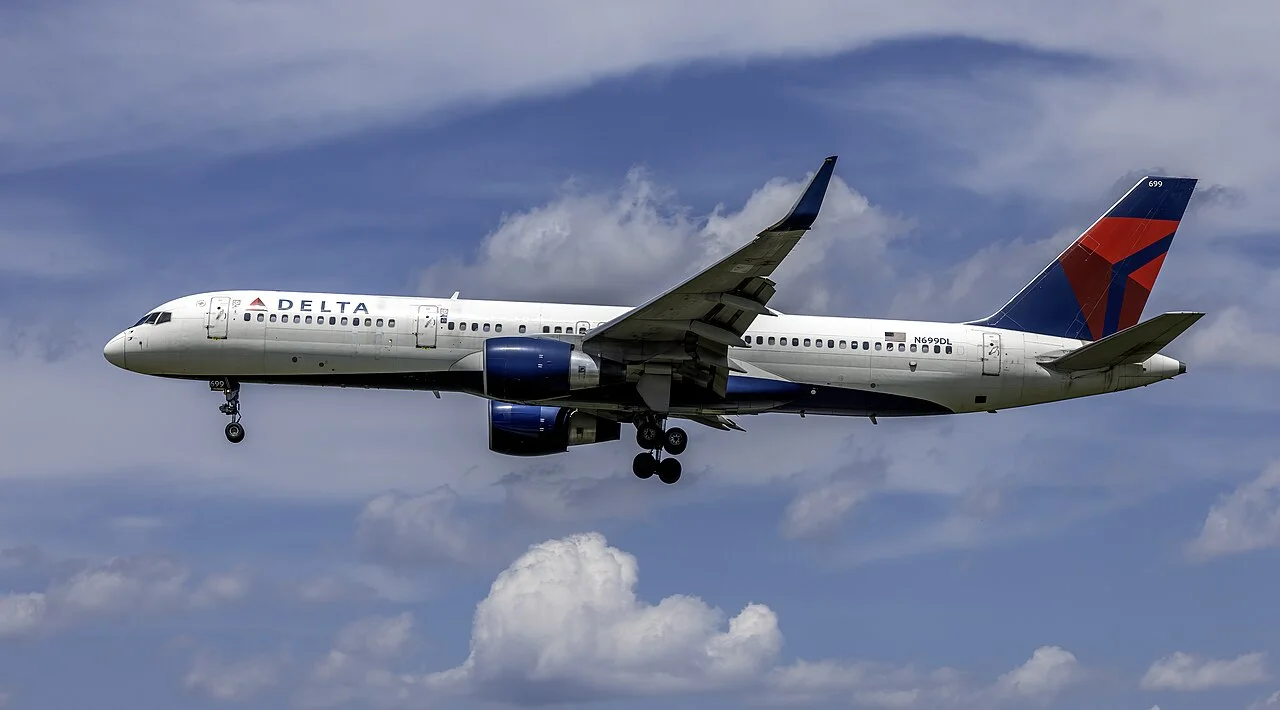
Delta 757-200 N699DL on approach.
Acroterion · CC BY-SA 4.0 · Source and credits · 2025-06-20

View full-size · Original imageResized WebP display copy.


FedEx 757 freighter N927FD at Hannover.
MarcelX42 · CC BY-SA 4.0 · Source and credits · 2024-03-03 11:21:57

View full-size · Original imageResized WebP display copy.

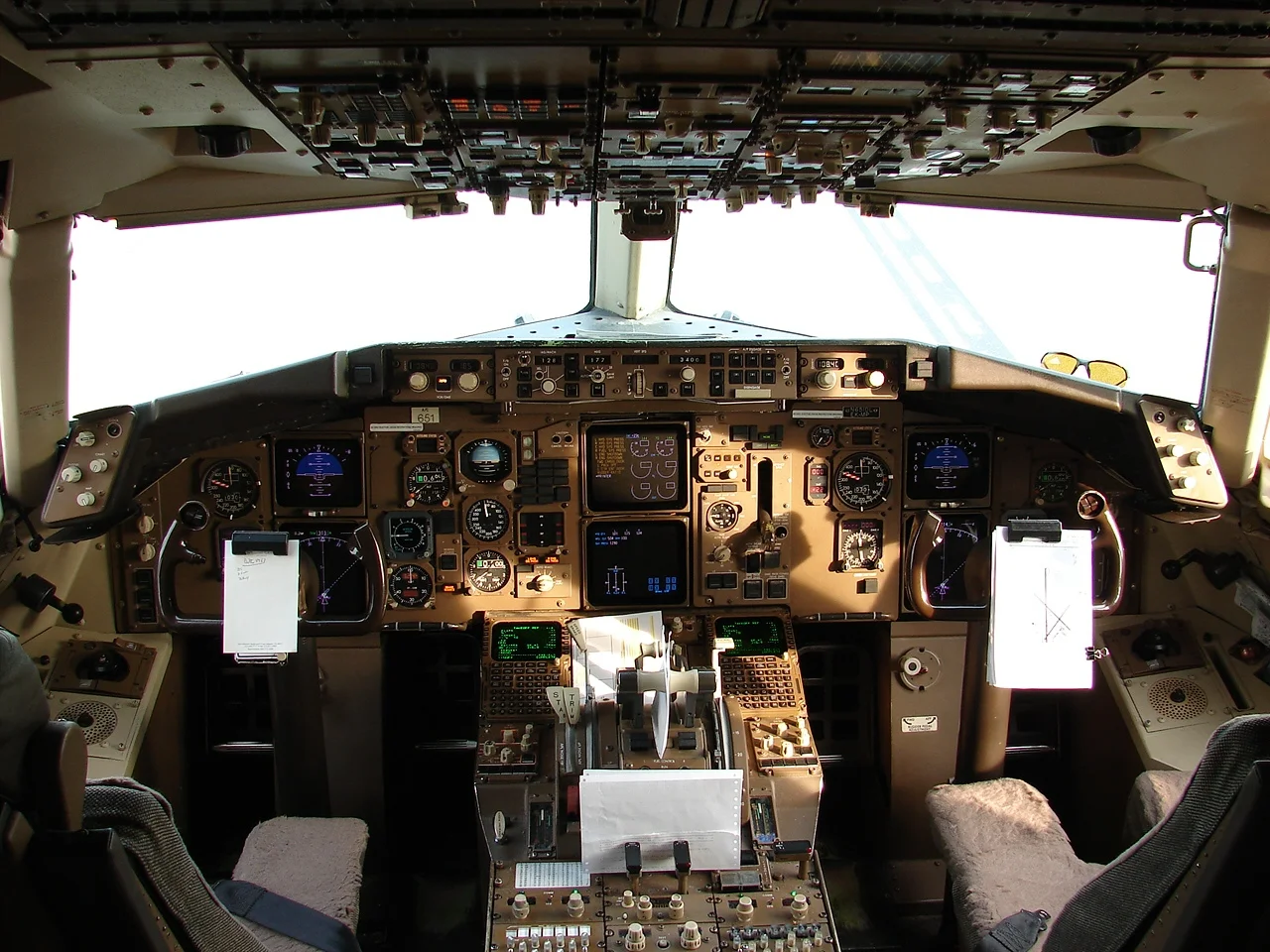
A real 757 cockpit, with control yokes and the instrument panel visible.
Cory W. Watts from Madison, Wisconsin, United States of America · CC BY-SA 2.0 · Source and credits · 2010-05-30 07:52

View full-size · Original imageResized WebP display copy.

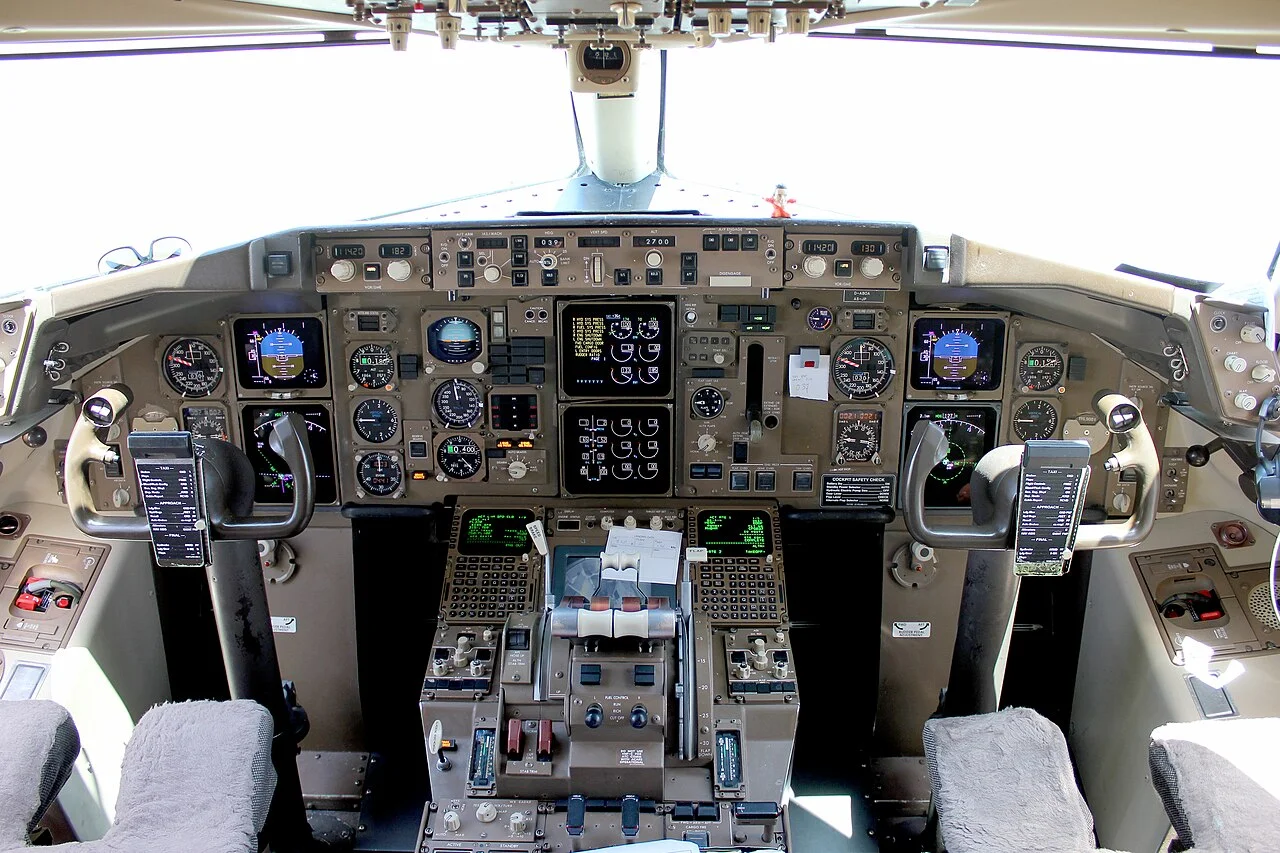
The cockpit of the longer 757-300 variant.
JHenryW · CC BY-SA 3.0 · Source and credits · 2012-06-07

View full-size · Original imageResized WebP display copy.

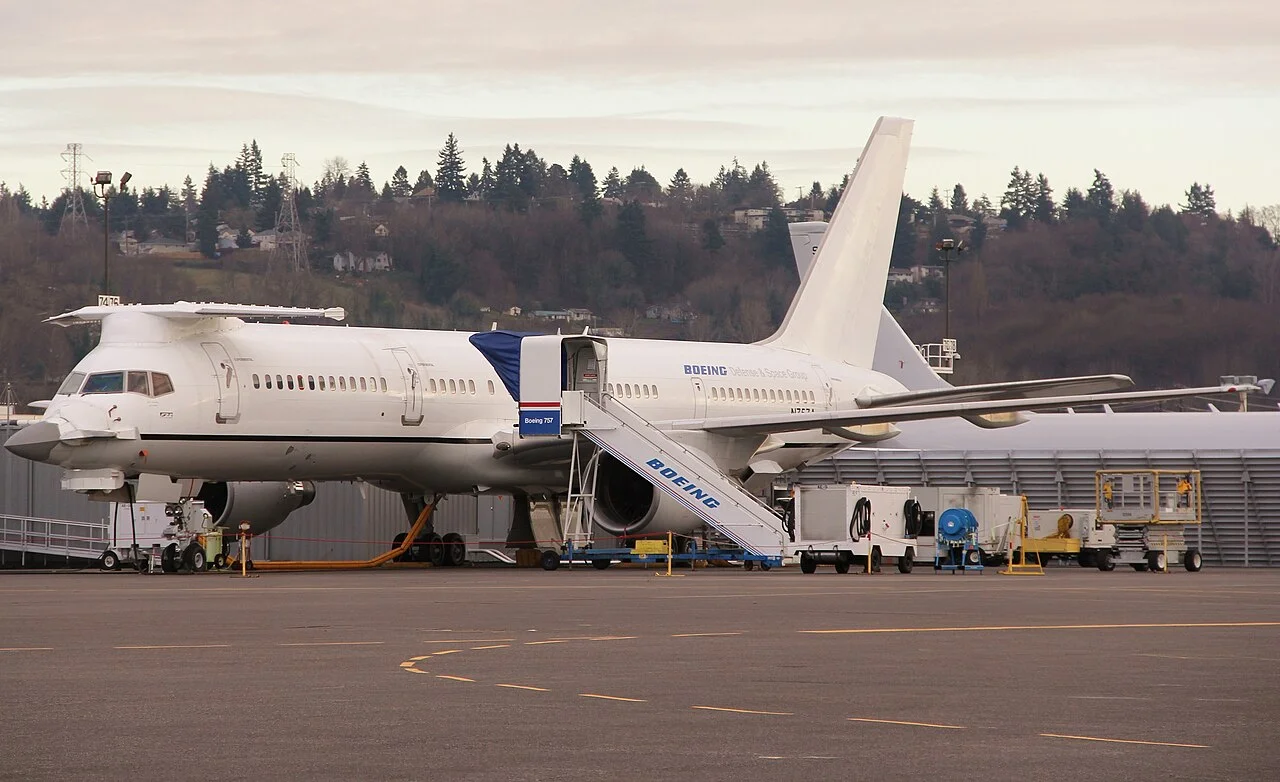
The prototype 757 in its later role as an F-22 systems testbed, with a visibly modified nose.
Clemens Vasters from Kirkland, WA, USA · CC BY 2.0 · Source and credits · 2012-01-08 14:57

View full-size · Original imageResized WebP display copy.

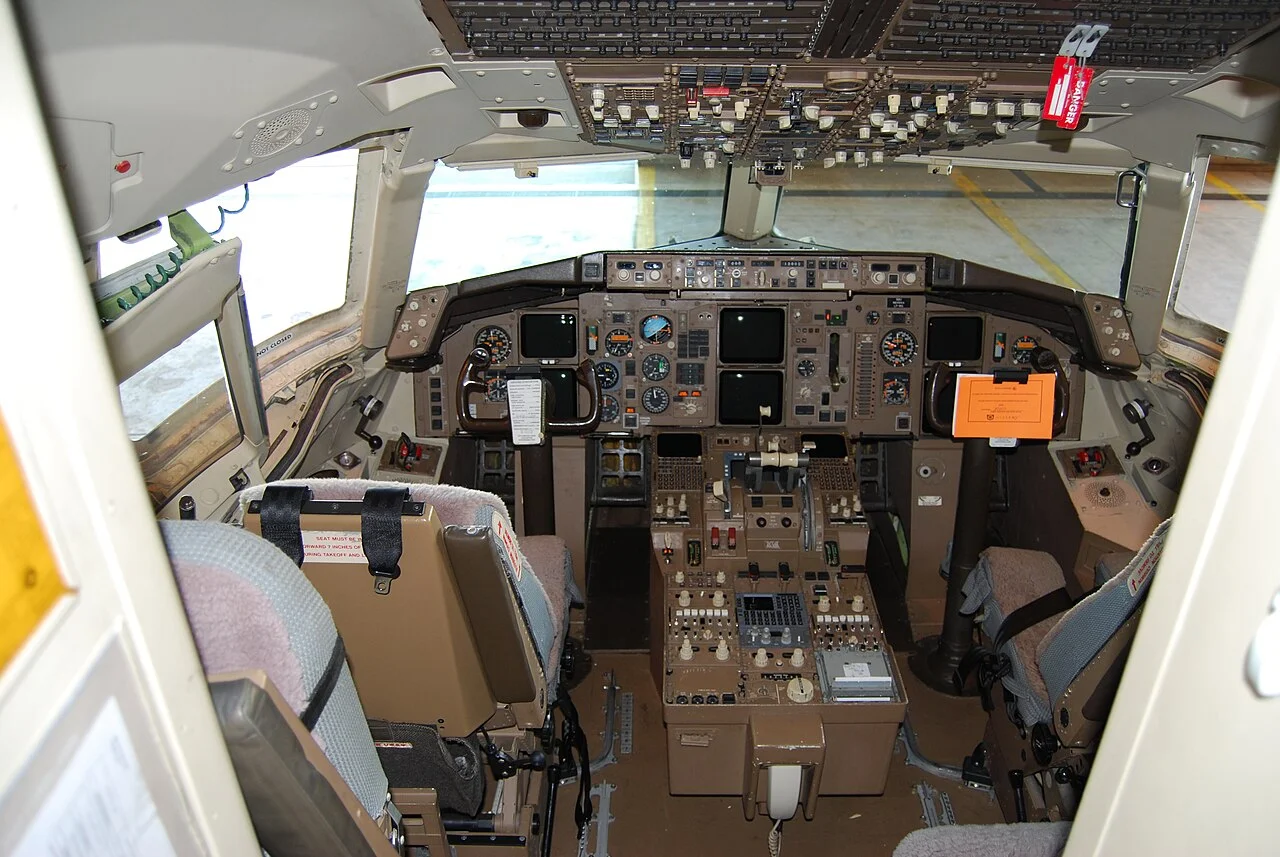
Another view of a 757-200 flight deck.
Bill Abbott · CC BY-SA 2.0 · Source and credits · 2008-02-23 17:52

View full-size · Original imageResized WebP display copy.

Drawings and original documents
Existing published drawings are credited below. These are reference illustrations, not manufacturing blueprints.
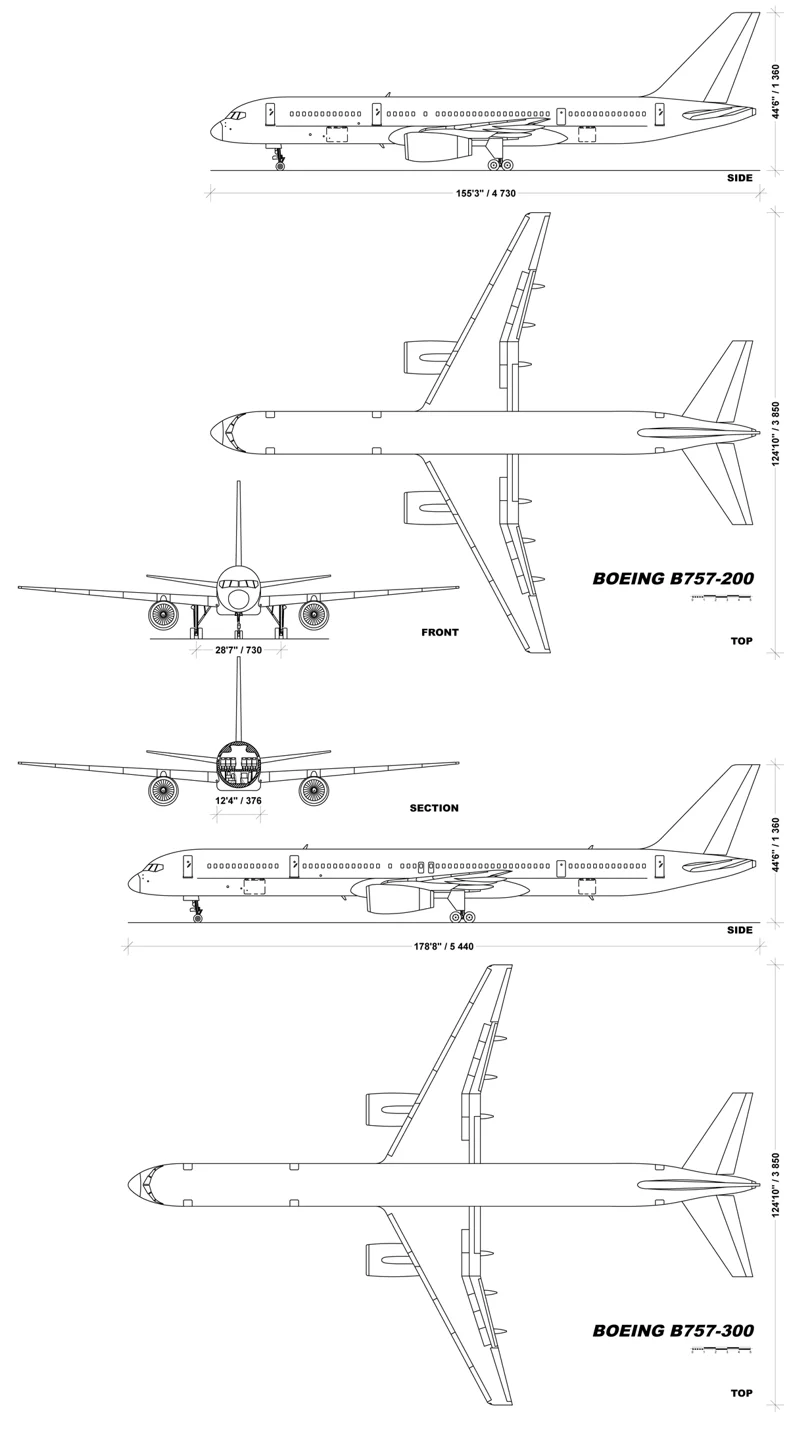
Julien Scavini’s published 2011 reference drawing compares the 757-200 and longer 757-300. It is not a factory blueprint.
Julien.scavini · CC BY-SA 3.0 · Source and credits · 2011-11-05

View full-size · Original imageResized WebP display copy.

- 757-200 and 757-300 airport planning drawings, December 2024
Boeing’s manual includes both passenger lengths, freighter arrangements and separate drawings for the -200’s overwing-exit and four-door layouts.
- The final 757-300 factory rollout, March 2004
Boeing’s licensed photo archive records the final stretched 757 leaving Renton, with the photograph’s identifier and a production-history caption.
See one for yourself
Skylark shows what is flying over Ireland right now, and the iPhone app points you at it. Next time you hear engines, look for the B752 or B753 code.
Sources
Facts checked against these sources on 28 September 2026. Numbers that change over time, such as orders and fleet sizes, are as of the date given beside them.
- Boeing closes chapter in aviation history with final 757 delivery (28 April 2005)Boeing
- 2/19/1982: Maiden flight of the Boeing 757Airways Magazine
- Type certificate data sheet EASA.IM.A.205, Boeing 757, issue 03 (17 December 2015)EASA (published by the UK Civil Aviation Authority)
- Boeing 757-300 rollout highlighted by order announcement (31 May 1998)Boeing
- Elegant stretch (24 March 1999)FlightGlobal
- Boeing 767-400ER receives common type rating from FAA (21 August 2000)Boeing
- Company history timelineAviation Partners Boeing
- Order JO 7110.126B, consolidated wake turbulence separation standards (2021)FAA
- Spotting the difference: Boeing narrow-bodies (15 May 2025)Flightradar24
- United Airlines to deploy aging 757s on expanded European routes in 2026AirMag.aero
- Last 757-300 Factory RolloutBoeing Images
- 757 Airplane Characteristics for Airport Planning, Revision HBoeing
How often does Skylark see it?
Read the existing Ireland observation log to see the days each type appeared. This is what Skylark recorded, with the coverage its receivers and providers supplied; it is not a census of Irish aircraft or a prediction of your next sighting.
One aircraft seen on three different days contributes three airframe-days. Repeated reports on the same day count once. Codes are shown separately, without adding them into a family total. A logged day does not mean continuous coverage throughout that day.
Observations load when you request them.