

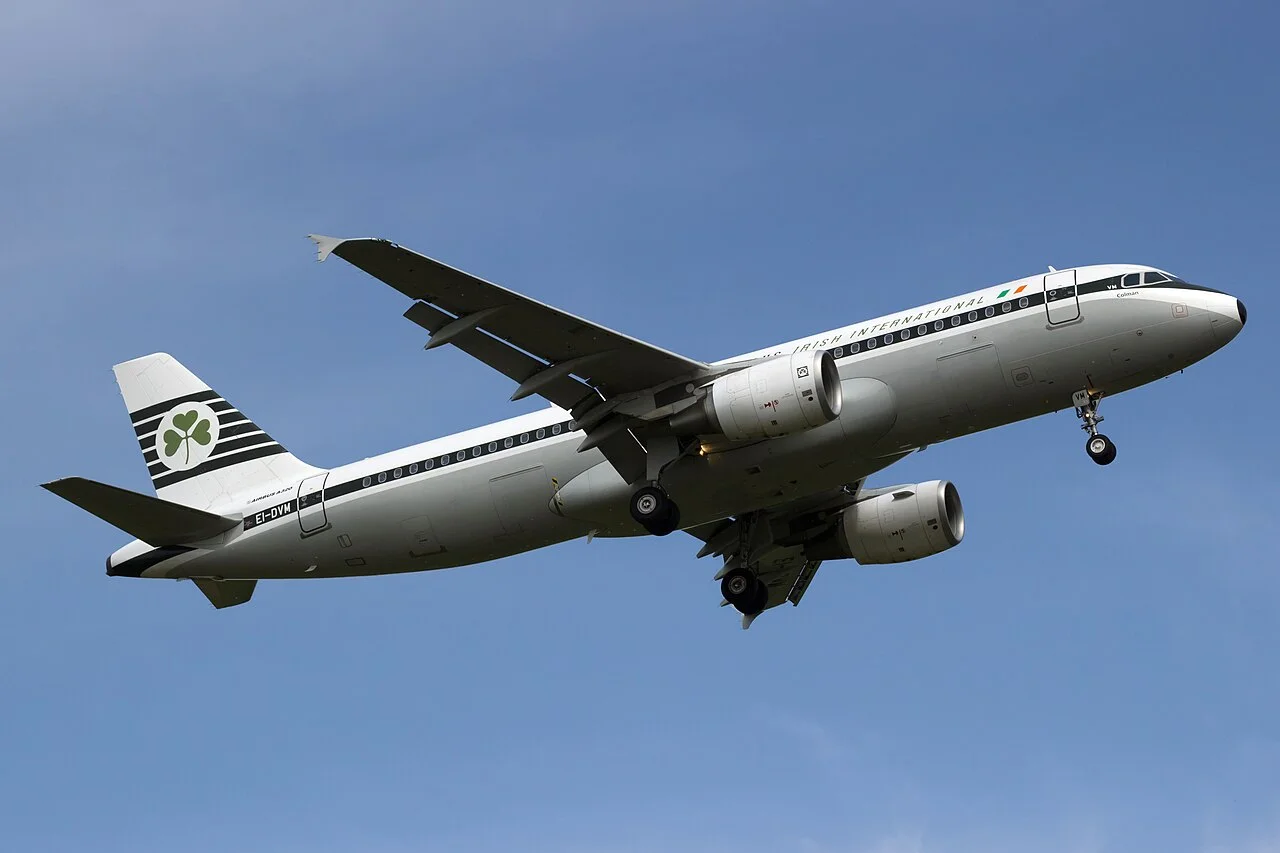


Recognise it overhead
Recognition clues checked 30 September 2026
- Cockpit
- Look for the clipped upper rear corner of the last cockpit side window in a clear side photo. [9]
- Engine intake
- Round nacelles contrast with the flattened underside of a 737 Next Generation intake. [9]
- Wingtip
- Small triangular wingtip fences indicate an original A320-family aircraft; Sharklets also appear on some originals. [8]
- Exit caveat
- An A320 has two overwing exits per side; an A319 usually has one, but high-density A319s can have two. [8]
Use several visible clues together. If a detail is too far away to see, leave it uncertain.
Could also be: Airbus A320neo, Boeing 737-800
Key facts
- Original (ceo) models built
- 8,101 [6]
If you have flown from Dublin to somewhere in Europe, there is a fair chance you have sat inside one of these. The A320 family is really four aircraft: the A318, A319, A320 and A321. They share one cockpit and one set of operating procedures, so a pilot with a single type rating can fly all four [1]. What mostly changes is the length of the tube behind the flight deck.
This article is about the originals, now known as the A320ceo, for "current engine option" [13]. Their re-engined successors have their own article. Airbus built 8,101 of the originals [6]. Airbus counts both generations together, and by the end of August 2026 the whole family had 20,418 orders and 12,841 deliveries, with 11,407 in service [7].
A computer between the pilot and the wings
The A320 first flew on 22 February 1987 [1] [2]. European certification followed on 26 February 1988 [2] [3], and Air France took the first deliveries that spring [2].
The shape was conventional. The controls were not. Airbus describes the A320 as the first commercial aircraft to use full digital fly-by-wire, replacing traditional manual controls with electronic signals [1]. In other words, when the pilot asks the aircraft to turn, the request travels as data rather than as a tug on a cable, and the family pioneered that arrangement in airliners [3].
The other change is visible from the jump seat. Instead of a traditional yoke, each pilot has a side-stick [1]. It became an Airbus habit: the same cockpit design is shared across the company's aircraft, so pilots can move between types more easily [1].
One cockpit, four lengths
The first stretch came quickly. Airbus launched the A321 on 24 November 1988 [4], and it first flew from the Hamburg Finkenwerder plant on 11 March 1993 [3] [4]. Lufthansa put it into service in January 1994 [3] [4]. It is 6.94 m longer than the A320 and can seat up to 224 people in a single-class cabin [4]. That makes it about 44.5 m long, against 37.57 m for the A320 [3] [14].
Going the other way, the shortened A319 entered service in 1996 [3] [5]. The smallest of the lot, the A318, was launched on 26 April 1999 and first flew on 15 January 2002 [3] [5]. It stayed rare: Flightradar24 counts 81 orders before production ended in 2013 [5].
Every member of the original family was offered with a choice of CFM56 or IAE V2500 engines [2] [3]. From 2012, Airbus added Sharklets, tall upturned wingtips that trim fuel burn [2] [3]. Airbus credits them with saving up to 4% in fuel [1]. The first Sharklet-equipped A320 went to Indonesia AirAsia on 21 December 2012 [3].
Production of the originals ended in 2021 [2]. The last new original-engine aircraft, an A321 for Delta Air Lines, was delivered on 16 December 2021 and ferried from Airbus's plant at Mobile, Alabama, to Minneapolis [3] [6].
How to spot one
From the ground, start by ruling out the aircraft it is most often confused with, the Boeing 737-800.
- The cockpit windows. The rearmost cockpit side window on the A320 has a clipped top corner, a small "missing corner" that is easy to see in a photo [9].
- The engines. A320 nacelles are round. The 737-800's have a flattened bottom to clear the ground [9].
Then work out which member of the family you have:
- Count the overwing exits. An A319 has one on each side, and an A320 has two [8]. easyJet's A319s are the exception, with extra exits for their dense cabins [8].
- Count the doors. An A321 has four doors along each side [8], and its overwing exits were enlarged and moved to sit in front of and behind the wing [3].
- Look at the fin. The A318's tail looks too tall for its short body [8].
To tell an original from a neo, look at the engines and the wingtips. Neo engines are much larger in diameter [8]. Every neo has Sharklets, but only some originals do [8]. The older ones have small wingtip fences instead [10], so a fence means an original. Take care with a Sharklet in silhouette: it looks very like the blended winglet on many 737s [10].
If the Airbus in front of you has four cockpit windows rather than the usual six, it is not an A320 at all but an Airbus A220 [8].
Over Ireland
Aer Lingus is the operator to look for. When its first A321LR arrived in July 2019, it already flew 37 A320 family aircraft [11]. It began replacing them with A320neos in September 2022, retiring two older A320s as the first two new ones arrived [12].
The rarest member had an Irish connection too. British Airways flew two all-business-class A318s on a London City to New York service via Shannon, and retired the last of them in March 2020 [5].
From the archive
The A320 family can carry cargo in containers below the passenger cabin, an option Airbus highlights as unusual among single-aisle airliners. [15]
The family grew in both directions: the A321 reached Lufthansa in January 1994, the A319 reached Swissair in April 1996, and the tiny A318 reached Frontier in July 2003. [15]
In photographs
Look closer at the shapes, details and liveries. Every photograph links to its original and credits its creator.
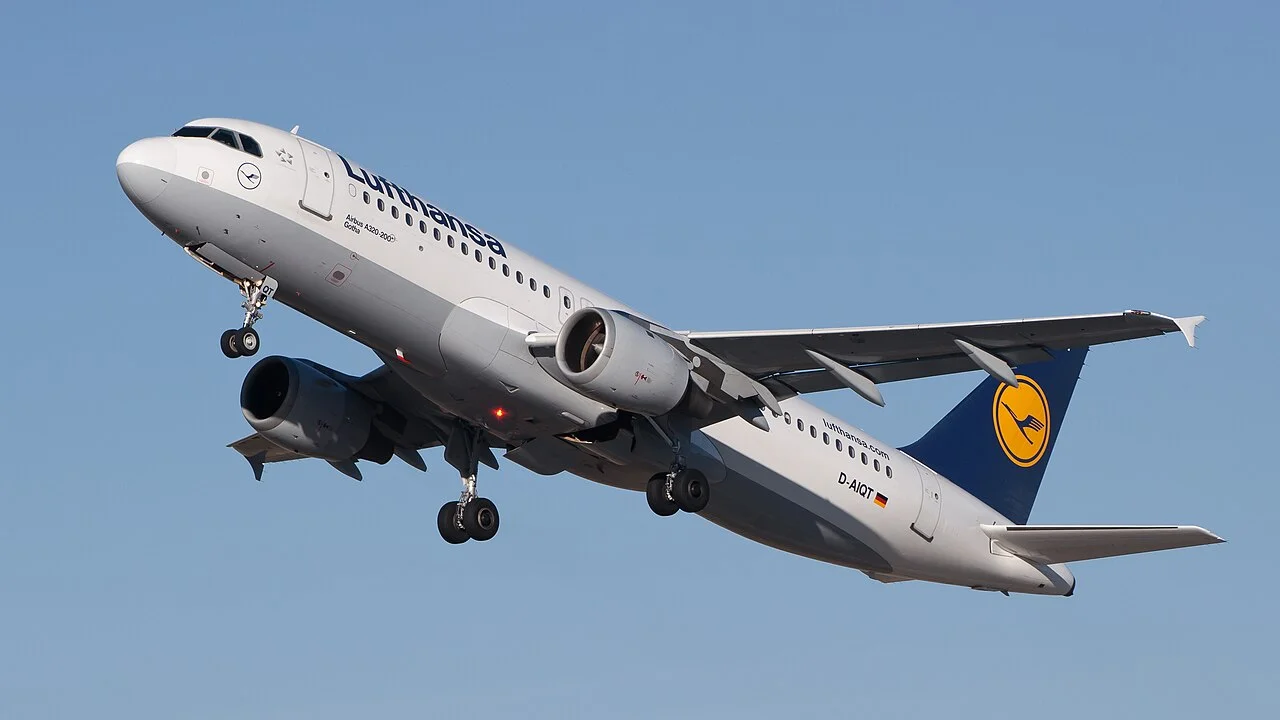
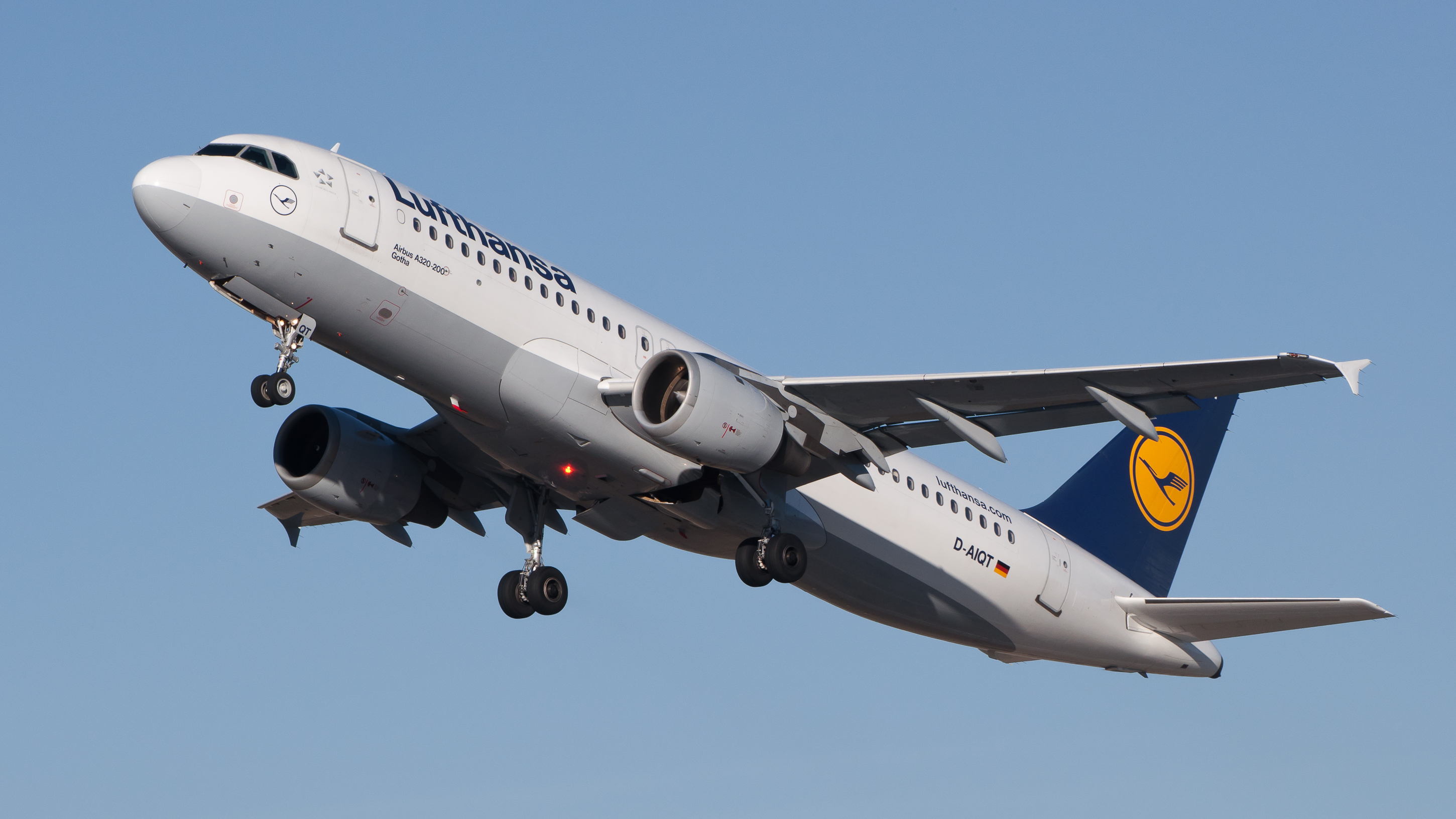
A Lufthansa A320 taking off at Stuttgart. The round engine housings and cockpit windows are useful recognition cues.
Julian Herzog (Website) · CC BY 4.0 · Source and credits · Taken on 7 February 2011, 15:13:24

View full-size · Original imageResized WebP display copy.
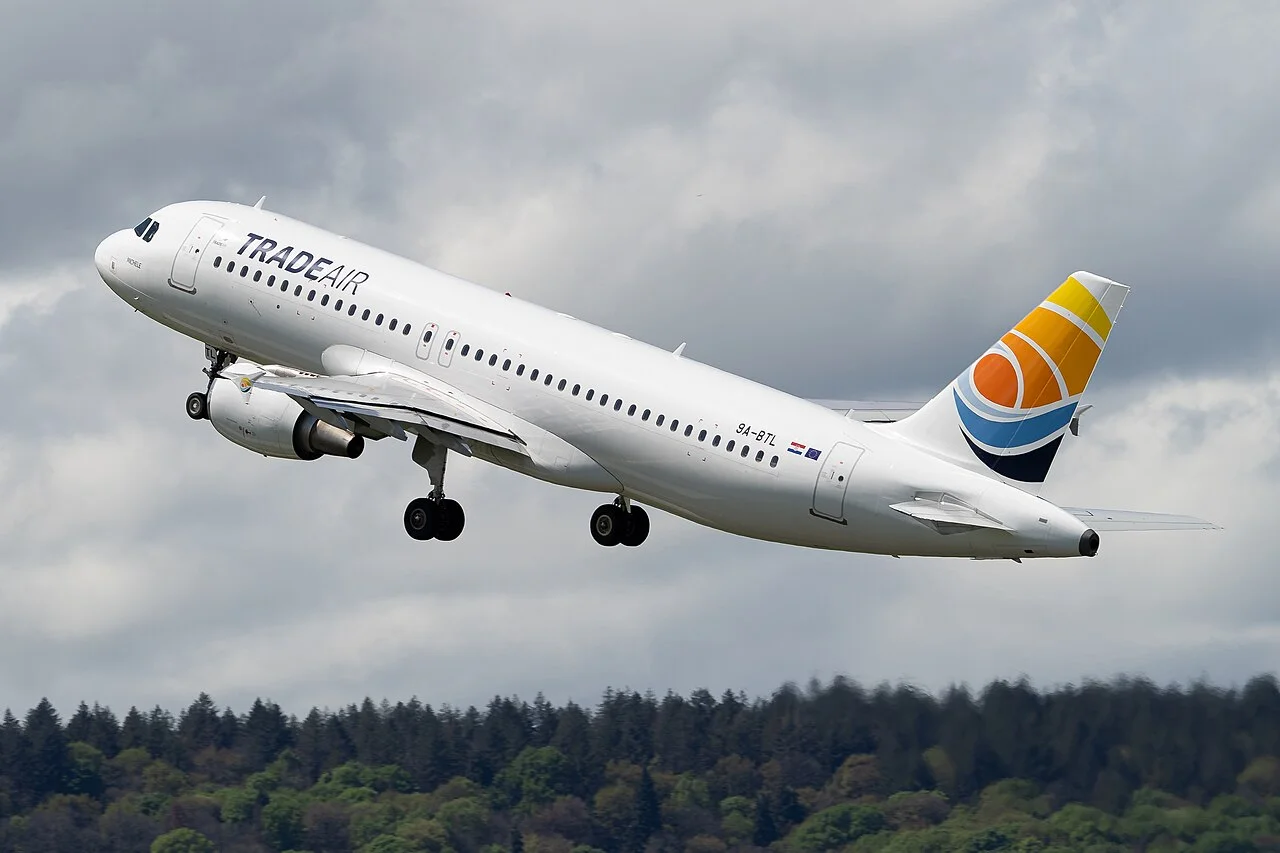
Trade Air A320 9A-BTL taking off at Tarbes. Compare the doors and overwing exits with the longer A321.
Shougissime · CC BY-SA 4.0 · Source and credits · 2025-04-16

View full-size · Original imageResized WebP display copy.

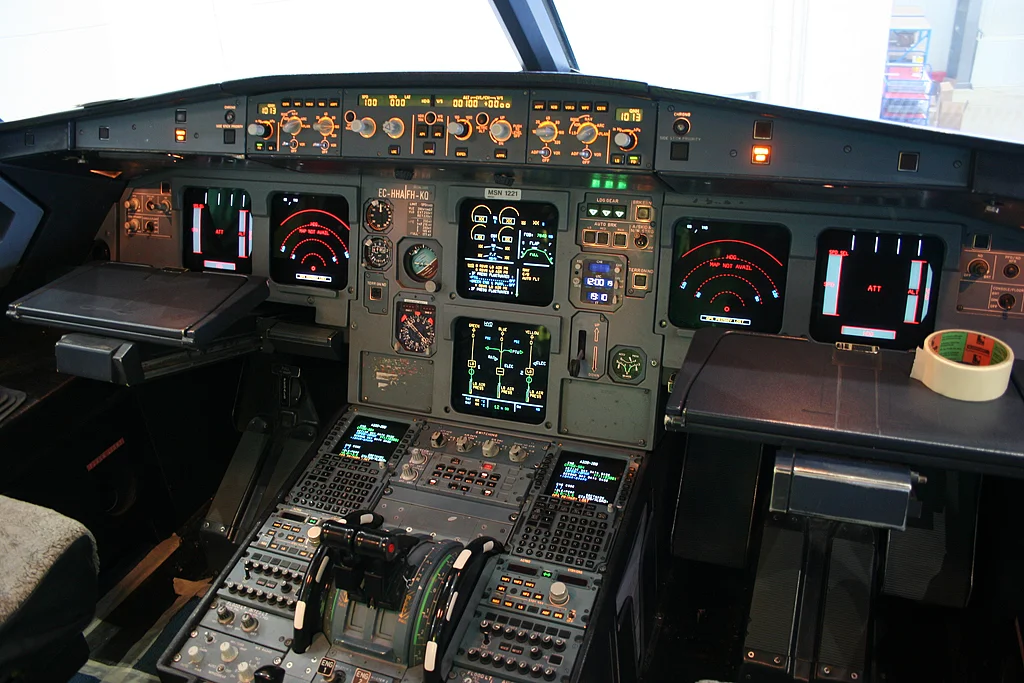
Inside a Vueling A320 flight deck. The sidesticks sit beside the pilots rather than in front of them.
Curimedia · CC BY 2.0 · Source and credits · 2011-03-08 14:01

View full-size · Original imageResized WebP display copy.

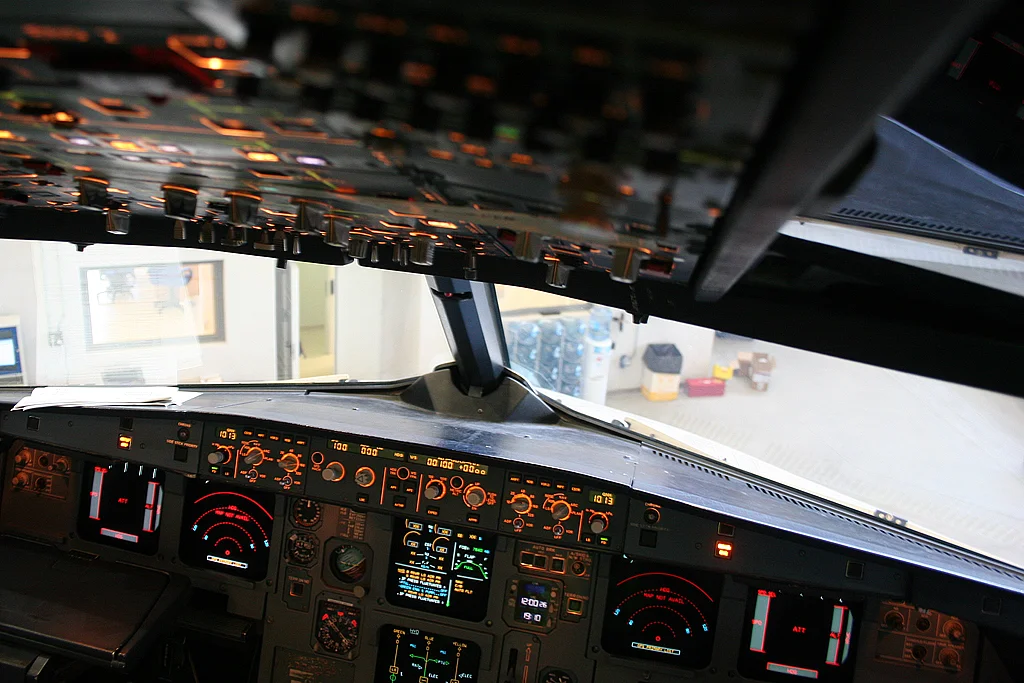
A closer look at the A320 overhead panel and cockpit instruments.
Curimedia · CC BY 2.0 · Source and credits · 2011-03-08 14:02

View full-size · Original imageResized WebP display copy.

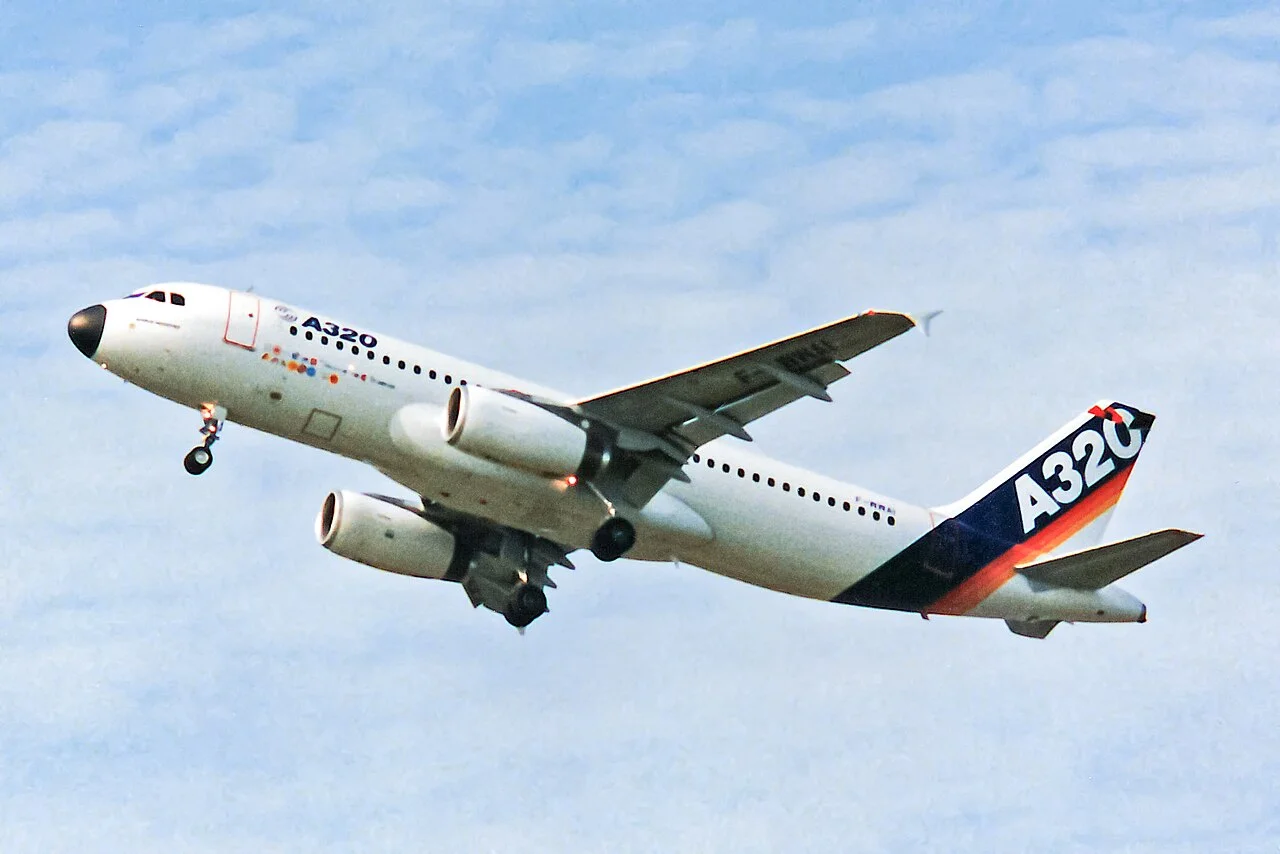
A320 prototype F-WWAI at Farnborough in September 1988, wearing Airbus Industrie colours.
Ken Fielding, derivative work Lämpel · CC BY-SA 3.0 · Source and credits · 1988-09

View full-size · Original imageResized WebP display copy.

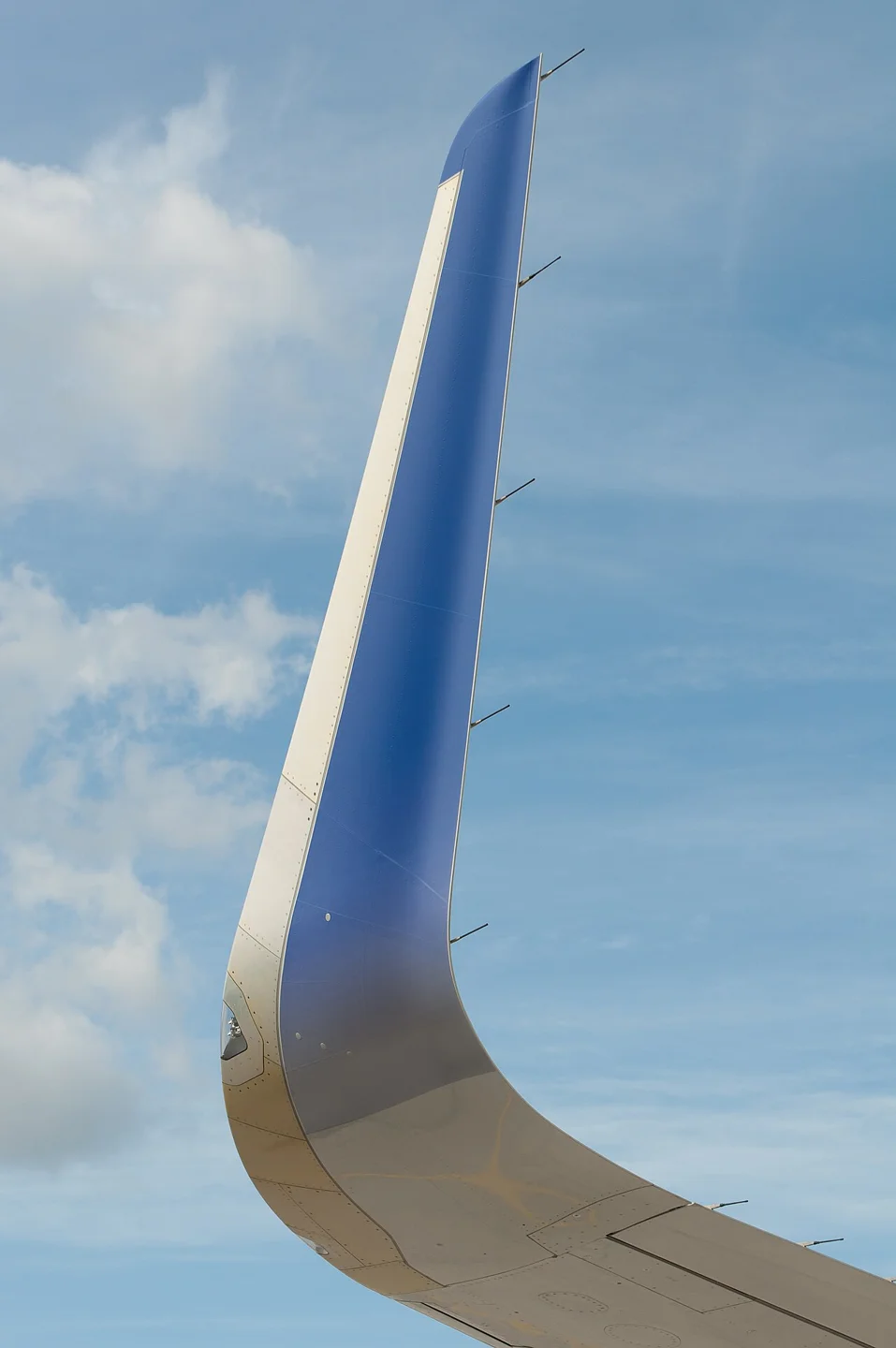
A close-up of the Sharklet fitted to Airbus test aircraft F-WWIQ at ILA Berlin in 2012.
Julian Herzog (Website) · CC BY 4.0 · Source and credits · Taken on 12 September 2012, 14:46:14

View full-size · Original imageResized WebP display copy.

Drawings and original documents
Existing published drawings are credited below. These are reference illustrations, not manufacturing blueprints.
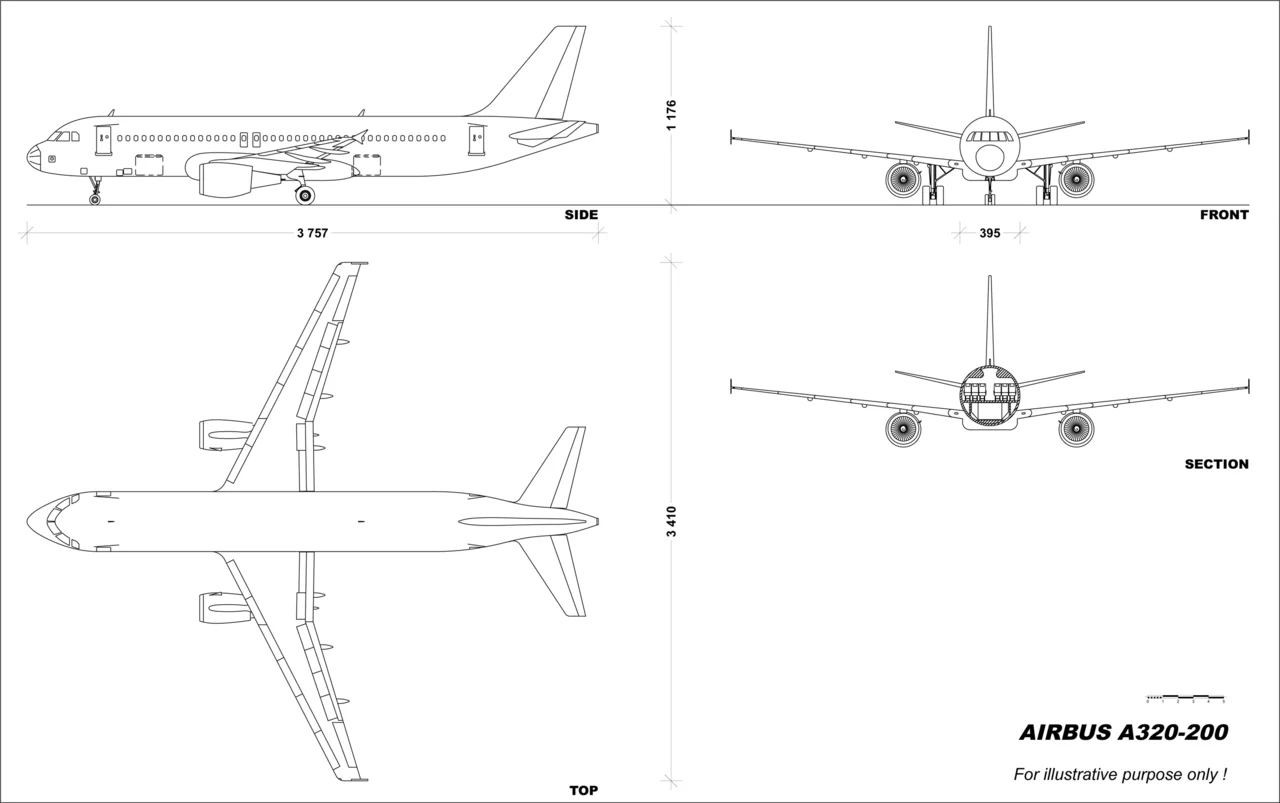
A320 reference drawing by Julien Scavini, with side, overhead, front and fuselage-section views. Published in 2011; not an original factory blueprint.
Julien.scavini · CC BY-SA 3.0 · Source and credits · 2011-10-03

View full-size · Original imageResized WebP display copy.

- A320 airport and maintenance planning drawings, July 2026
Airbus’s own technical reference, including aircraft dimensions, cabin cross-sections, door positions, ground clearances and servicing diagrams. These are manufacturer planning drawings.
- A320 Family facts and programme timeline, June 2026
Airbus’s illustrated family backgrounder records the first deliveries of the A320, A321, A319 and A318, alongside dimensions for both engine generations.
See one for yourself
Skylark shows what is flying over Ireland right now, and the iPhone app points you at it. Next time you hear engines, look for the A320 or A319 or A321 or A318 code.
Sources
Facts checked against these sources on 28 September 2026. Numbers that change over time, such as orders and fleet sizes, are as of the date given beside them.
- Airbus A320 FamilyAirbus
- Airbus A320: a medium-haul bestseller for almost 40 yearsMTU AeroReport
- Airbus A320 familyWikipedia
- Maiden flight of the Airbus A321Airways Magazine
- A318: a history of the Baby BusFlightradar24
- World's last A320ceo Family jet delivered, to Deltach-aviation
- Orders and deliveriesAirbus
- Spotting the difference: the Airbus narrow-bodiesFlightradar24
- How to tell the difference between Airbus and Boeing aircraftFlightradar24
- All about airplane winglets, and how to tell them apartThe Points Guy
- Aer Lingus takes delivery of its first A321LRAirbus
- Aer Lingus takes delivery of first new A320neo aircraftTravelMole
- Airbus A320neo familyWikipedia
- A320ceoAirbus
- A320 Family facts and figures, June 2026Airbus
How often does Skylark see it?
Read the existing Ireland observation log to see the days each type appeared. This is what Skylark recorded, with the coverage its receivers and providers supplied; it is not a census of Irish aircraft or a prediction of your next sighting.
One aircraft seen on three different days contributes three airframe-days. Repeated reports on the same day count once. Codes are shown separately, without adding them into a family total. A logged day does not mean continuous coverage throughout that day.
Observations load when you request them.