

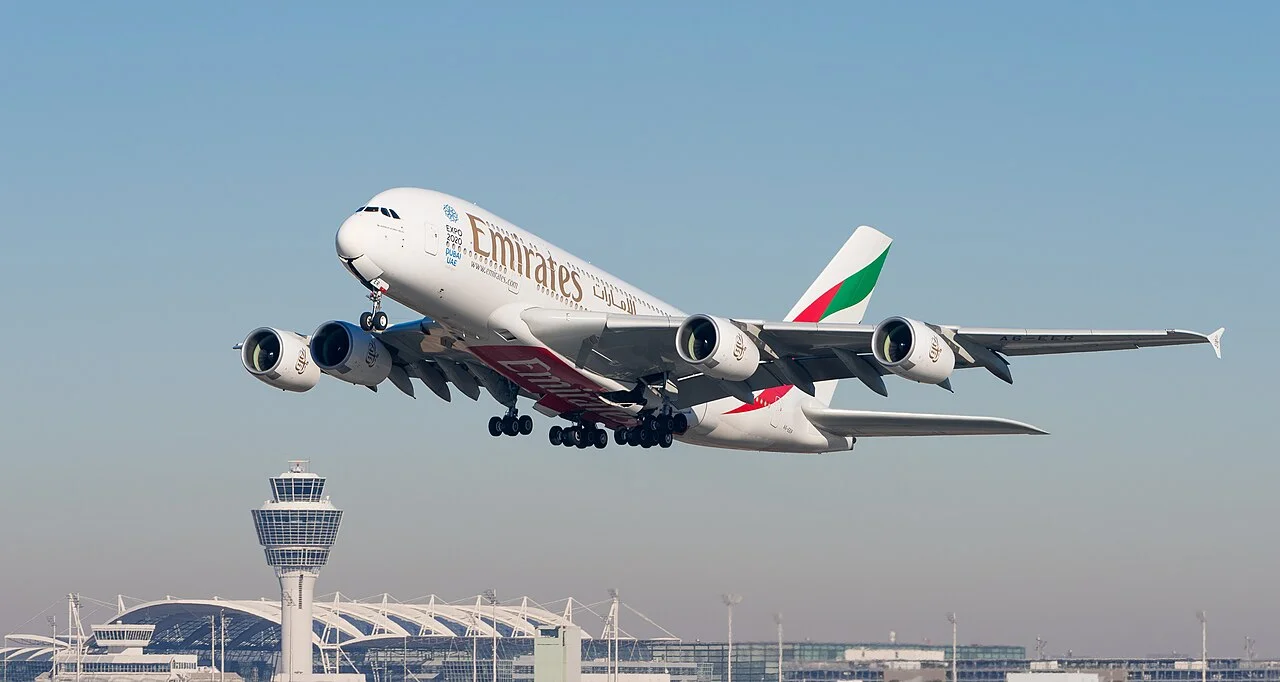

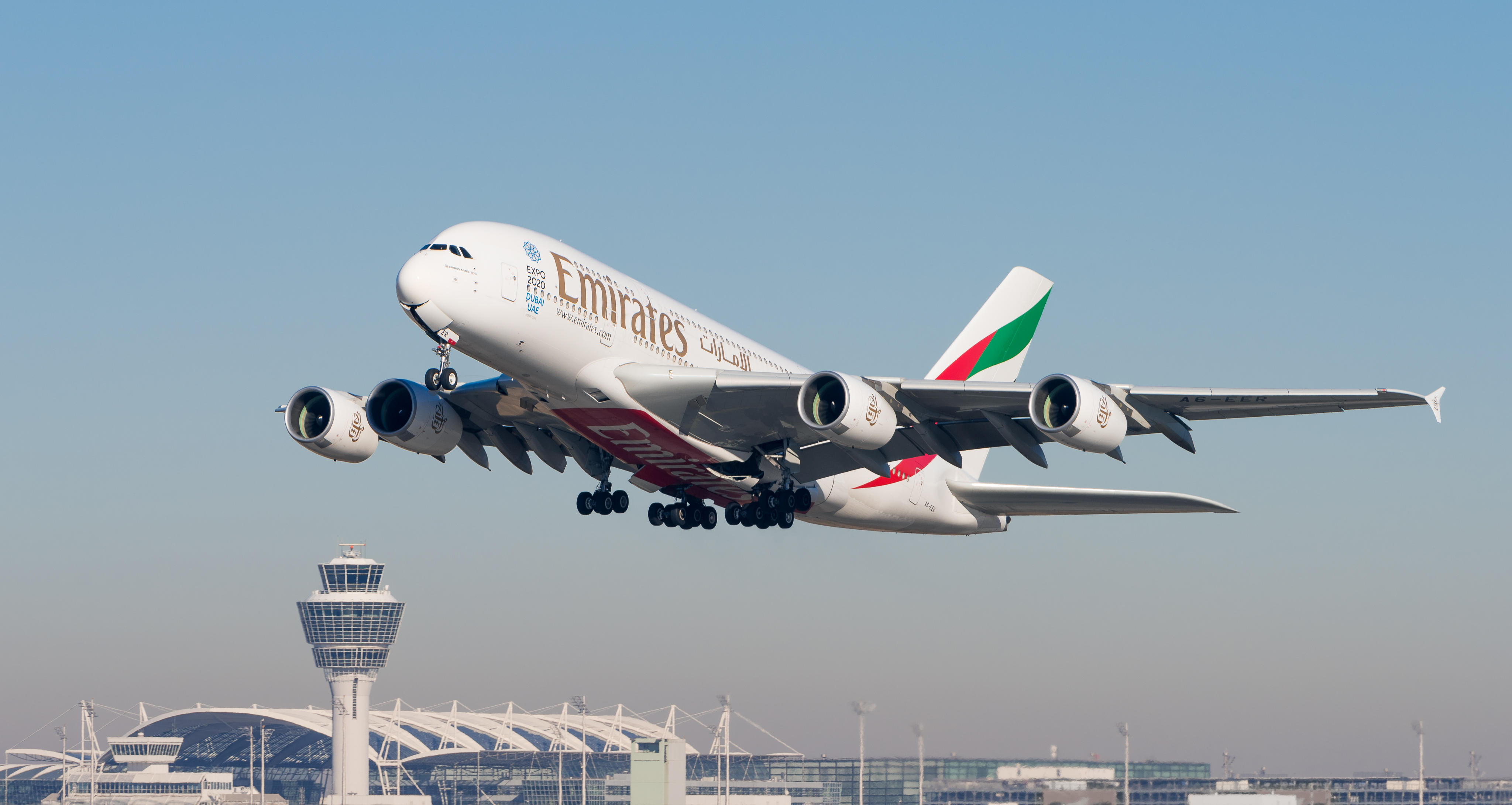
Key facts
There is no mistaking an A380 once you have seen one. It is the airliner with a second passenger deck running from nose to tail, four engines, and a wing that spans more than the aircraft is long [1]. It is also a type whose production story is finished: Airbus decided in 2019 to stop building it, the last deliveries went to Emirates in 2021, and 251 were delivered in all [1] [5] [6].
Big from the start
The first A380, test aircraft MSN001, took off from Toulouse at 10:30 on 27 April 2005 [2]. Airbus says it was the first time its engineers had designed an aircraft entirely on a full digital mock-up, and that the programme registered more than 380 patents [2].
European certification of the Rolls-Royce-powered A380-841 and -842 came on 12 December 2006, and the Engine Alliance-powered A380-861 followed on 14 December 2007 [3]. Those are the only two engine families: the Rolls-Royce Trent 900 and the Engine Alliance GP7000 [1].
Singapore Airlines took the first delivery on 15 October 2007, nearly two years behind schedule, and flew its first passenger service from Singapore to Sydney with 455 passengers aboard [4]. It ended the Boeing 747's nearly 37-year reign as the world's most spacious passenger plane [4].
How big is big?
The A380 is 73 m long, 24 m high and 79.8 m from wingtip to wingtip [1]. Its two passenger decks have 550 square metres of floor between them [1]. Airbus says it can carry more than 850 passengers in an all-economy layout, and that it is the only aircraft to offer more than 500 seats [1]. For emergency evacuation EASA's certificate approves up to 868 people: 330 upstairs and 538 on the main deck [3].
It can fly about 8,000 nautical miles (14,800 km), or around 17 hours [1]. Airbus puts its fuel burn at about 3.1 litres per 100 passenger-kilometres [1].
Too big to keep building
Airbus had once forecast 1,200 sales. It sold 234 by early 2019, and no US passenger airline ordered one [5]. In February 2019 Airbus announced it would stop production, with the final deliveries to Emirates in 2021 [5]. Its chief executive, Tom Enders, said there was "no basis to sustain production" [5].
Emirates was always the type's great champion. It took its 123rd and final A380, A6-EVS, on 16 December 2021, the last new A380 to join its fleet [6]. That is almost half of all 251 built [1] [6].
The type is far from gone. As of April 2025 Airbus counted some 180 A380s in service, which had between them flown more than 800,000 flights and carried more than 300 million passengers since 2007 [2]. Airbus has also chosen the A380 as its flight demonstrator for future propulsion systems [2].
On an ADS-B receiver every A380 shows the same type code: A388.
How to spot one
- Count the rows of windows. The A380 is the only airliner with two full passenger decks [7], so you will see two lines of windows along the whole fuselage. A Boeing 747 has an upper deck too, but not a full-length one [7].
- Count the engines. Four [1]. The Airbus widebody you will see far more often, the A330, has two [7].
- Look at the wingtips. The A380 has small triangular wing fences on the end of each wing [7], rather than tall winglets or curling tips.
- Rule out the big twins. A Boeing 777 or an A350 is big too, but has one full passenger deck, not two [7].
Over Ireland
In February 2018 TheJournal.ie reported that the superjumbo had never touched down at Dublin Airport [8]. Emirates had planned to land one there in March 2017 but postponed the visit for "operational reasons" [8]. Handling one would need a double-decker gate, which would take six months to build and put four other gates out of commission, and the airfield had only one parking spot where the aircraft could manoeuvre safely [8].
The west of the country has had closer encounters. On 20 February 2020 an ex-Air France A380, F-HPJB, landed at Ireland West Airport Knock from Dresden [9]. It had flown its last Air France revenue flight on 31 December 2019, and its new owner, Eirtrade Aviation, was expected to break it up for spare parts [9].
In July 2026 another retired A380, the former Malaysia Airlines 9M-MNF, now registered 2-JAYN, flew into Shannon to be repainted [10]. It once carried a "100th A380" sticker, and Airbus is preparing it as a flying test bed [10]. It was reported to be replacing the current one, F-WWOW, although the report could not confirm that [10].
From the archive
The A380’s horizontal tail spans 30.4 metres, almost as wide as the wings of an original A320. [11]
Airbus’s production retrospective counts about four million individual components and 220 windows in each A380. [11]
In photographs
Look closer at the shapes, details and liveries. Every photograph links to its original and credits its creator.
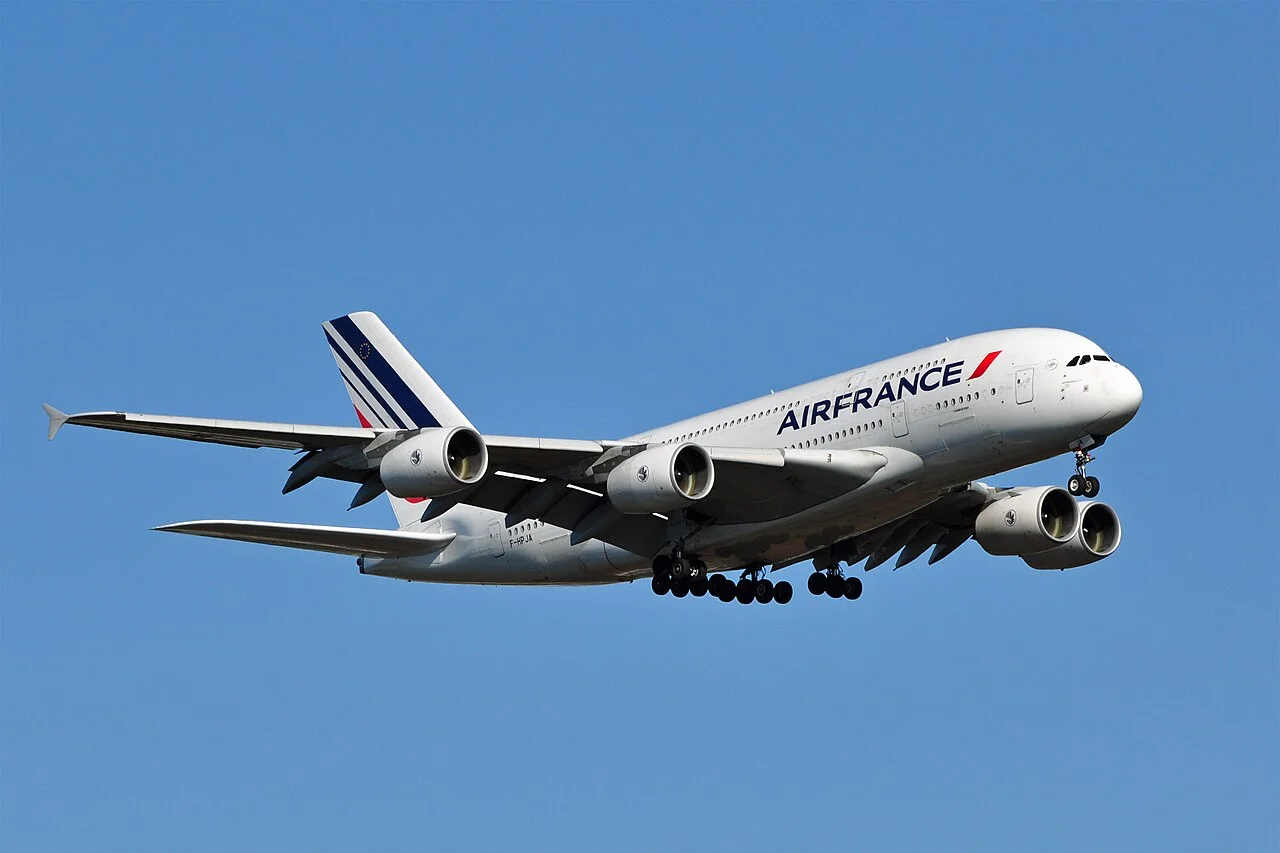
Air France A380 F-HPJA on approach.
Joe Ravi · CC BY-SA 3.0 · Source and credits · 12 November 2011

View full-size · Original imageResized WebP display copy.

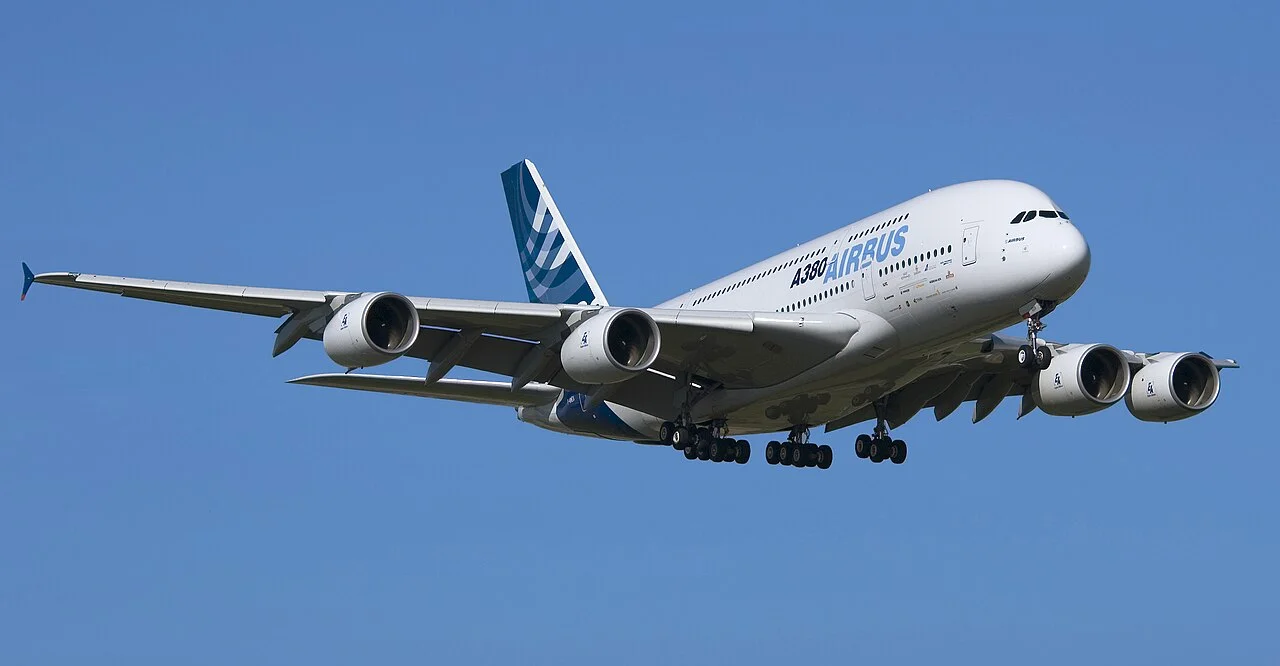
An A380 in Airbus colours, with its landing gear extended.
Keta · CC BY-SA 2.5 · Source and credits · 2007-05-07

View full-size · Original imageResized WebP display copy.

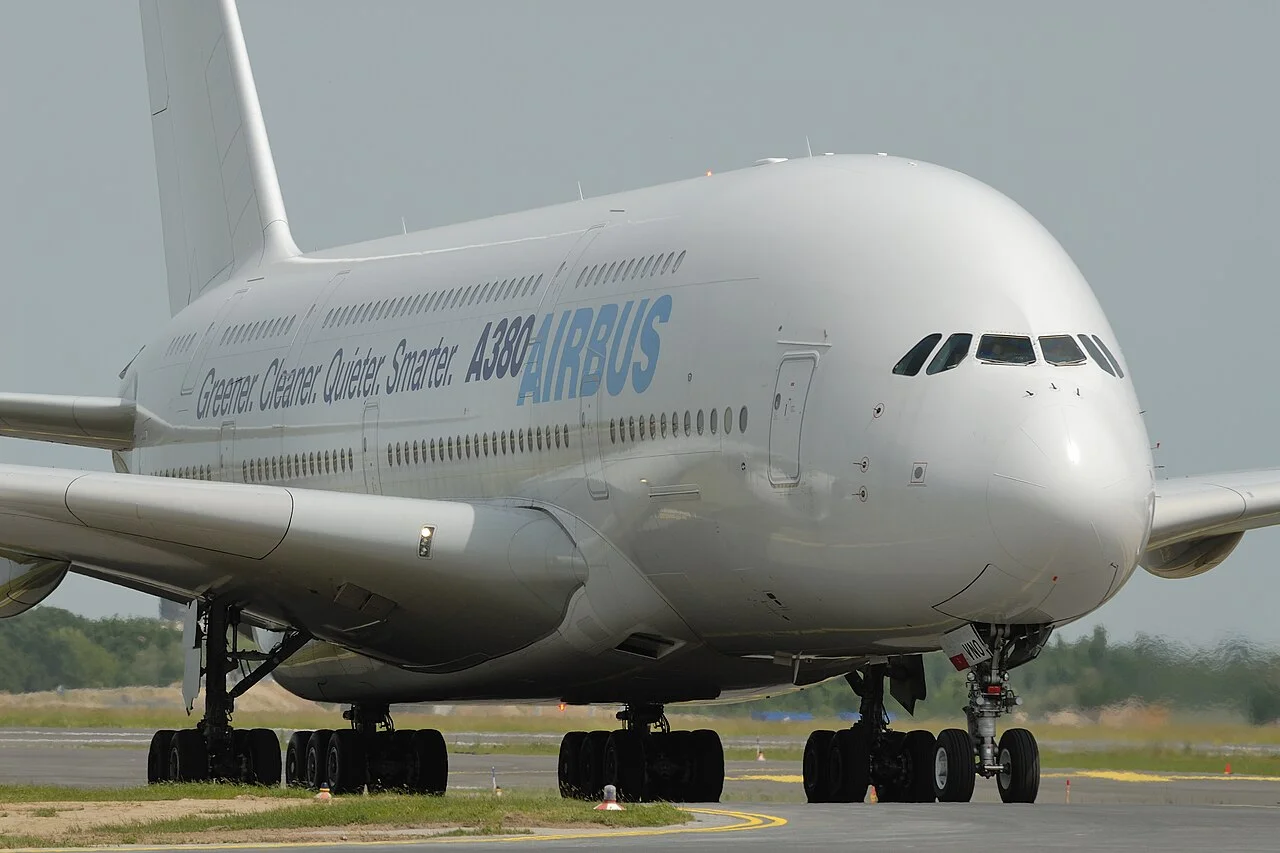
The A380 nose and cockpit at ILA Berlin in 2008.
Jochen Teufel · CC BY-SA 3.0 · Source and credits · 2008-05-29

View full-size · Original imageResized WebP display copy.

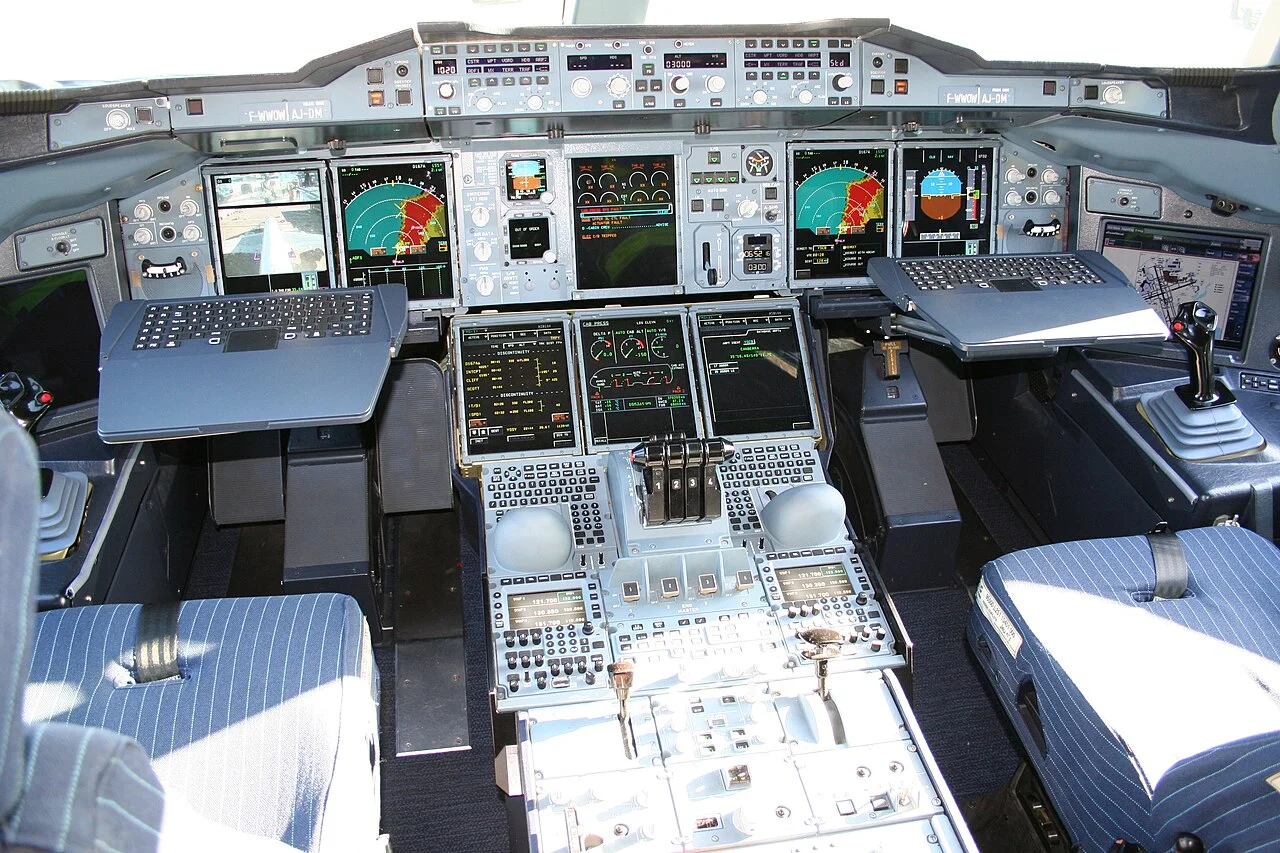
Inside a real A380 cockpit. Its flight deck sits between the two passenger decks.
Naddsy · CC BY 2.0 · Source and credits · 17 September 2007

View full-size · Original imageResized WebP display copy.

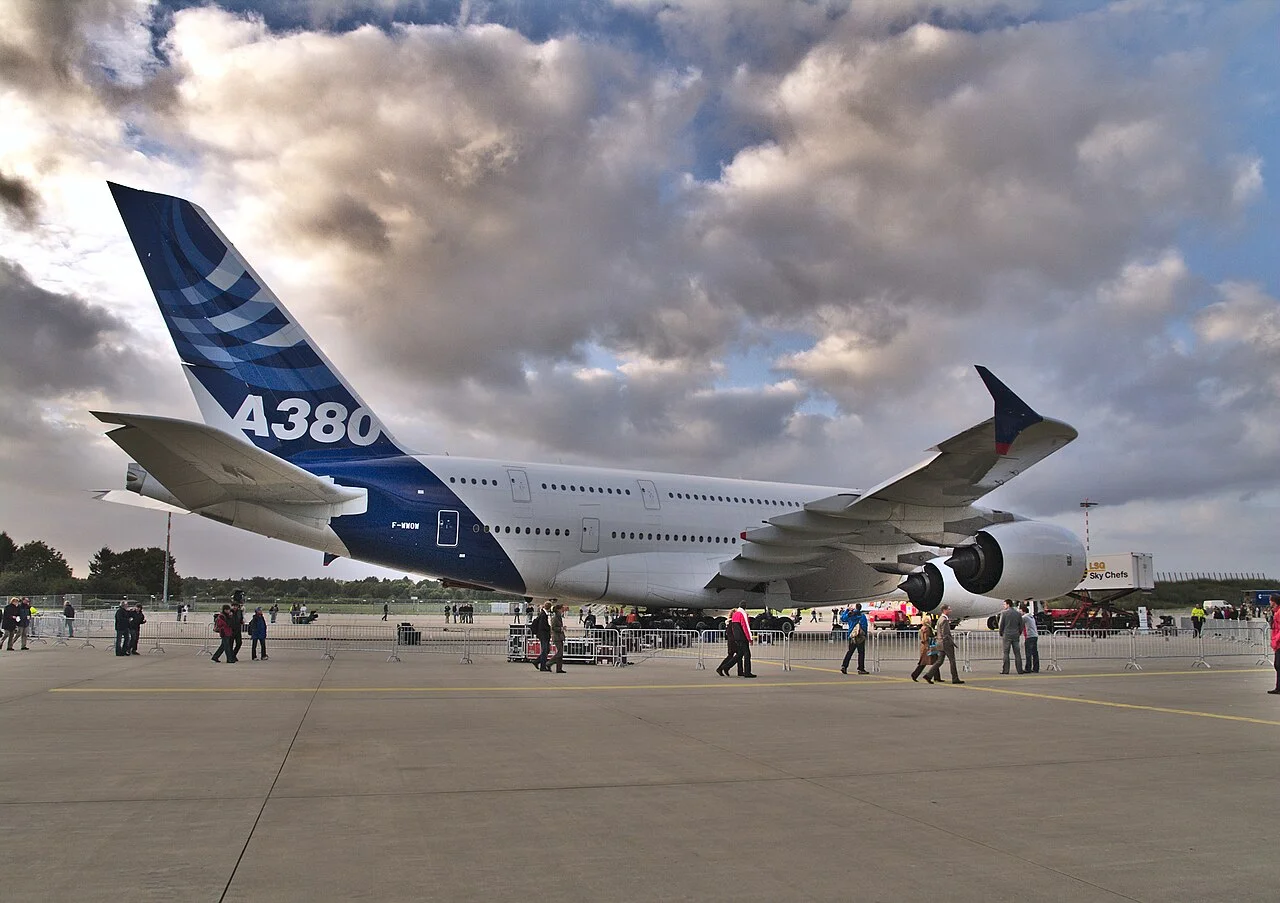
A380 prototype F-WWOW at Hamburg in 2007.
Jacek Rużyczka · CC BY-SA 3.0 · Source and credits · Taken on 15 September 2007

View full-size · Original imageResized WebP display copy.

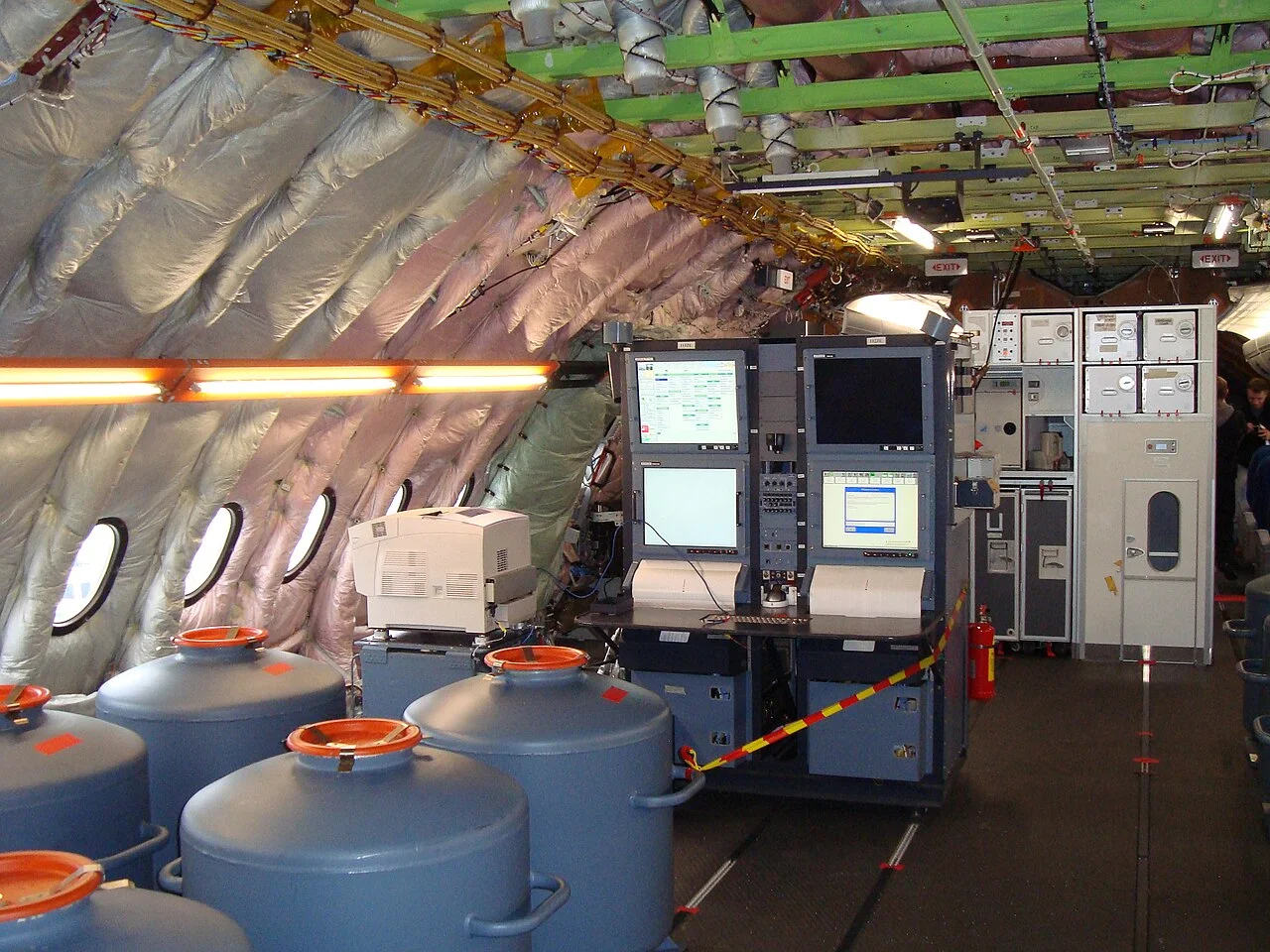
Flight-test equipment inside an A380 in 2009. Test instrumentation occupied space later used by passengers.
Apetrov09703 · CC BY-SA 4.0 · Source and credits · 2009-10-17 13:21:26

View full-size · Original imageResized WebP display copy.

Drawings and original documents
Existing published drawings are credited below. These are reference illustrations, not manufacturing blueprints.
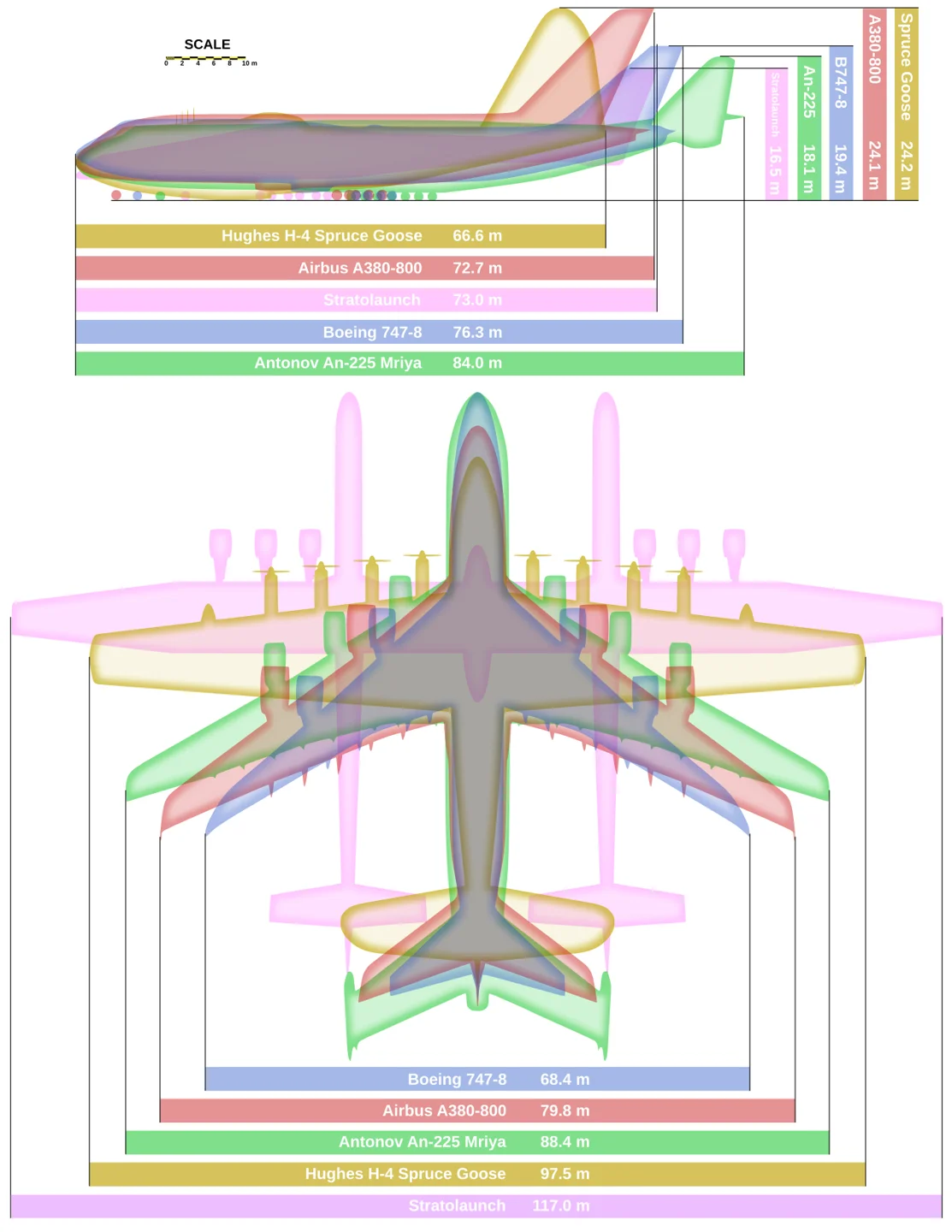
A published size-comparison drawing places the A380 alongside other large aircraft. This is a reference illustration, not an A380 factory blueprint.
Clem Tillier (clem AT tillier.net) · CC BY-SA 2.5 · Source and credits · 2006-08-26

View full-size · Original imageResized WebP display copy.

- A380 airport and maintenance planning drawings, December 2025
Airbus’s airport planning manual contains dimensioned aircraft views, the two passenger decks, door positions, turning geometry and servicing arrangements.
- A380 facts and production timeline, February 2022
A dated Airbus archive snapshot published just after production ended, with programme milestones, component counts and technical dimensions.
See one for yourself
Skylark shows what is flying over Ireland right now, and the iPhone app points you at it. Next time you hear engines, look for the A388 code.
Sources
Facts checked against these sources on 28 September 2026. Numbers that change over time, such as orders and fleet sizes, are as of the date given beside them.
- Airbus A380Airbus
- Happy 20th anniversary, A380!Airbus
- EASA type certificate data sheet A.110, Airbus A380, issue 15UK Civil Aviation Authority
- Airbus A380 completes maiden voyageNBC News
- Airbus to stop production of A380 superjumbo jetNPR
- Emirates completes A380 fleet with 123rd delivery of iconic aircraftEmirates
- Spotting the difference: the Airbus wide body fleetFlightradar24
- Why Emirates' flagship superjumbo jets won't be coming to Ireland any time soonTheJournal.ie
- Flight of the Condor: an A380's final flightFlyingInIreland.com
- Airbus prepares ex-Malaysia A380 as new flying testbedAerospace Global News
- A380 facts and figures, February 2022Airbus
How often does Skylark see it?
Read the existing Ireland observation log to see the days each type appeared. This is what Skylark recorded, with the coverage its receivers and providers supplied; it is not a census of Irish aircraft or a prediction of your next sighting.
One aircraft seen on three different days contributes three airframe-days. Repeated reports on the same day count once. Codes are shown separately, without adding them into a family total. A logged day does not mean continuous coverage throughout that day.
Observations load when you request them.