

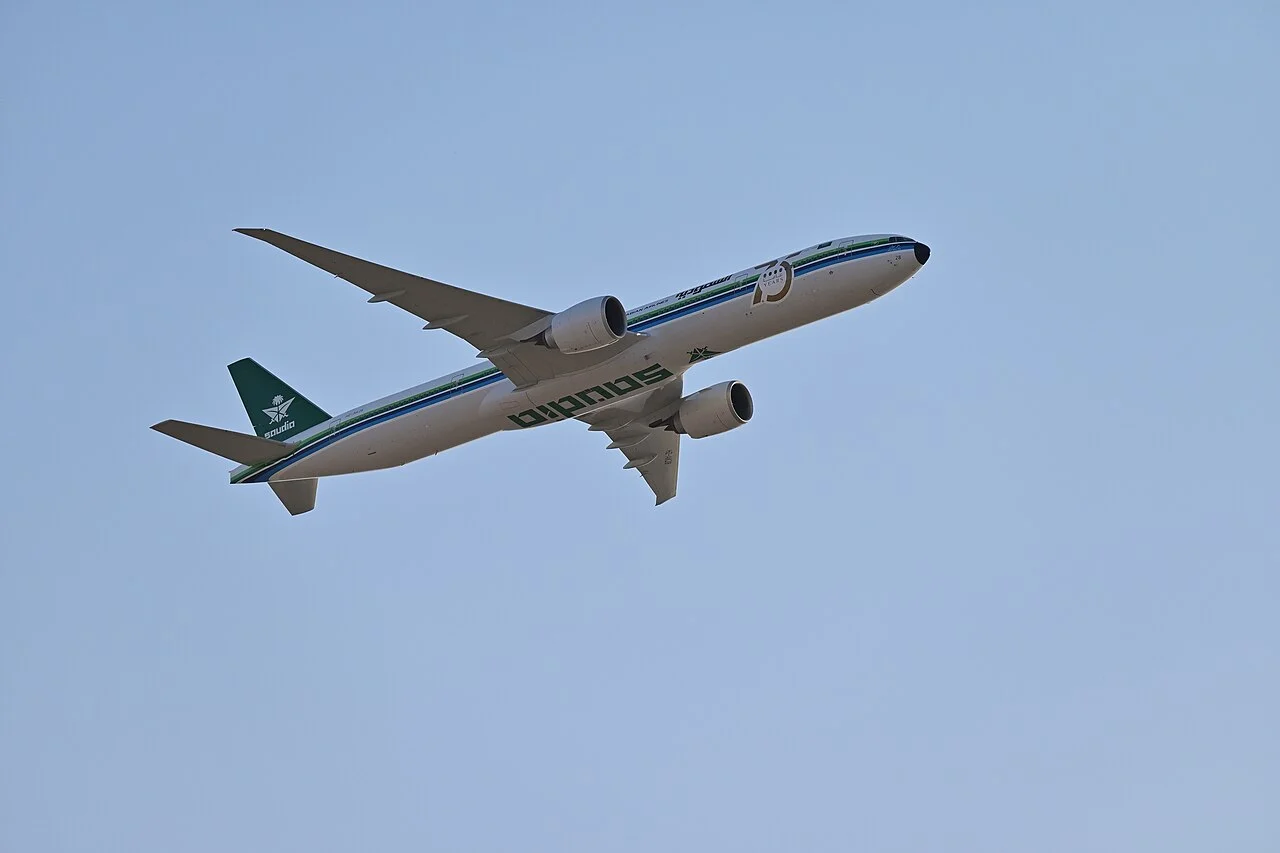


Recognise it overhead
Recognition clues checked 30 September 2026
- Main wheels
- Six wheels on each main gear leg; use another cue too because an A350-1000 also has six. [14]
- Tail cone
- The rear fuselage ends in a flat, squared-off blade, unlike the rounded cone on a 767. [14]
- Variant wingtip
- Raked tips identify the 777-200LR, 777F and 777-300ER group; original -200, -200ER and -300 tips are not raked. [14]
- Passenger doors
- On original passenger variants, four doors per side indicate the shorter -200 family; five indicate the longer -300 family. [14]
Use several visible clues together. If a detail is too far away to see, leave it uncertain.
Could also be: Boeing 787 Dreamliner, Boeing 767, Airbus A350
Key facts
The Boeing 777 is the big twin. Two very large engines, a long, wide fuselage and a set of main wheels that looks as if it was borrowed from a lorry. The first one flew in 1994 [1], and a new generation with folding wingtips is still waiting to enter service [6].
Designed on a screen
United Airlines launched the programme on 14 October 1990 with an order for 34 aircraft worth US$11 billion [1]. Unusually, eight major airlines sat in on the design as a group Boeing called "Working Together" [1].
The 777 was the first jetliner designed entirely in 3D on computers, doing away with the traditional mock-ups [1] [2]. It also had fully digital fly-by-wire flight controls [1]. Engines came from three makers: General Electric, Pratt & Whitney and Rolls-Royce [1].
Chief test pilot John Cashman took the first one up on 12 June 1994, and the flight test programme that followed ran for 11 months, longer than any earlier Boeing model's [1]. United took the first delivery on 15 May 1995 and flew the first passenger service on 7 June 1995, between London Heathrow and Washington Dulles [1] [2].
Crossing oceans on two engines
Twin-engine airliners flying far from land work under rules called ETOPS, which cap how many minutes of flying time the aircraft may be from the nearest suitable airport [13]. The 777 received 180-minute ETOPS approval from the FAA on 30 May 1995, at the start of its service life [1]. Europe's Joint Aviation Authorities were more cautious and first gave it a 120-minute rating, wanting to see trouble-free experience before going further [13].
In May 1998 the stretched 777-300 earned its type certificate and its 180-minute ETOPS approval on the same day, which Boeing said was a first for any manufacturer [3].
The family
The original family uses four ICAO type codes [7]:
- 777-200 (B772). The first version, delivered to United in 1995 [1] [2].
- 777-200LR and 777 Freighter (B77L). They share a code [7]. A 777-200LR flew non-stop from Hong Kong to London in 2005, which AeroTime describes as the longest flight completed by an airliner without refuelling [2].
- 777-300 (B773). At 242 feet 4 inches, 33 feet longer than the 777-200, it was the longest commercial jetliner yet built when it was certified in 1998 [3]. Cathay Pacific was the launch customer [3].
- 777-300ER (B77W). The long-range version of the -300. Air France took the first one on 29 April 2004, when Boeing had sold 71 to seven customers [4]. The 777's GE90-115B engine was, according to AeroTime, the most powerful commercial aircraft engine for about 25 years [2].
More than 1,700 of the original 777 family had been built by May 2025 [2]. The freighter is still coming off the line: in September 2026 the FAA agreed to let Boeing sell 35 more 777Fs beyond the 1 January 2028 date when new emissions rules would otherwise have ended them [6].
The 777X
The next generation is the 777X, in two sizes: the 777-8 (B778, which also covers the 777-8F freighter) and the larger 777-9 (B779) [8] [9]. The first 777X flew on 25 January 2020, landing in Seattle [5]. Its new composite wing spans 235 feet, too wide for a standard airport gate, so the outer 11 feet on each side fold upward on the ground [5]. Each GE9X engine is about 11 feet across and has 16 fan blades, against 22 on the earlier 777s [5].
It is not in airline service yet. In September 2026 Reuters reported that Boeing was aiming for the first 777-9 delivery in 2027, with the 777-8F about two years after that [6].
How to spot one
- The wheels. Six wheels on each main landing gear. From below, on approach, count them [10] [11] [14].
- The tail cone. The very back of the fuselage ends in a flat, squared-off blade rather than a rounded cone [10] [11] [14].
- The engines. Enormous. A GE9X on the 777X is about as wide as a 737's fuselage [5]. On a 777X at the gate, look for the folded wingtips too [5].
- The wingtips. The 777-300ER, 777-200LR and the freighter have raked wingtips, swept back at the ends; the 777-200, -200ER and -300 do not [14].
- The nose. Six cockpit windows, the standard Boeing widebody arrangement [11].
Telling it from its neighbours:
- A Boeing 767 has four wheels on each main gear, not six, and a rounded tail cone [10].
- A Boeing 787 has only four cockpit windows and serrated engine exhausts [11].
- An Airbus A350 is the hard one: the A350-1000 also has six wheels on each main gear [11]. Check the wingtips: the A350's curve upward into winglets [11], where a 777-300ER's are raked back [14].
Over Ireland
In July 2025 Emirates put a retrofitted 777 with four cabin classes on its Dublin to Dubai route, flights EK161 and EK162, making it the only airline offering four classes from Dublin at the time [12].
Schedules change with the seasons, so treat this as an example rather than a timetable. The live map will tell you which 777s are overhead now.
From the archive
Boeing’s chronology identifies the 777 as the first jetliner designed entirely digitally, and records its first flight on 12 June 1994. [15]
A Korean Air 777-200ER became Everett’s 3,000th widebody delivery in August 2007. [16]
In photographs
Look closer at the shapes, details and liveries. Every photograph links to its original and credits its creator.
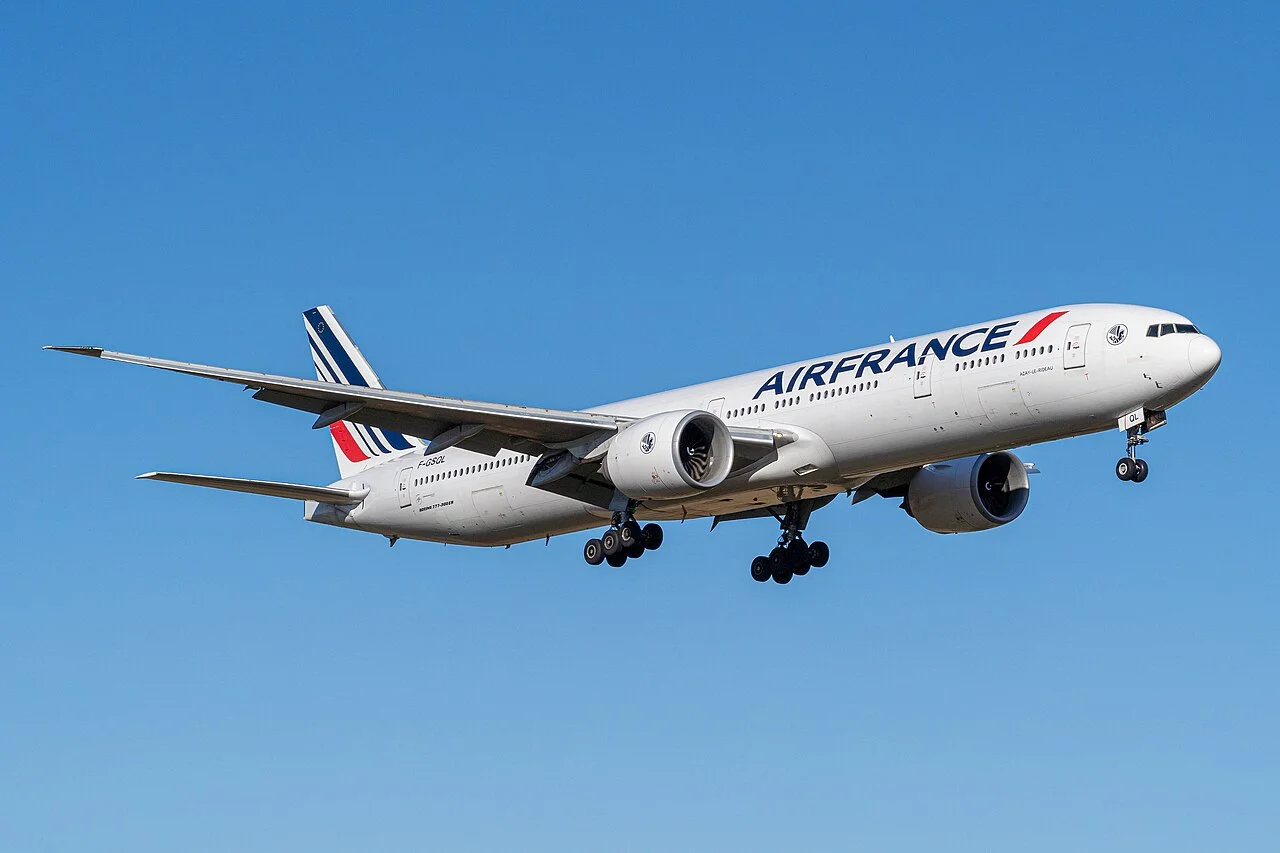
Air France 777-300 F-GSQL landing at Tarbes.
Hugo LUC · CC BY-SA 4.0 · Source and credits · 2026-09-13

View full-size · Original imageResized WebP display copy.

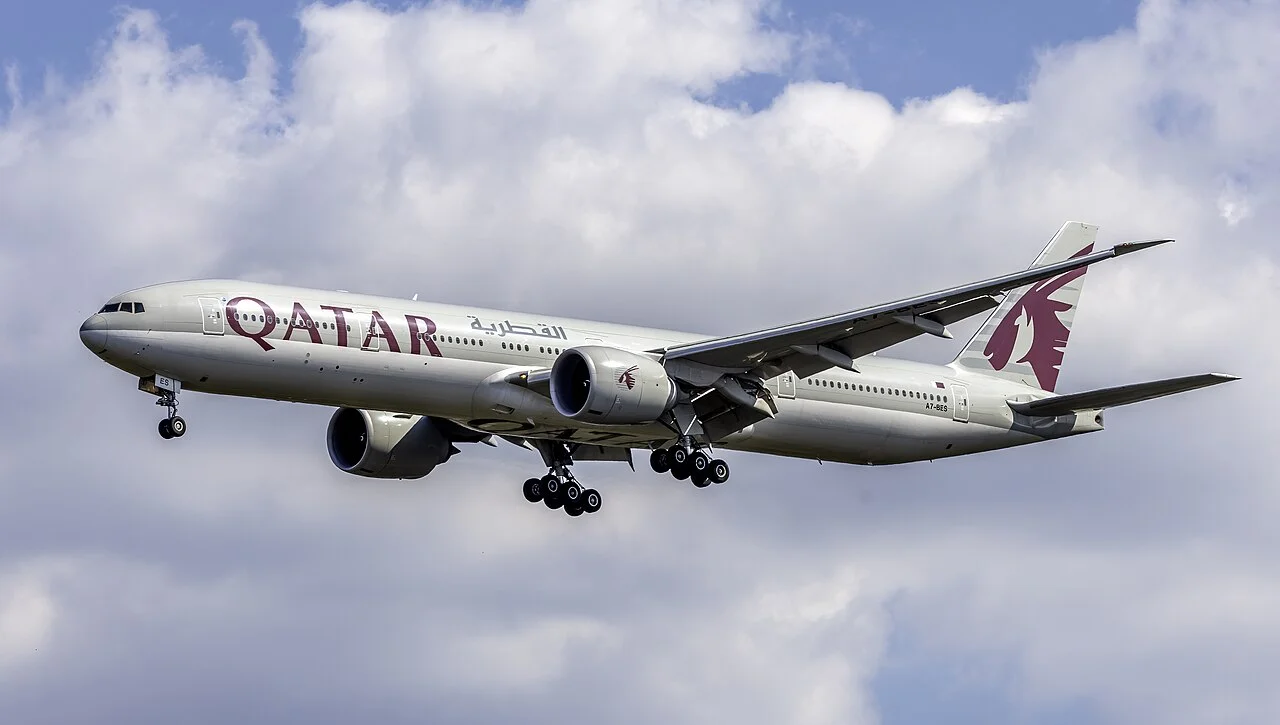
Qatar Airways 777-300ER A7-BES on approach.
Acroterion · CC BY-SA 4.0 · Source and credits · 2025-09-12

View full-size · Original imageResized WebP display copy.

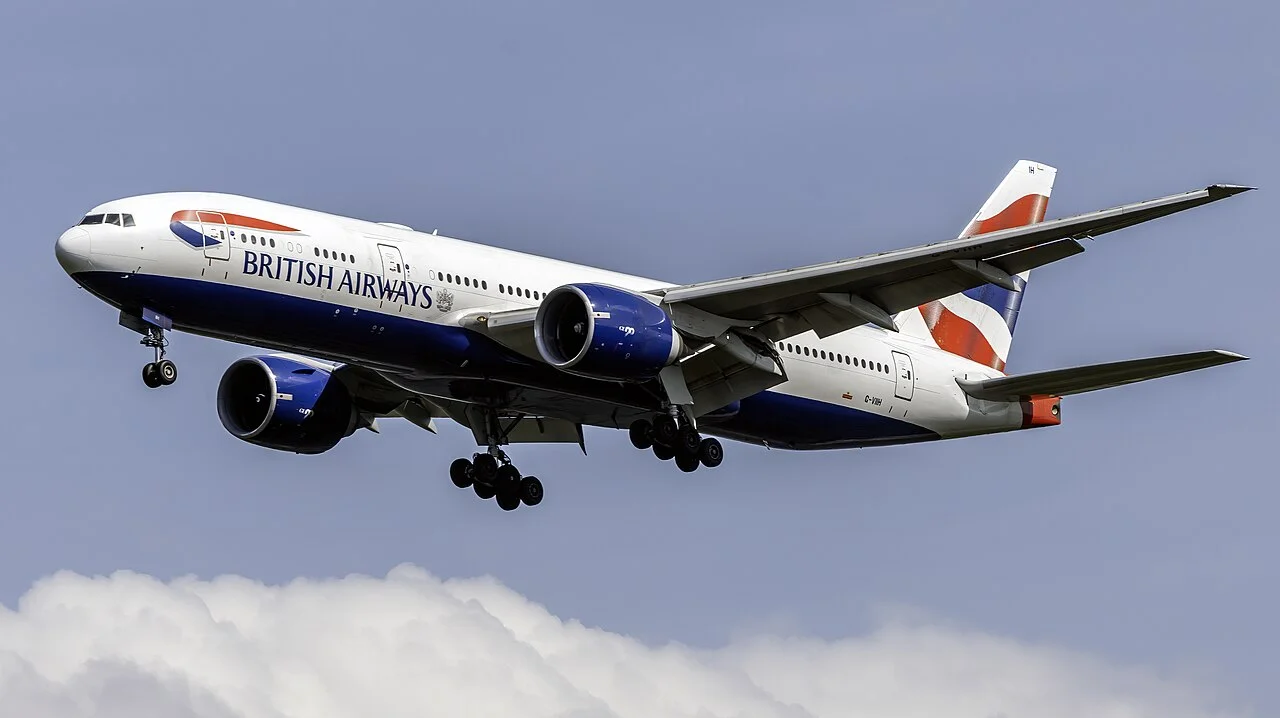
British Airways 777-200ER G-VIIH. Compare its shorter fuselage with the -300ER.
Acroterion · CC BY-SA 4.0 · Source and credits · 2025-04-30

View full-size · Original imageResized WebP display copy.

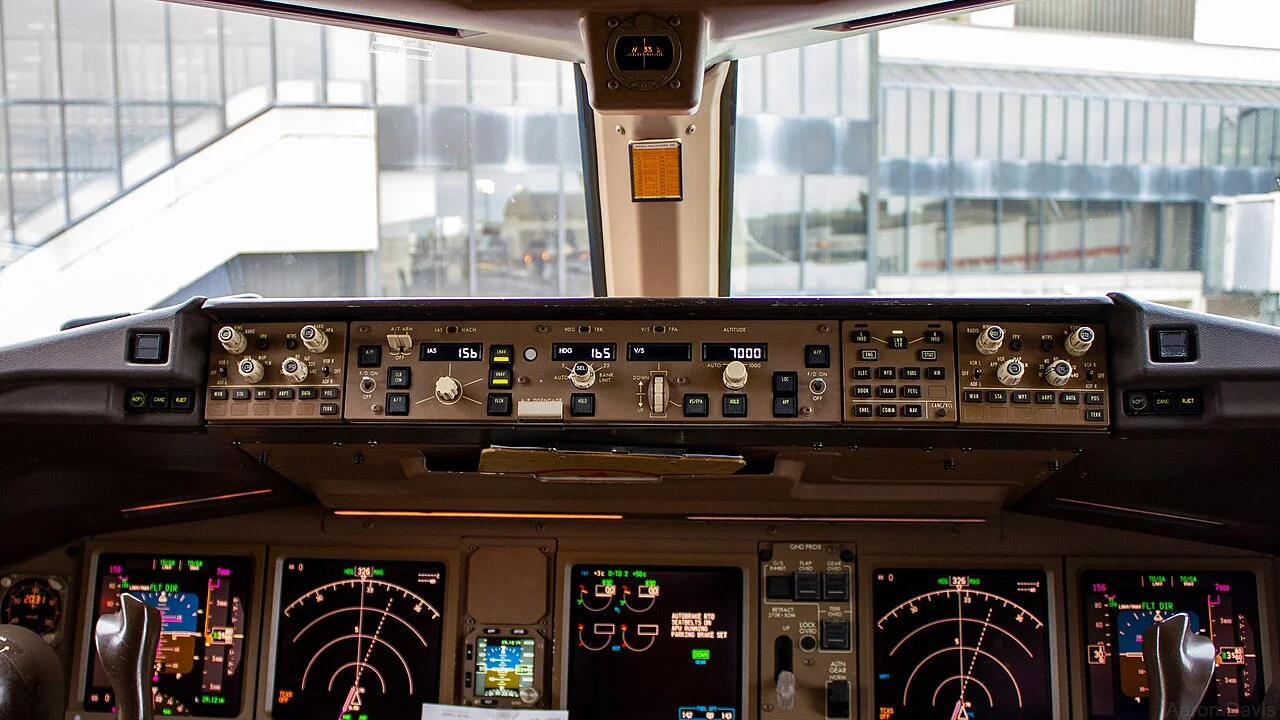
A real 777-200LR flight deck, with control yokes and digital displays.
Aaron Davis · CC BY-SA 4.0 · Source and credits · 6 January 2019

View full-size · Original imageResized WebP display copy.

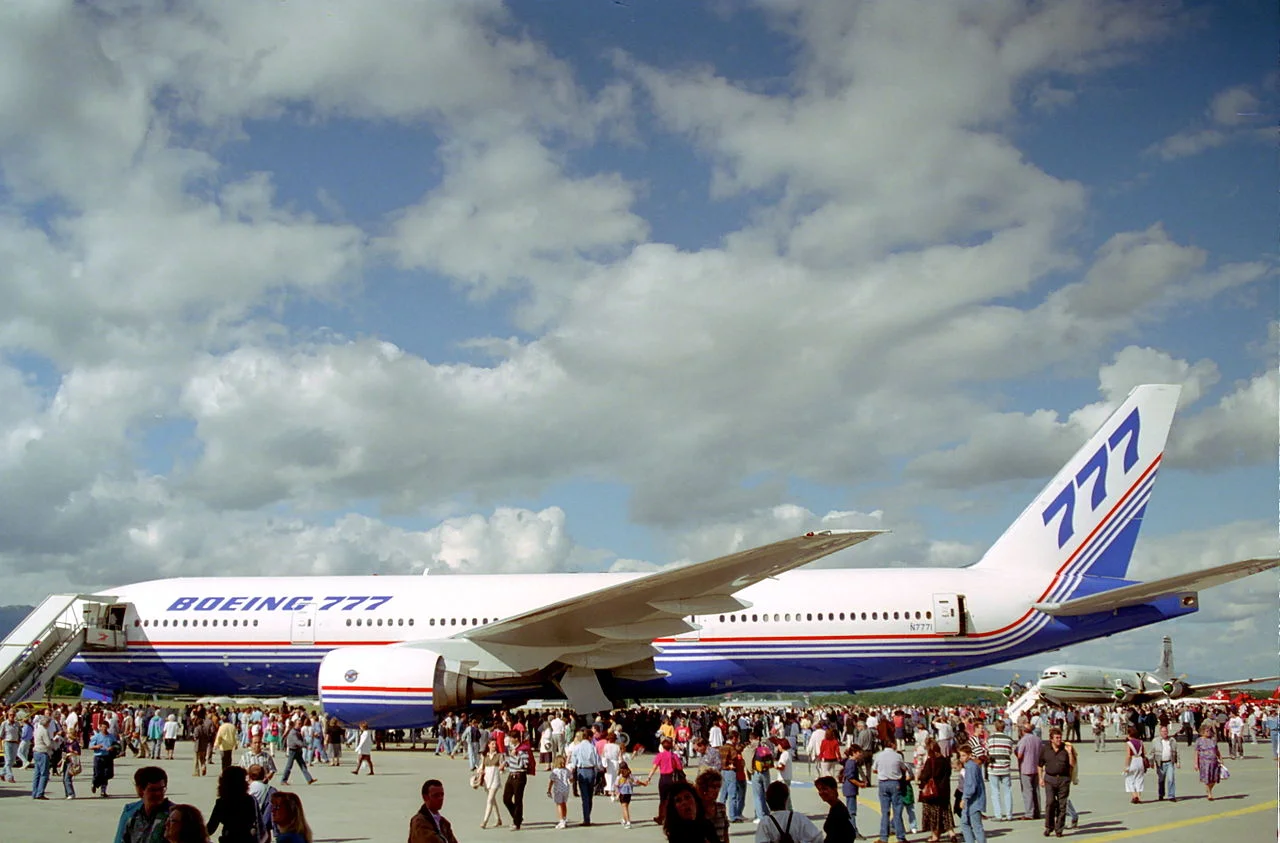
Boeing’s original 777 test aircraft N7771 at Geneva on 9 September 1995.
Aero Icarus from Zürich, Switzerland · CC BY-SA 2.0 · Source and credits · 1995-09-09 00:00

View full-size · Original imageResized WebP display copy.

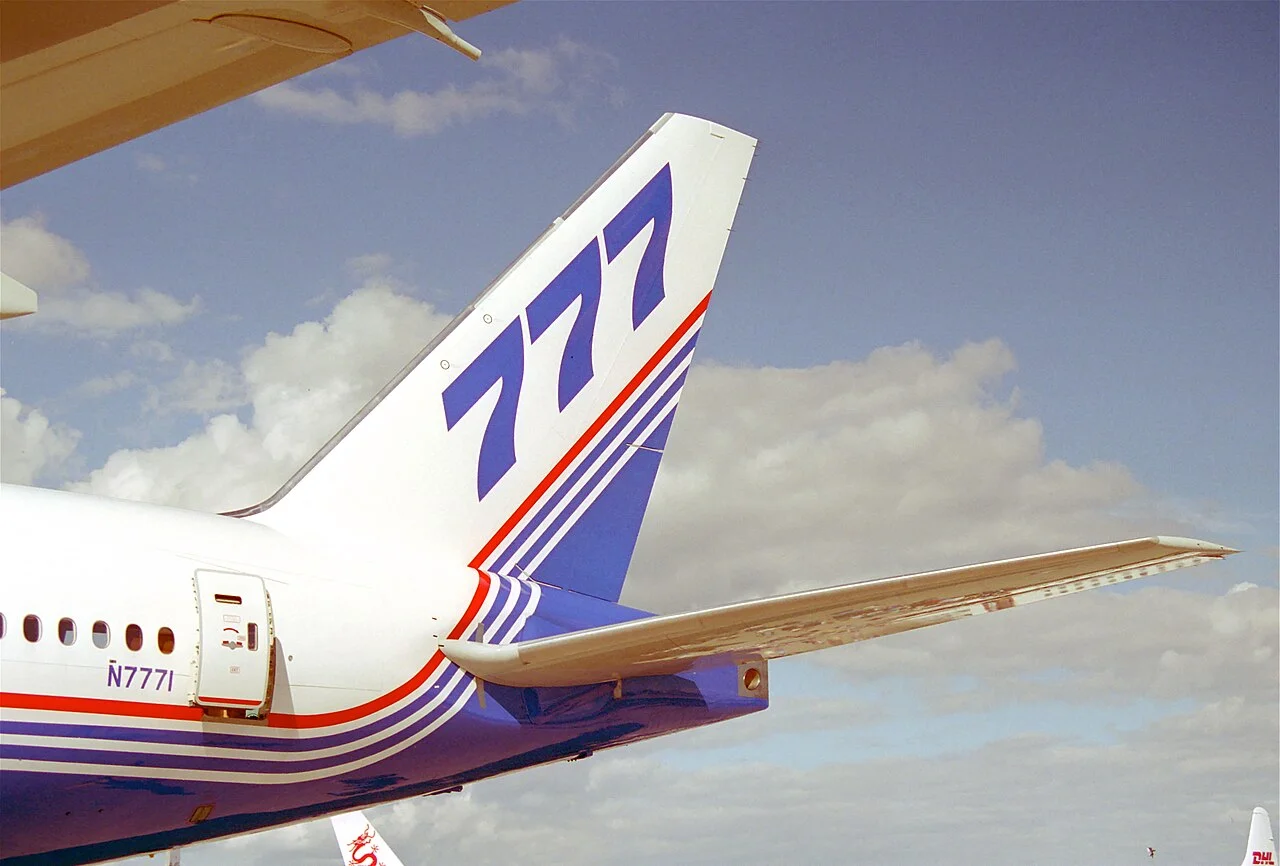
The tail of N7771 at Geneva in 1995, with its original Boeing 777 branding.
Aero Icarus from Zürich, Switzerland · CC BY-SA 2.0 · Source and credits · 1995-09-09 00:00

View full-size · Original imageResized WebP display copy.

Drawings and original documents
Existing published drawings are credited below. These are reference illustrations, not manufacturing blueprints.
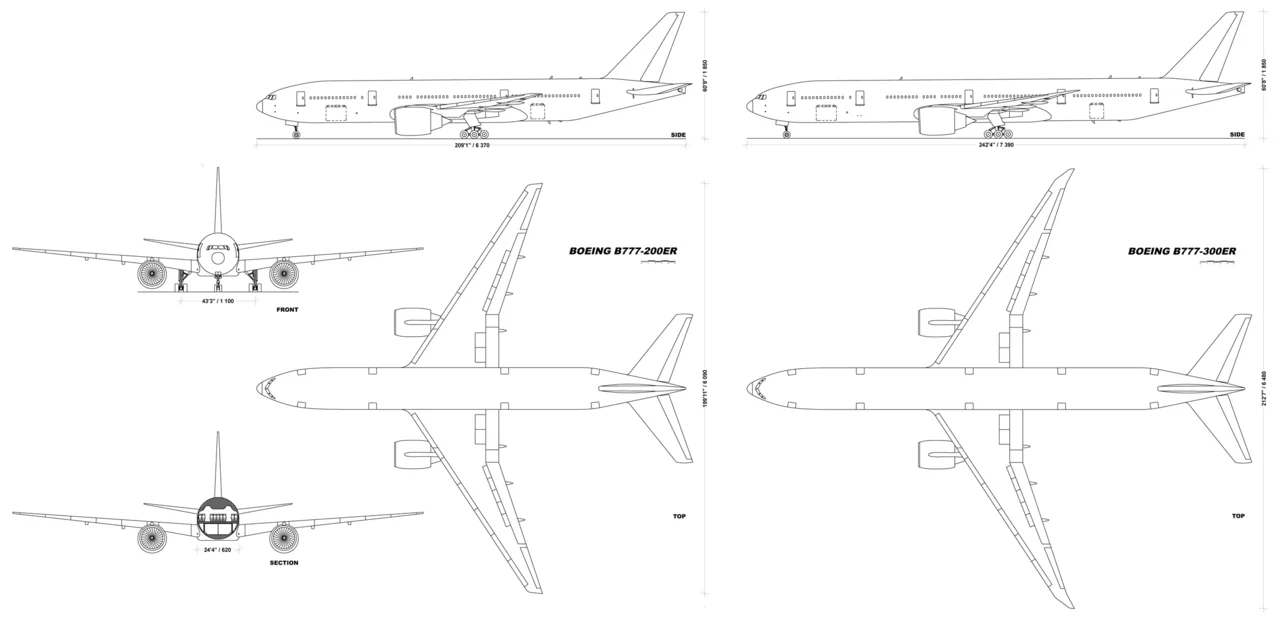
Julien Scavini’s reference drawing compares 777-200 and -300 layouts. These are published reference views, not factory blueprints.
Julien.scavini · CC BY-SA 3.0 · Source and credits · 2014-07-16

View full-size · Original imageResized WebP display copy.

- 777-200LR, 777-300ER and 777F airport planning drawings, December 2024
Boeing’s manufacturer drawings compare the long-range passenger jets and freighter, with dimensioned plans, ground clearances and airport service layouts.
- Boeing historical chronology
Boeing’s official chronology records the original 777’s 12 June 1994 first flight and its place in the company’s aircraft-development history.
- Everett’s 3,000th widebody, August 2007
A contemporary factory milestone report: the 3,000th Everett-built widebody was a 777-200ER delivered to Korean Air.
See one for yourself
Skylark shows what is flying over Ireland right now, and the iPhone app points you at it. Next time you hear engines, look for the B772 or B77L or B773 or B77W or B778 or B779 code.
Sources
Facts checked against these sources on 28 September 2026. Numbers that change over time, such as orders and fleet sizes, are as of the date given beside them.
- 6/12/1994: The first flight of the Boeing 777Airways Magazine
- Boeing marks 30th anniversary of first 777 deliveryAeroTime
- Boeing 777-300 achieves historic industry certificationBoeing
- First Boeing 777-300ER delivers to Air France, ILFCBoeing
- Boeing's massive wing-folding 777X just flew for the first timePopular Science
- FAA waives emissions rules to let Boeing sell 35 additional 777F freightersReuters, via Business Standard
- Order JO 7360.1, Aircraft type designatorsFAA
- BOEING 777-8, B778, ICAO type designatorDoc8643.com
- BOEING 777-9, B779, ICAO type designatorDoc8643.com
- Boeing 767Aircraft Recognition Guide
- Boeing 787Aircraft Recognition Guide
- Emirates unveils retrofitted Boeing 777 on Dublin routeDublin Gazette
- ETOPS: history, evolution, current applicationsAirways Magazine
- Boeing 777Aircraft Recognition Guide
- Boeing historical chronologyBoeing
- Boeing Delivers 3,000th Everett-built Widebody AirplaneBoeing
How often does Skylark see it?
Read the existing Ireland observation log to see the days each type appeared. This is what Skylark recorded, with the coverage its receivers and providers supplied; it is not a census of Irish aircraft or a prediction of your next sighting.
One aircraft seen on three different days contributes three airframe-days. Repeated reports on the same day count once. Codes are shown separately, without adding them into a family total. A logged day does not mean continuous coverage throughout that day.
Observations load when you request them.