

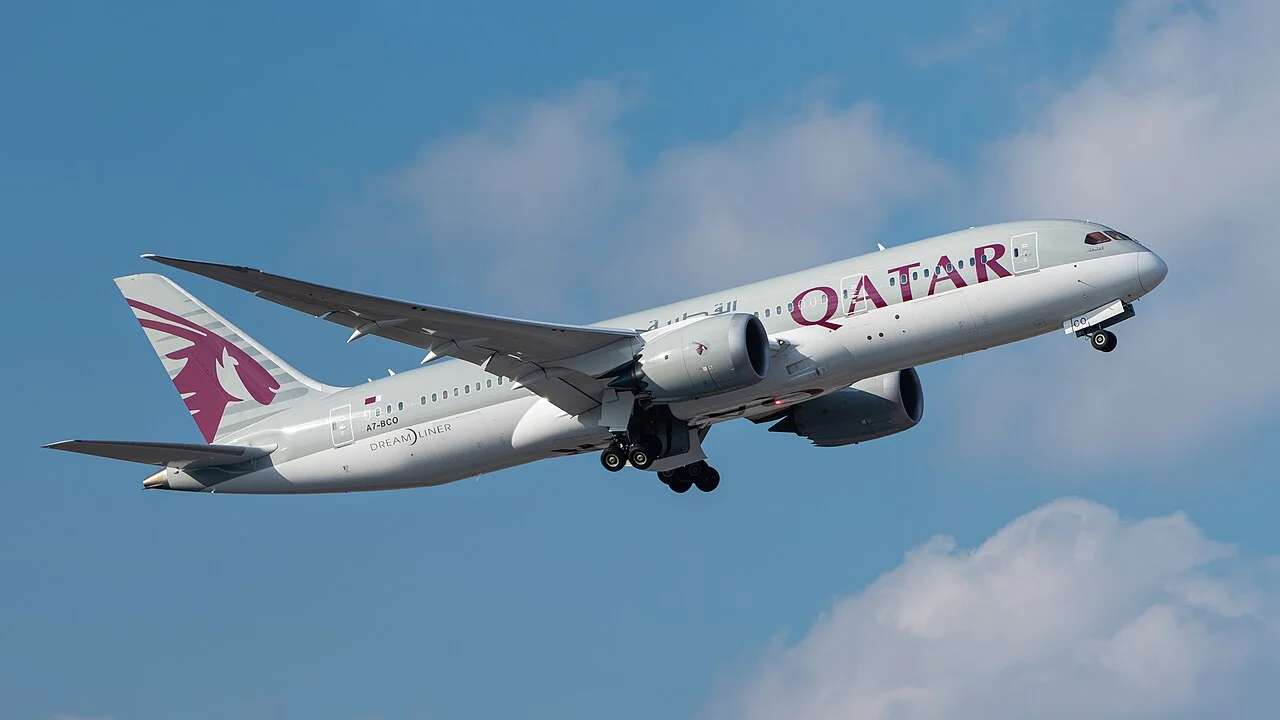


Recognise it overhead
Recognition clues checked 30 September 2026
- Cockpit windows
- Four cockpit windows, compared with six on the 767, 777 and A350. [9]
- Engine rear edge
- The nacelles have serrated fan exhaust edges; combine this with the cockpit and wing shape. [9]
- Wings
- Long wings curve upward and end in swept-back raked tips, rather than the A350's upturned winglets. [9]
- Variant clue
- Between the first two doors, roughly 10 cabin windows suggest -8, 15 suggest -9 and 20 suggest -10; confirm the variant separately. [9]
Use several visible clues together. If a detail is too far away to see, leave it uncertain.
Could also be: Boeing 777, Boeing 767, Airbus A350
Key facts
The Boeing 787 looks as if it was drawn rather than riveted together. The nose is smooth, the wings curve upward in flight, and the engines have saw-toothed back edges [8] [9]. That impression is not far off: Boeing says about half of the airframe, by weight, is made of composite materials rather than metal [3].
It is a twin-engine widebody, and it comes in three sizes [7] [8]. The giveaways that separate it from other big twins are the nose, the wingtips and the engines, which is handy, because those are exactly the parts you can see from a garden.
A slow start to a fast seller
The first 787 took off from Paine Field in Everett, Washington, at 10.27 on 15 December 2009, and landed at Boeing Field in Seattle about three hours later, with Mike Carriker and Randy Neville at the controls [1]. By then 55 customers had ordered 840 of them, and Boeing was calling it the fastest-selling new commercial jetliner in history [1].
Getting one to an airline took longer. All Nippon Airways, which launched the programme in April 2004 with an order for 50, received the first aircraft on 26 September 2011 [2]. The original target had been May 2008. The date slipped seven times, which Airways Magazine puts down to engineering and supply chain problems and a 58-day strike in 2008 [2].
The early years in service were not smooth either. In January 2013 the US Federal Aviation Administration issued an emergency airworthiness directive after lithium-ion battery failures released flammable electrolyte, heat and smoke. By 17 January all 50 of the 787s then flying, worldwide, were on the ground [6].
Three sizes
The family comes in three lengths, each with its own type code: the 787-8 (B788), the 787-9 (B789) and the 787-10 (B78X) [7].
- The 787-8 is the shortest of the three [4] [9].
- The 787-9 first flew on 17 September 2013, on a flight of five hours and 16 minutes [4]. Its fuselage is 20 feet (6 metres) longer than the 787-8's, and it carries 40 more passengers with 300 nautical miles more range [4].
- The 787-10 stretches the 787-9 by about another 6 metres [9], with more than 95% commonality between the two [5]. It seats about 330 in a two-class layout, some 40 more than the 787-9 [5]. Singapore Airlines took the first one on 25 March 2018 [5].
Boeing's 787 page said more than 1,270 had been delivered when we checked it in September 2026 [3].
What the passengers notice
The composite structure lets Boeing keep the cabin pressurised to the equivalent of 6,000 feet, and it runs at higher humidity than older jets [3]. Boeing also says the windows are the largest of any widebody flying today [3]. For the airlines, Boeing's pitch is a 25% cut in fuel use compared with the aircraft the 787 typically replaces [3].
How to spot one
- The nose. The 787 has four large, rounded cockpit windows, where Boeing's other widebodies have six angular ones, and the cockpit blends smoothly into the nose [8] [9].
- The engines. The rear edges of the engine nacelles are cut into serrated chevrons, a design feature Boeing uses to cut noise [3] [8].
- The wings. They curve upward and finish in raked wingtips rather than upturned winglets [9].
- The tail. The back end of the fin points slightly upward, a so-called shark tail, which the 777-8 and 777-9 share [9].
- Which size? Count the cabin windows between the first two sets of doors: about 10 on a 787-8, about 15 on a 787-9 and about 20 on a 787-10 [9].
Types it can be mistaken for:
- A Boeing 767 has six cockpit windows, plain engine exhausts, no shark tail, and main landing gear bogies that tilt forward when the aircraft is airborne [8] [9].
- A Boeing 777 has six cockpit windows, six wheels on each main landing gear and a flat tail cone [8] [9].
- An Airbus A350 is a similar size to the 787-9 and 787-10, but it has six cockpit windows, curved winglets and no serrated engine exhausts. The A350-1000 also has six wheels on each main gear [9].
Over Ireland
Dublin has had 787s on its long-haul routes since at least 2019 [10] [11]. United Airlines announced in November 2018 that it would put the 787-10 on its Newark to Dublin service from May 2019 [10]. Etihad Airways brought the 787-9 to its Dublin to Abu Dhabi route in the summer of 2019 [11]. For summer 2025, United replaced the Boeing 757-200 on its seasonal Dublin to Chicago O'Hare route with a 787-8 [12].
Airline schedules change from season to season, so treat these as examples of where the type turns up rather than a timetable. The live map is the better guide to what is overhead tonight.
From the archive
The first Dreamliner departed before an estimated 12,000 employees and guests; Boeing’s plan called for six test aircraft flying around the world. [1]
Its first flight used Rolls-Royce Trent 1000 engines, while two of the six planned test aircraft were to use General Electric GEnx engines. [1]
In photographs
Look closer at the shapes, details and liveries. Every photograph links to its original and credits its creator.
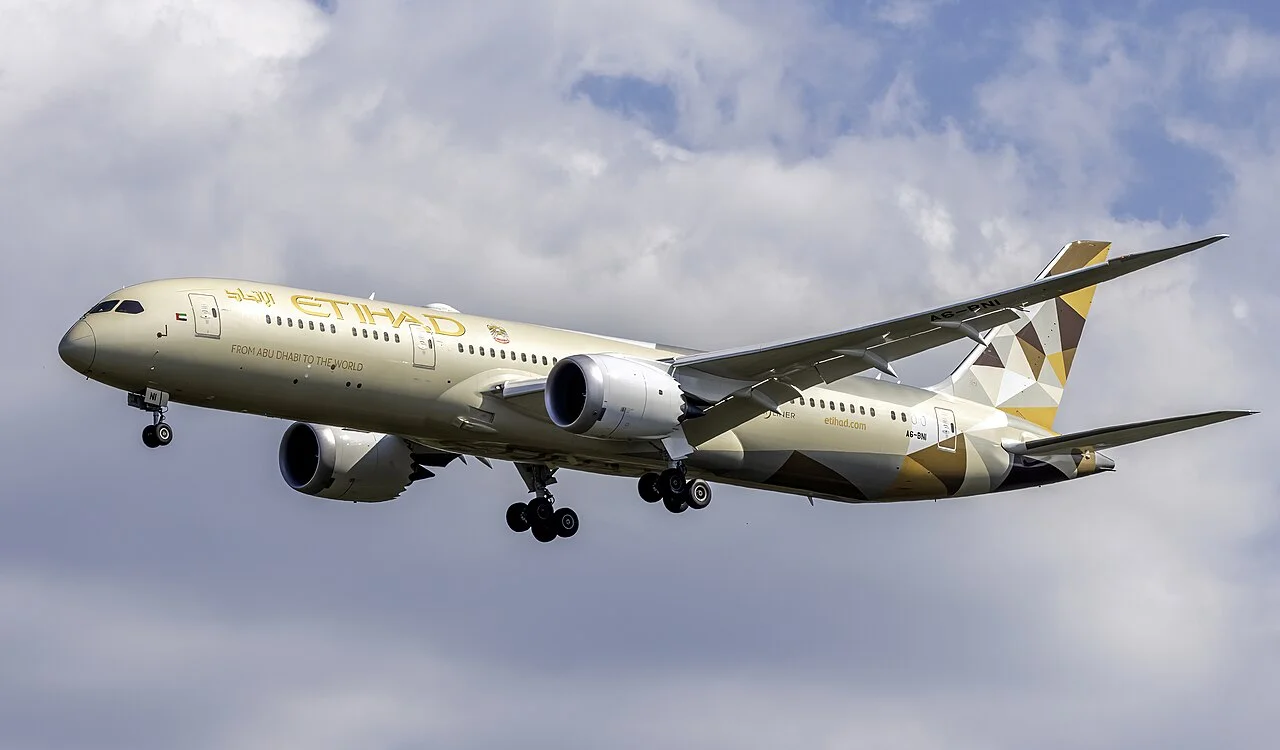
Etihad 787-9 A6-BNI on approach. Compare its longer body with the -8.
Acroterion · CC BY-SA 4.0 · Source and credits · 2025-09-12

View full-size · Original imageResized WebP display copy.

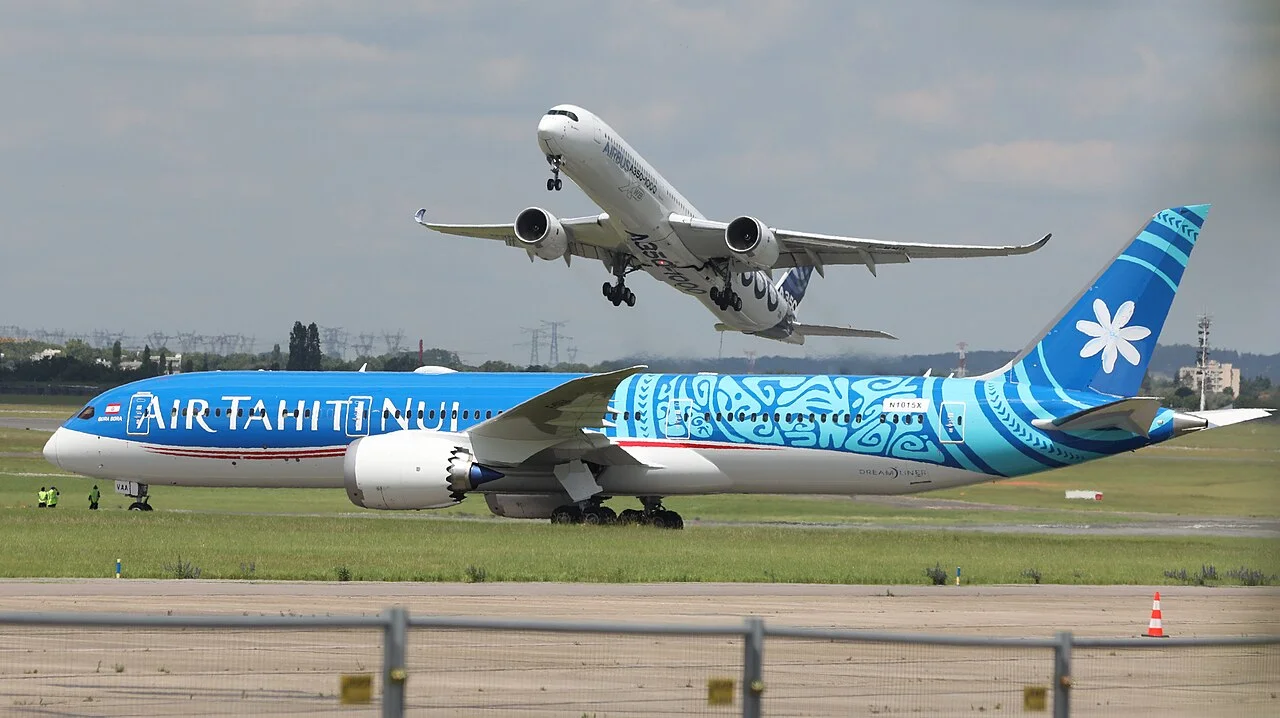
Air Tahiti Nui 787-9 N1015X, with its swept wing visible.
New York-air · CC BY-SA 4.0 · Source and credits · 2019-06-17

View full-size · Original imageResized WebP display copy.

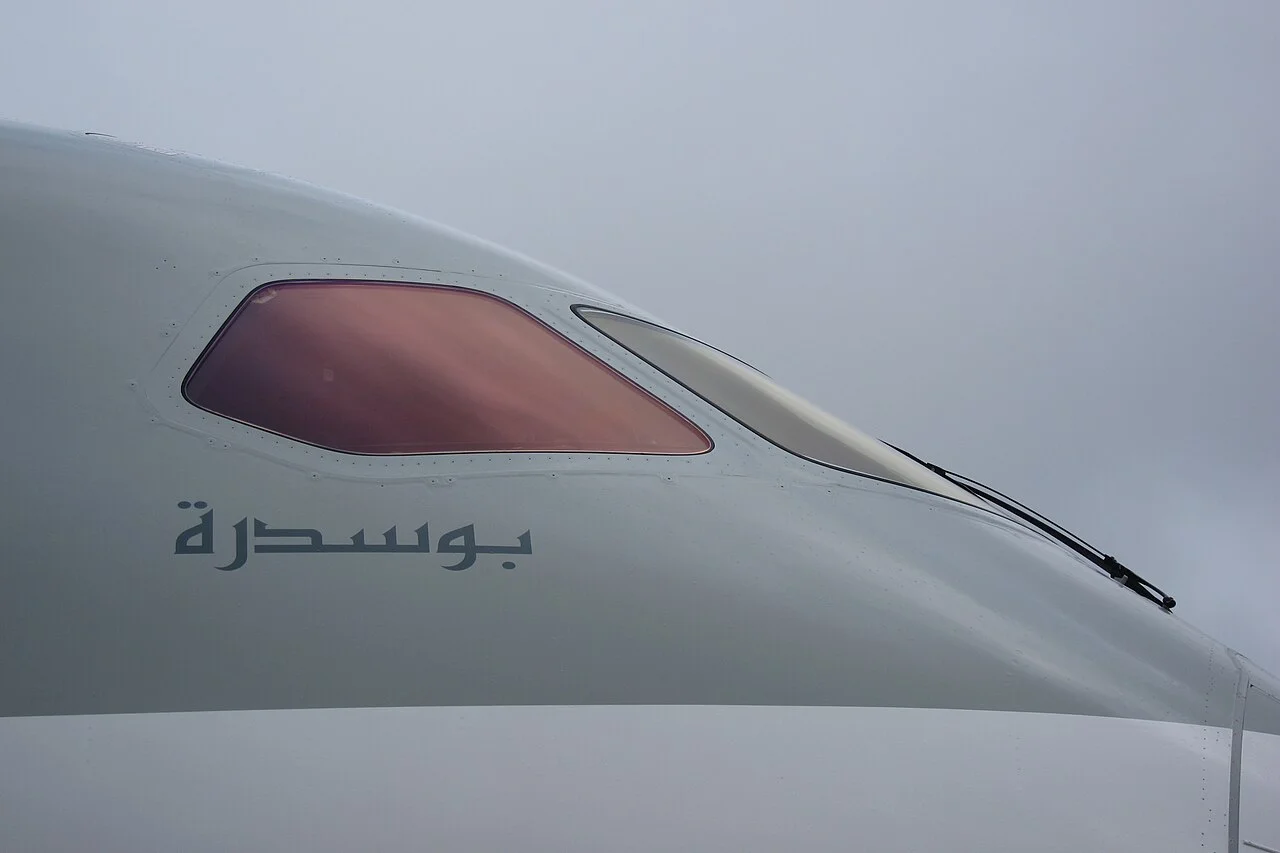
A close-up of the 787 cockpit windows and nose.
Olivier Cleynen · CC BY-SA 3.0 · Source and credits · 2013-06-20 10:22:06

View full-size · Original imageResized WebP display copy.

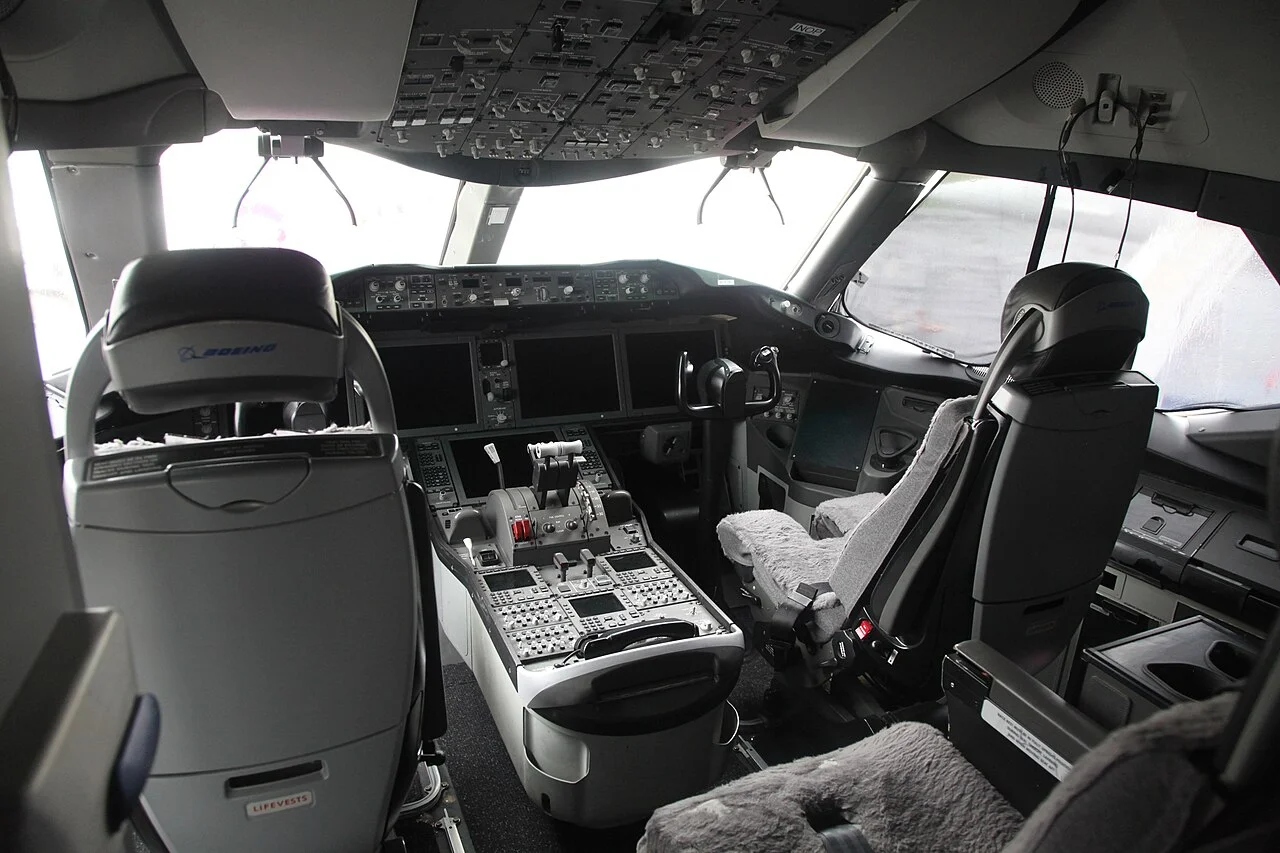
Inside a real 787 flight deck, with large displays and traditional control yokes.
dschwen · CC BY-SA 3.0 · Source and credits · 2015-03-23

View full-size · Original imageResized WebP display copy.

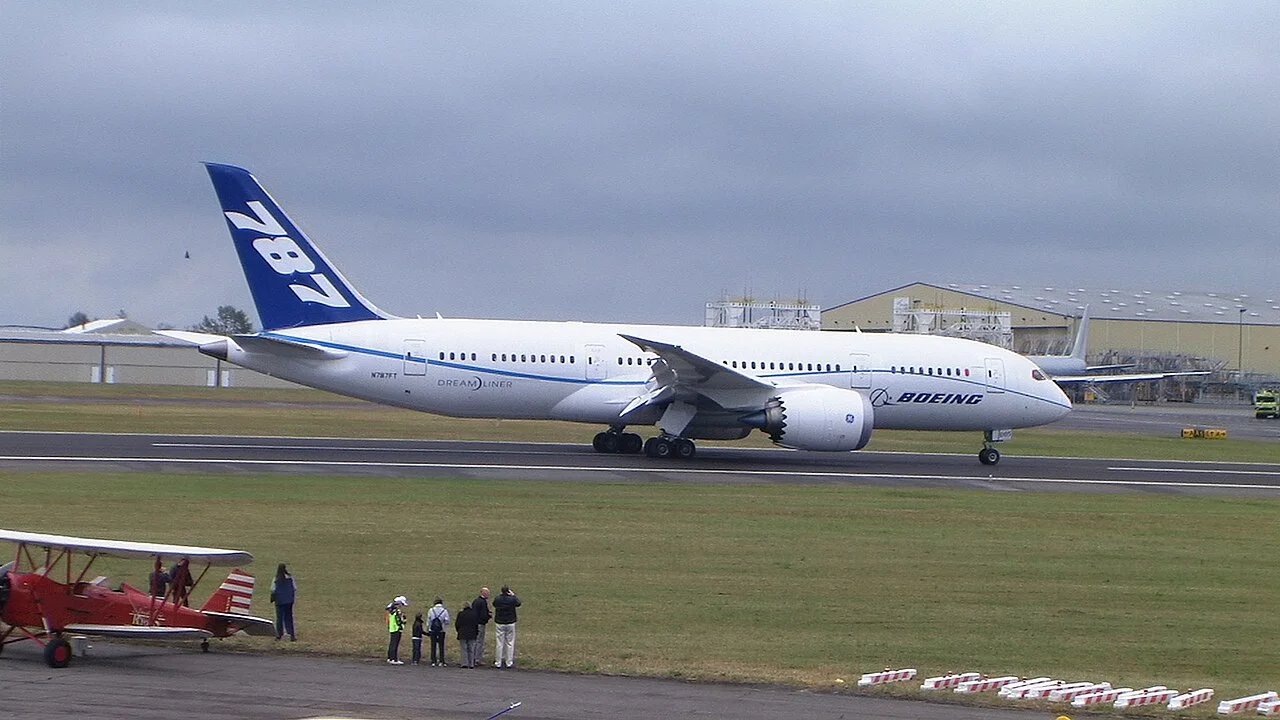
A prototype 787-8 in Boeing colours during the flight-test period.
Clemens Vasters from Viersen, Germany · CC BY 2.0 · Source and credits · 2010-09-04 12:17

View full-size · Original imageResized WebP display copy.

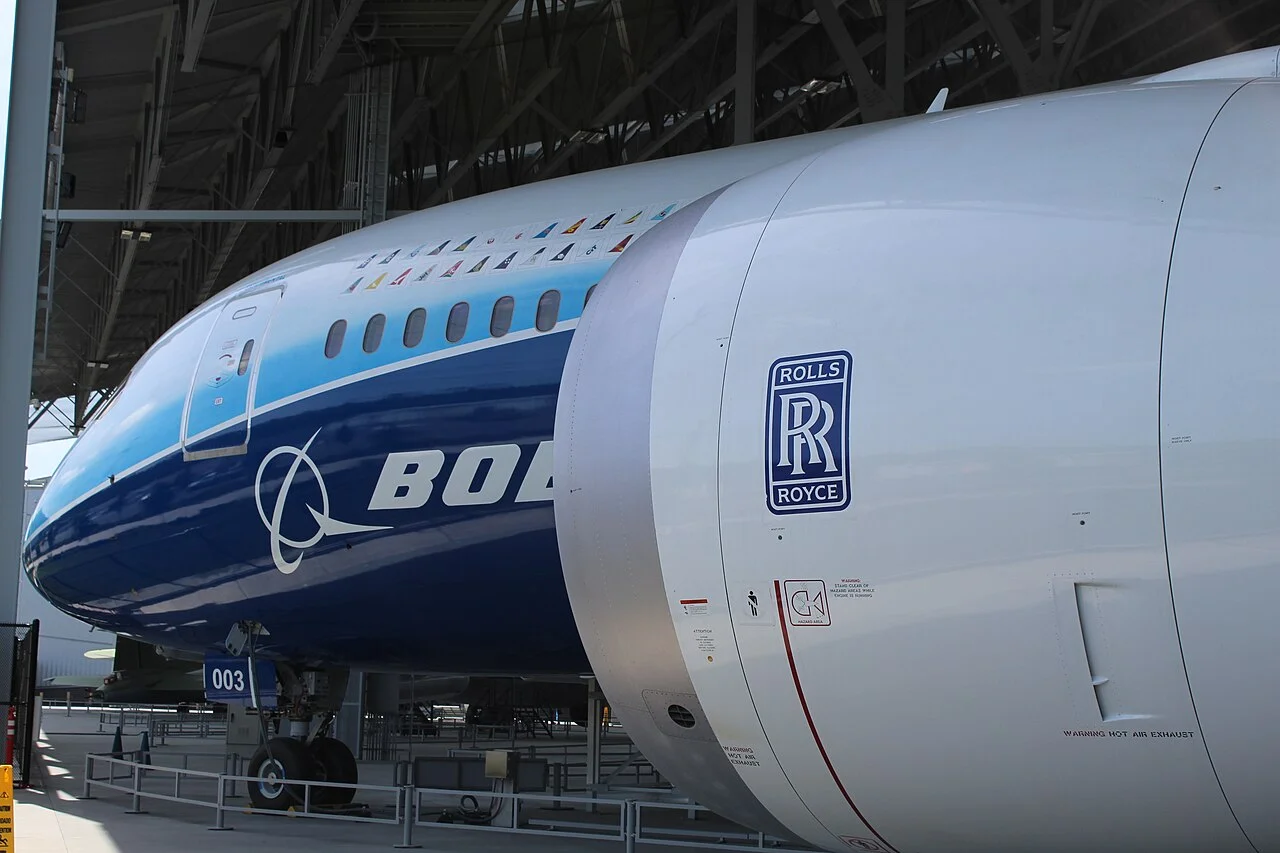
A closer view of a prototype 787’s Rolls-Royce engine.
HollywoodGuard · CC BY-SA 4.0 · Source and credits · 2019-06-04

View full-size · Original imageResized WebP display copy.

Drawings and original documents
Existing published drawings are credited below. These are reference illustrations, not manufacturing blueprints.
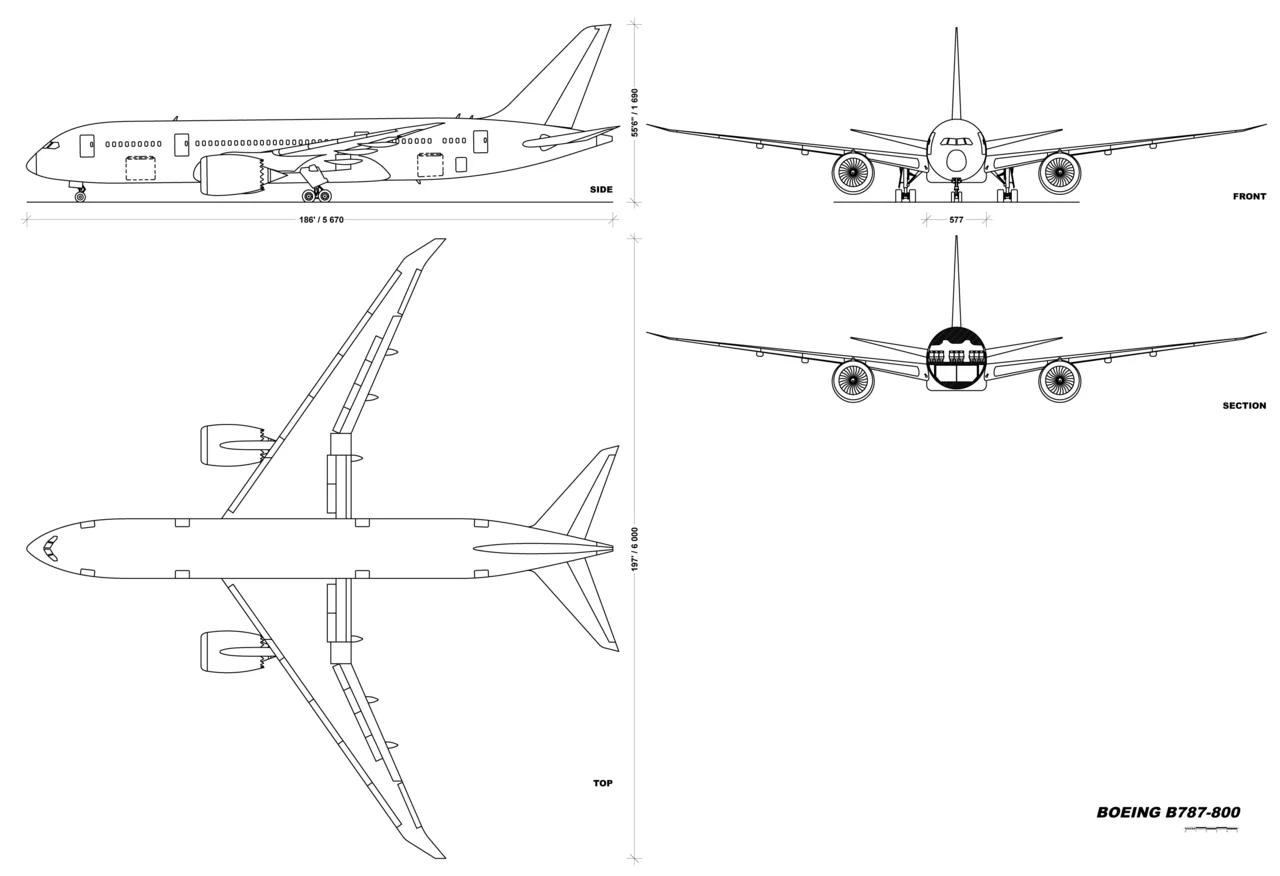
Julien Scavini’s published three-view reference drawing of the 787-8. It is not an original factory blueprint.
Julien.scavini · CC BY-SA 3.0 · Source and credits · 2011-12-12

View full-size · Original imageResized WebP display copy.

- 787-8, 787-9 and 787-10 airport planning drawings, October 2025
Boeing’s planning manual compares all three Dreamliner lengths, their dimensioned views, cabin arrangements and airport servicing requirements.
- The Dreamliner’s first flight, 15 December 2009
Boeing’s original first-flight report includes real photographs and the test pilots’ route, flight duration and early flight-test programme.
See one for yourself
Skylark shows what is flying over Ireland right now, and the iPhone app points you at it. Next time you hear engines, look for the B788 or B789 or B78X code.
Sources
Facts checked against these sources on 28 September 2026. Numbers that change over time, such as orders and fleet sizes, are as of the date given beside them.
- Boeing 787 Dreamliner completes first flightBoeing
- 9/26/2011: First Boeing 787 handed over to ANAAirways Magazine
- 787 Dreamliner by designBoeing
- Boeing flies first 787-9 DreamlinerBoeing
- Boeing delivers world's first 787-10 Dreamliner to Singapore AirlinesBoeing
- FAA grounds all 787 planes in the U.S. to seek a fix for battery issueNPR
- Order JO 7360.1, Aircraft type designatorsFAA
- Spotting the difference: the Boeing long-haulersFlightradar24
- Boeing 787Aircraft Recognition Guide
- United to deploy latest Dreamliner on Dublin routeThe Irish Times
- Etihad Airways introduces Boeing 787-9 Dreamliner on Dublin routeNorthern Ireland Travel News
- Dublin Airport welcomes United Airlines' expansion for summer 2025Dublin Airport
How often does Skylark see it?
Read the existing Ireland observation log to see the days each type appeared. This is what Skylark recorded, with the coverage its receivers and providers supplied; it is not a census of Irish aircraft or a prediction of your next sighting.
One aircraft seen on three different days contributes three airframe-days. Repeated reports on the same day count once. Codes are shown separately, without adding them into a family total. A logged day does not mean continuous coverage throughout that day.
Observations load when you request them.