

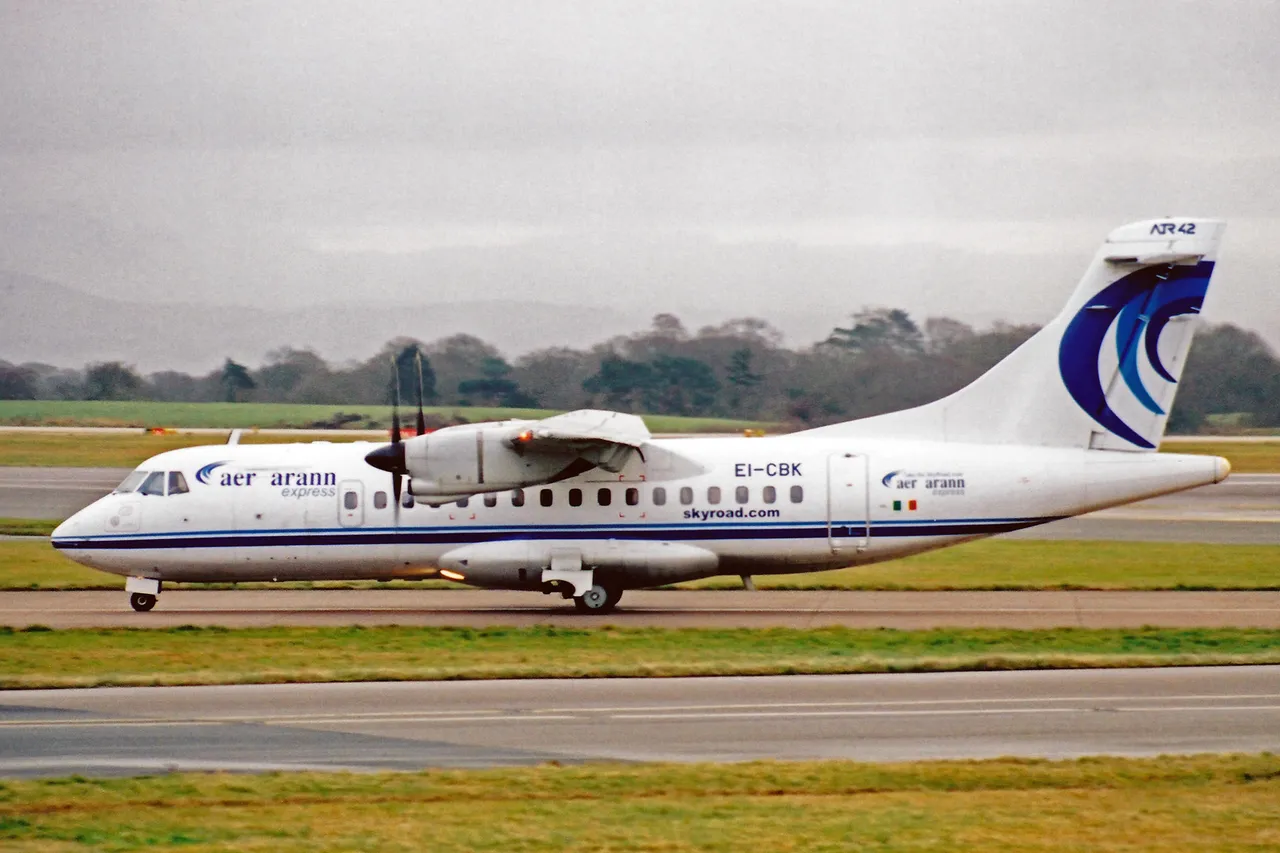


Recognise it overhead
Recognition clues checked 5 October 2026
- Windows
- Six passenger windows behind the wing on each side; an ATR 72 has ten [16]
- Cockpit
- Six cockpit windows, where a Bombardier-built Dash 8 has four [16]
Use several visible clues together. If a detail is too far away to see, leave it uncertain.
Could also be: ATR 72
Key facts
- ICAO type designators
- AT43, AT44, AT45, AT46 [1]
- First flight
- 16 August 1984 [2]
- Entry into service
- 3 December 1985, Air Littoral [3]
- First 42-600 delivery
- November 2012, Precision Air Services [5]
- Length (42-600)
- 22.67 m [4]
- Compared with the ATR 72
- Fuselage 4.5 m shorter [14]
- Short-runway 42-600S
- Development halted, November 2024 [13]
If a small airliner with its wing on top and a propeller on each side looks a little stubby, you may be looking at an ATR 42. It was the first aircraft ATR built [2], and the ATR 72 is its stretched sibling, with a fuselage 4.5 m longer [14].
The two are so alike that the only external difference between them is size [16]. That makes the 42 one of the harder aircraft to name from a garden. The good news is that there is a reliable trick, and it comes down to counting windows.
Where it came from
ATR began on 4 November 1981 as a joint venture between Aérospatiale of France and Aeritalia of Italy, the companies that later became part of Airbus and Leonardo [2]. The ATR 42 was the partners' first aircraft, and it first flew on 16 August 1984 [2]. It entered service with Air Littoral on 3 December 1985 [3].
Leonardo, the Italian half of the partnership, still builds the fuselages and tail parts in Italy [2].
One name, several generations
The 42 has been through several versions, and air traffic control still tells them apart. The FAA's list of aircraft type designators gives it four codes [1]:
- AT43: the ATR 42-300.
- AT44: the ATR 42-400.
- AT45: the ATR 42-500.
- AT46: the ATR 42-600.
So a flight-tracking app can tell you not only that you are looking at a 42 but which generation it belongs to.
The 42-600
The 42-600 is the newest of the four [1]. ATR announced the first delivery, to Precision Air Services, in a statement from Toulouse dated 9 November 2012 [5].
ATR's factsheet gives the 42-600's length as 22.67 m [4]. The 72-600 is 27.17 m long [15]. Those 4.5 m are the whole of the difference you are trying to see from the ground [14] [16].
Engines have moved on since that first delivery: Pratt & Whitney Canada has had a newer engine, the PW127XT-M, certified to power new-build ATR aircraft [6].
The short-runway 42-600S
For a few years ATR worked on a version of the 42 that could use very short runways. AIN reported in June 2017 that ATR was offering a short take-off and landing version of the 42-600 [7].
The idea, later sold as the 42-600S [8], drew 17 orders from three launch customers [9]. The lessor Elix Aviation Capital was named as one of them on 19 June 2019 [10], and Air Tahiti ordered two [11]. The selling point was runways just 800 m long [21], and ATR's product sheet promised "a shorter runway to wider horizons" [8].
AIN reported on 11 May 2022 that the 42-600S had flown for the first time in a partial configuration [12]. Then, in November 2024, ATR halted development of the short-runway variant to concentrate on its core products [13]. So the 42-600S is a programme that stopped, not a version you should expect to see.
Over Ireland
The 42 has an Irish chapter. In January 2012 Aer Arann painted its first ATR 42 in Aer Lingus Regional colours [18]. For a while, then, an Aer Lingus Regional turboprop over Ireland could be the shorter ATR.
Aer Lingus Regional today is a different story. Emerald Airlines flew its first Aer Lingus Regional route on 26 February 2022 [19], and it flies the bigger ATR 72-600 [20]. Our sources name no airline flying the 42 to Ireland now, so if you see a short ATR overhead, count the windows before you name it.
How to spot one
From the ground the ATR recipe is easy to learn: the wing sits on top of the fuselage, the tailplane sits on top of the fin in a T-tail, and each engine turns a propeller [17]. The main wheels fold into blister fairings low on the fuselage rather than into the engine nacelles [17]. The 42 and the 72 share all of that, because the only external difference between them is size [16].
ATR 42 or ATR 72? This is the hard one. Count the passenger windows behind the wing: the 42 has six on each side and the 72 has ten [16]. If you cannot count them, judge the proportions. With 4.5 m less fuselage [14], a 42 looks short and stocky beside its sibling.
The tracking code settles it when you have one: an ATR 42 shows as AT43, AT44, AT45 or AT46, while the 72's codes are AT72, AT73, AT75 and AT76 [1].
ATR or Dash 8? The De Havilland Canada Dash 8 is the other common regional turboprop. Its main wheels retract into long engine nacelles under the wing, where the ATR's tuck into the fuselage [16] [17]. Close up, the ATR has six cockpit windows where a Bombardier-built Dash 8 has four [16].
ATR or a regional jet? If there are no propellers and the engines hang under a low wing, you are looking at a jet doing a similar job, such as an Embraer E-Jet.
In photographs
Look closer at the shapes, details and liveries. Every photograph links to its original and credits its creator.
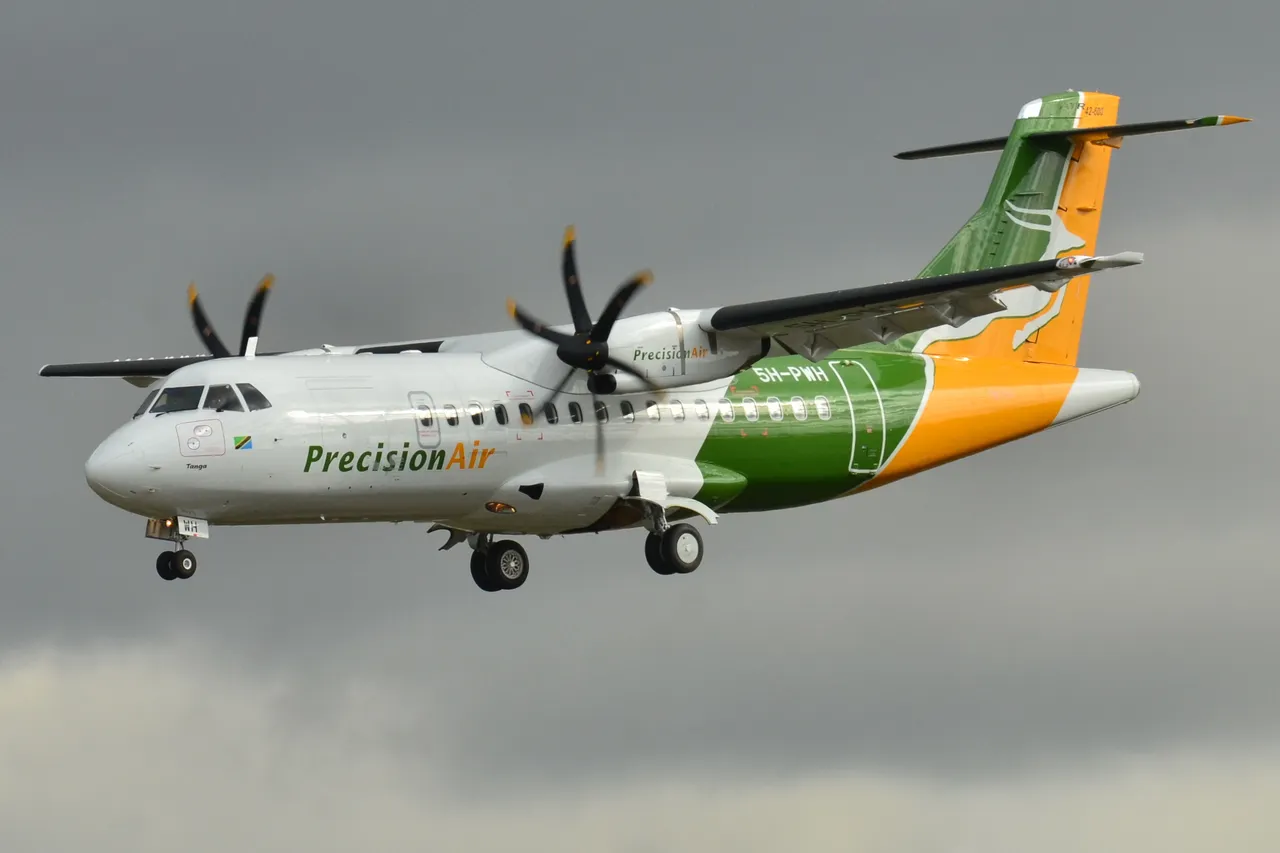
Precision Air ATR 42-600 5H-PWH at Toulouse-Blagnac; Precision Air took the first 42-600.
Laurent ERRERA from L'Union, France · CC BY-SA 2.0 · Source and credits · 2012-11-06 12:49

View full-size · Original imageResized WebP display copy.

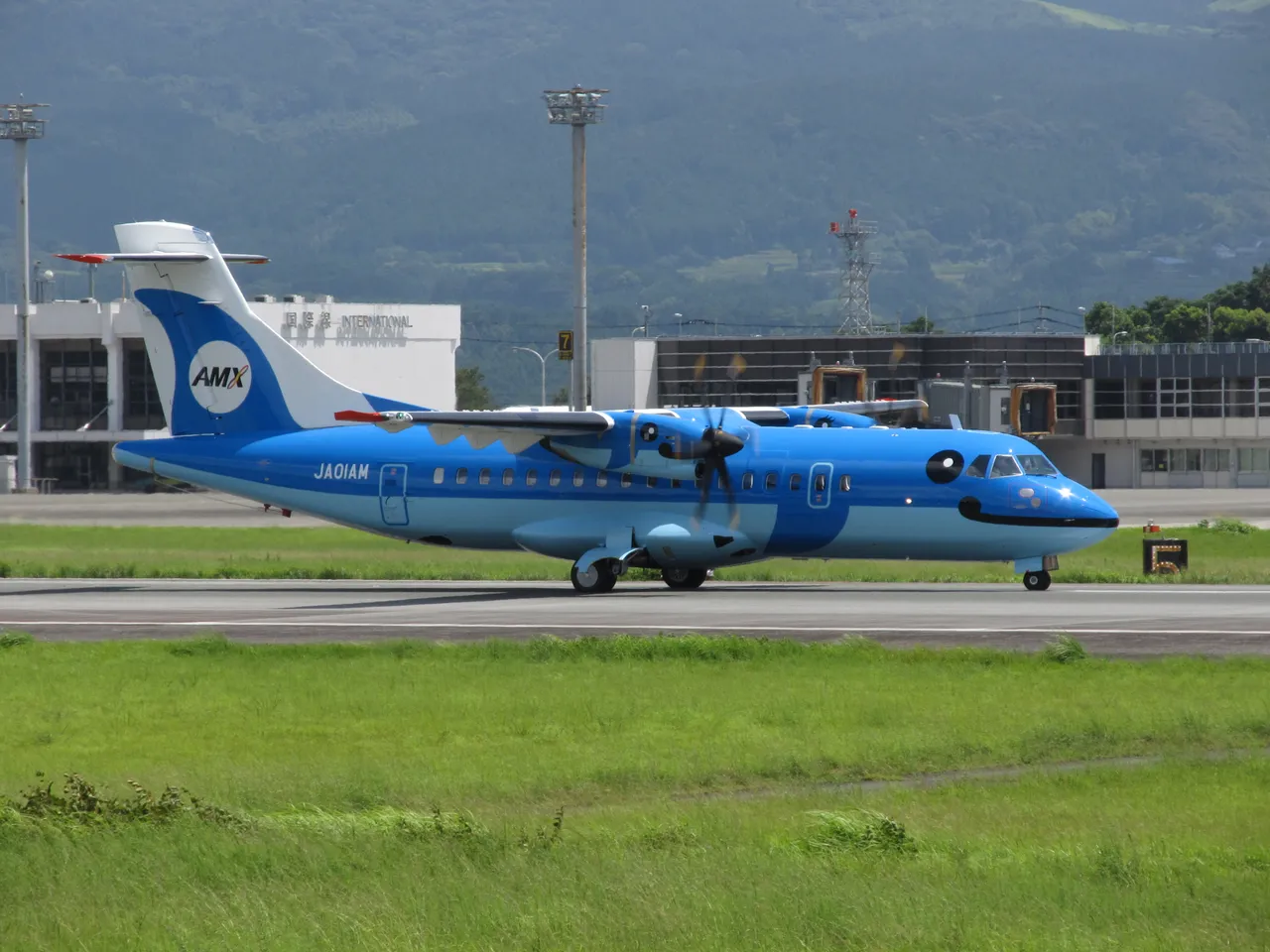
Amakusa Airlines ATR 42-600 JA01AM, with the main wheels housed in fairings on the lower fuselage.
Piggy1 This photo was taken with Canon PowerShot SX130 IS · CC BY-SA 4.0 · Source and credits

View full-size · Original imageResized WebP display copy.


The cabin of Amakusa Airlines ATR 42-600 JA01AM.
Yasu ( talk ) · CC BY-SA 3.0 · Source and credits · Taken on 10 February 2019

View full-size · Original imageResized WebP display copy.


Canadian North-First Air ATR 42-500 C-FTIL at Cambridge Bay Airport, showing the short, stocky fuselage.
CambridgeBayWeather · CC BY-SA 4.0 · Source and credits · 2019-10-22 14:06:28

View full-size · Original imageResized WebP display copy.

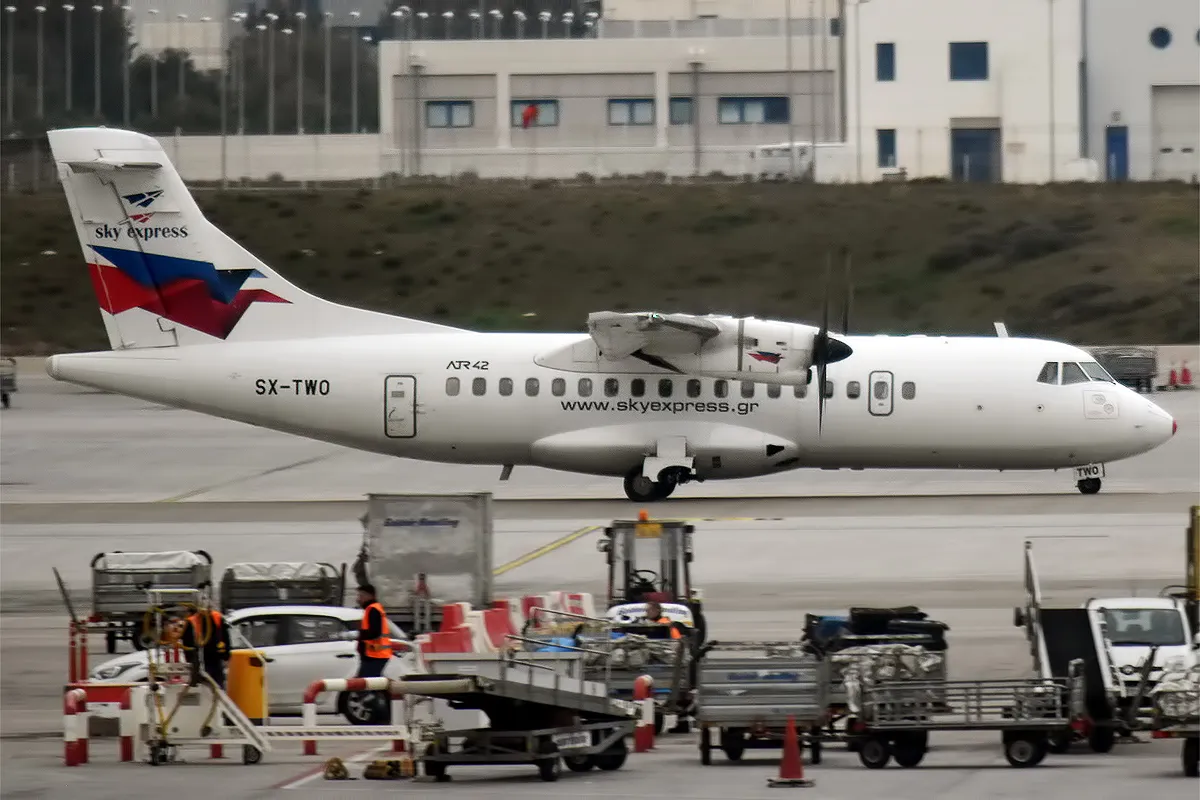
Sky Express ATR 42-500 SX-TWO at Athens in January 2020, with an engine under each side of the high wing.
Anna Zvereva from Tallinn, Estonia · CC BY-SA 2.0 · Source and credits · 2020-01-26 17:17

View full-size · Original imageResized WebP display copy.

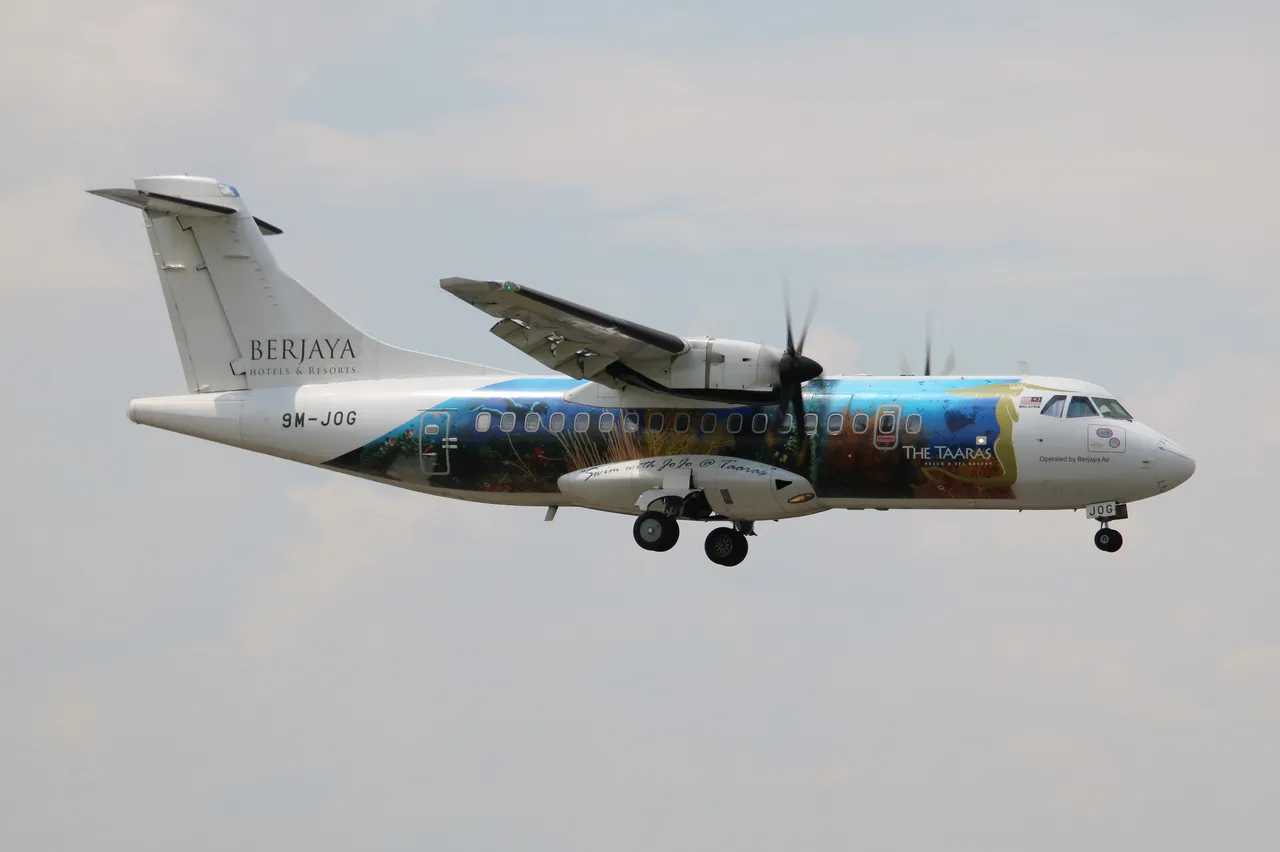
ATR 42-500 9M-JOG at Kuala Lumpur Subang Airport, with the main wheels housed in the lower fuselage.
Carl Knight · CC BY 4.0 · Source and credits · 2023-05-29 13:57:51

View full-size · Original imageResized WebP display copy.

Drawings and original documents
The manufacturer's drawing is on page 1 of ATR's own two-page 42-600 factsheet: a dimensioned three-view with the 22.67 m length, 24.57 m span and 7.59 m height. It is linked, not reproduced: reproduction rights stay with ATR. It is a product illustration, not a manufacturing blueprint.
- ATR 42-600 factsheet
ATR's two-page technical factsheet for the 42-600. Page 1 is a dimensioned drawing of the aircraft (length 22.67 m, span 24.57 m, height 7.59 m, propeller diameter 3.93 m, wing area 54.5 m²) with a 48-seat cabin layout at 30-inch pitch; page 2 lists the PW127M engines, Hamilton Standard 568F six-blade propellers, weights (maximum take-off 18,600 kg) and airfield performance.
- ATR 42-600S product sheet
ATR's two-page product sheet for the short take-off and landing 42-600S, headed "A shorter runway to wider horizons": PW127XT engines, operation from runways as short as 800 m, an enlarged rudder and ground spoilers, and a standard 48-seat layout at 30-inch pitch with cabin cross-section dimensions. It carries no dimensioned drawing of the aircraft.
See one for yourself
Skylark shows what is flying over Ireland right now, and the iPhone app points you at it. Next time you hear engines, look for the AT43 or AT44 or AT45 or AT46 code.
Sources
Facts checked against these sources on 5 October 2026. Numbers that change over time, such as orders and fleet sizes, are as of the date given beside them.
- Order JO 7360.1G, Aircraft Type DesignatorsFederal Aviation Administration
- ATR turns 40Leonardo
- 12/03/1985: ATR-42 enters service with Air LittoralAirways Magazine
- Factsheet: ATR 42-600ATR
- First ATR 42-600 delivered to Precision Air Services, Toulouse, 9 November 2012ATR
- Pratt & Whitney Canada receives certification of PW127XT-M engine to power new-build ATR aircraftSkies Mag
- ATR offering STOL version of 42-600 turboprop, 21 June 2017AIN
- ATR 42-600S product sheet: A shorter runway to wider horizonsATR
- ATR42-600 STOL attracts 17 orders from 3 launch customersch-aviation
- Elix Aviation Capital to become launch customer for ATR's new short take off and landing version, 19 June 2019AviTrader
- Air Tahiti orders two ATR 42-600 STOL aircraftATR
- ATR 42-600S flies for first time in partial configuration, 11 May 2022AIN
- ATR focuses on core products as STOL variant development halted, 14 November 2024AviTrader
- 10/27/1988: ATR 72 prototype takes to the skiesAirways Magazine
- ATR 72-600ATR
- Spotting the difference: regional aircraftFlightradar24
- ATR 72-600: specs, history and live trackingAviation Geeks
- Aer Arann paints its first ATR 42 in the Aer Lingus Regional colors, 19 January 2012World Airline News
- Emerald flies first Aer Lingus Regional routeThe Irish Times
- Our servicesEmerald Airlines
- Wow: the ATR 42 can now land on runways just 800m longSimple Flying
How often does Skylark see it?
Read the existing Ireland observation log to see the days each type appeared. This is what Skylark recorded, with the coverage its receivers and providers supplied; it is not a census of Irish aircraft or a prediction of your next sighting.
One aircraft seen on three different days contributes three airframe-days. Repeated reports on the same day count once. Codes are shown separately, without adding them into a family total. A logged day does not mean continuous coverage throughout that day.
Observations load when you request them.