

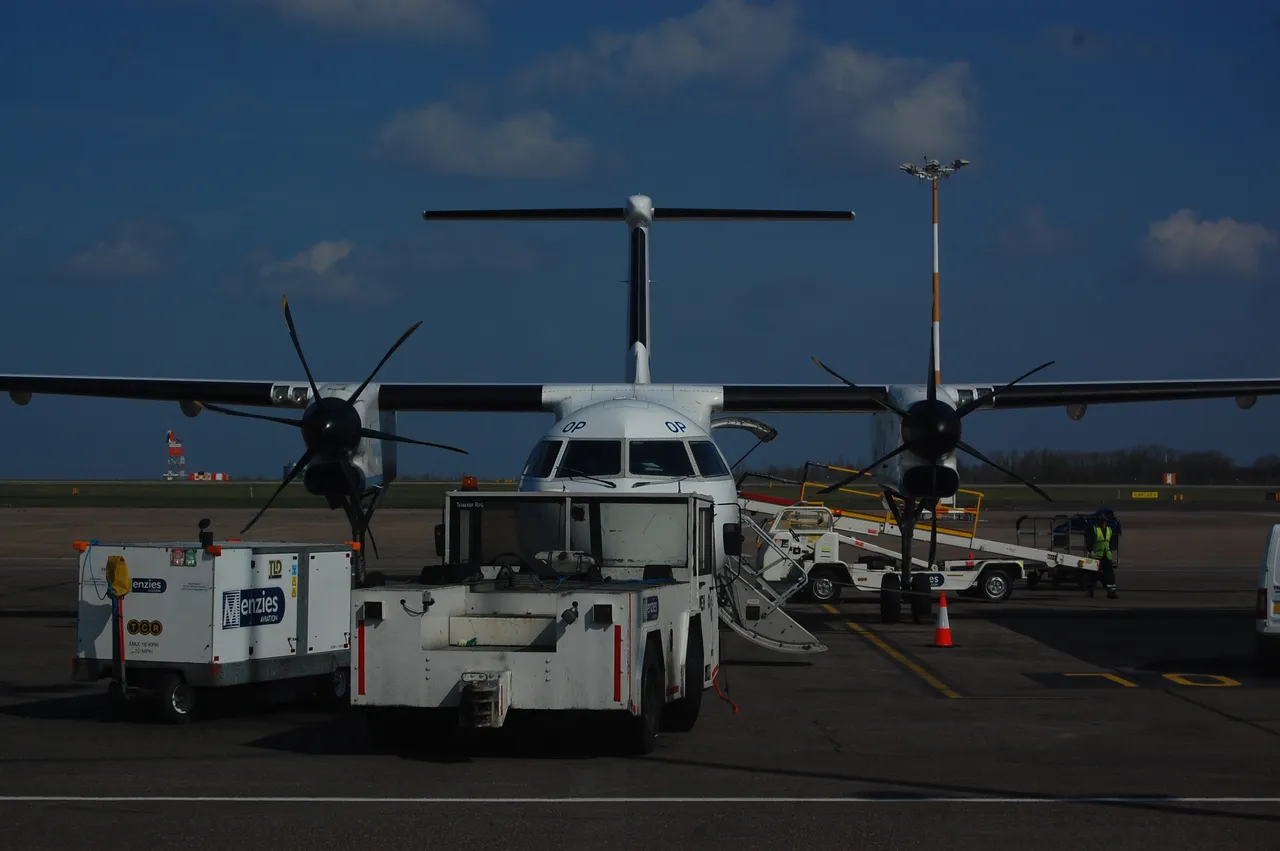


Recognise it overhead
Recognition clues checked 5 October 2026
- Wheels
- Main landing gear folds into long engine nacelles under the wing, not into blisters on the fuselage [10]
- Cockpit
- Four cockpit windows on a Bombardier-built Dash 8, where an ATR has six [10]
- Tail
- The Q400 carries a small bullet-shaped fairing on its tail [10]
Use several visible clues together. If a detail is too far away to see, leave it uncertain.
Could also be: ATR 72
Key facts
If a propeller airliner hums over the garden and its wheels seem to tuck away behind the engines, you may be watching a Dash 8. It is a Canadian design that has been built in four sizes, has changed hands three times, and earned a letter Q for being quiet.
Air traffic systems know the family by four codes, one per size: DH8A for the Series 100, DH8B for the 200, DH8C for the 300 and DH8D for the 400 [1] [2] [3] [4] [13]. The last of those, the Q400, was the model still being built when the programme changed hands in 2019 [8], and De Havilland has since announced a pause in Dash 8 production [14].
Where it came from
The Dash 8 came from de Havilland Canada, the company behind the Twin Otter and a line of aircraft numbered DHC-1 to DHC-7 [8].
The prototype, registered C-GDNK, first flew on 20 June 1983 [5]. Type certification followed in September 1984 [6], and the first aircraft went to norOntair, a Canadian regional airline, which put the type into service on 23 October 1984 [5] [6].
The family then grew in steps:
- Series 100: the original, with Pratt & Whitney Canada PW120A engines of 2,000 shaft horsepower each and up to 39 seats [1].
- Series 200: the same airframe with more powerful PW123 engines, carrying 37 to 39 passengers with better performance [2].
- Series 300: a stretch of the 200, with 50 to 56 seats, which debuted in 1987 and entered service in 1989 [3] [5]. At 25.68 m it is about 3.4 m longer than the 100 and 200 [1] [3].
- Series 400: a further stretch with new, quieter engines [4], covered below.
BAE Systems' heritage pages give production of 299 Series 100s, 105 Series 200s and 267 Series 300s [5].
Boeing, Bombardier and the letter Q
The aircraft changed hands twice while it was in production. In 1986 the Canadian government privatised de Havilland Canada and sold it to Boeing [5] [6]. In 1992 Boeing sold it on to Bombardier [5] [6].
Under Bombardier the aircraft gained its best-known name. In 1996 a noise and vibration suppression system was introduced, and the Dash 8s that carried it became the Q models, Q for quiet [6]. SKYbrary describes the system on the Q400 as computer controlled [4]. The air traffic codes did not change: a Q300 is still a DH8C [3].
The Q400 stretch
The Series 400 is a much bigger aircraft than the original. It first flew on 31 January 1998 [1] and reached airline service in 2000 [5].
It is 32.81 m long, against 22.25 m for the Series 100 and 200, and its wings span 28.4 m [2] [4]. Two PW150A engines replace the PW120 and PW123 family of the smaller models [7]. De Havilland quotes 5,071 shaft horsepower for take-off from each one, driving Dowty R408 propellers [9], and SKYbrary gives the propellers six blades and a diameter of 4.11 m [4].
De Havilland's current specification sheet offers 82 seats at a 30 inch pitch as standard and up to 90 in a single class [9]. It quotes a cruising speed of 360 knots, about 667 km/h [9].
Back under the de Havilland name
On 3 June 2019 De Havilland Aircraft of Canada announced that Longview Aviation Capital, which already held the Twin Otter and the older de Havilland designs, had acquired the whole Dash 8 programme from Bombardier: the Series 100 to 300 and the in-production Q400 [8]. It said the deal brought the entire de Havilland product line under one banner for the first time in decades [8].
Today the builder calls the aircraft the Dash 8-400 rather than the Q400, the name on its July 2026 specification sheet [9].
Interesting facts
- The Q400 was built with a Japanese partner: Mitsubishi Heavy Industries took a major share in the Dash 8-400 programme [15].
- Europe's type certificate lists eleven separate models, from the DHC-8-102 to the DHC-8-402 [7].
- Bombardier published a separate airport planning manual for the Series 400 [12].
How to spot one
Start with the engines and wheels. The Dash 8 is a twin turboprop [4], and its main landing gear sticks out from under the wing and retracts into long engine nacelles [10].
Dash 8 or ATR 72? The ATR 72 is the other regional turboprop you are likely to see, and the two are easy to confuse. The quickest tell is where the wheels go. The ATR stows its main gear in blister fairings on the lower fuselage, so its engine nacelles stay short [10]. Close up, count the cockpit windows: a Bombardier-built Dash 8 has four, an ATR has six [10]. The Q400 also has a small bullet-shaped fairing on its tail [10].
Do not rely on propeller blades to separate them. The ATR 72-600 and the Q400 both turn six-blade propellers [4] [11]. The older Dash 8s are different: a Q300 has four blades [3].
Which Dash 8? Length is the clue. The Series 100 and 200 are short at 22.25 m [2], the 300 is a little longer at 25.68 m [3], and the 400 is a long, slim aircraft of 32.81 m [4]. If it looks stretched and the code reads DH8D, it is a Q400.
In photographs
Look closer at the shapes, details and liveries. Every photograph links to its original and credits its creator.
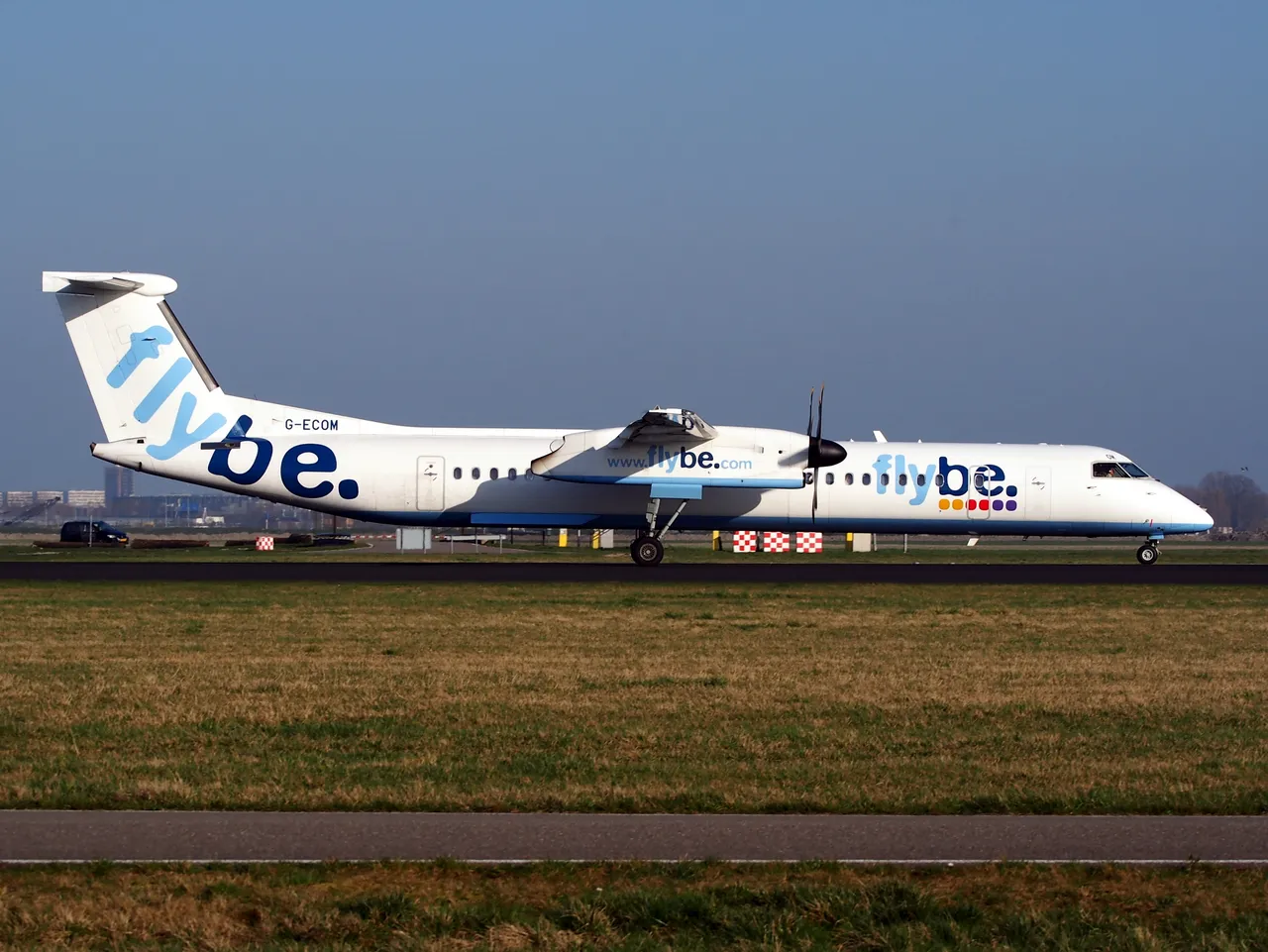
Flybe DHC-8-402Q G-ECOM landing at Schiphol, its main gear lowered from the engine nacelles.
Alf van Beem · CC0 1.0 · Source and credits · 2014-03-09 16:21:58

View full-size · Original imageResized WebP display copy.

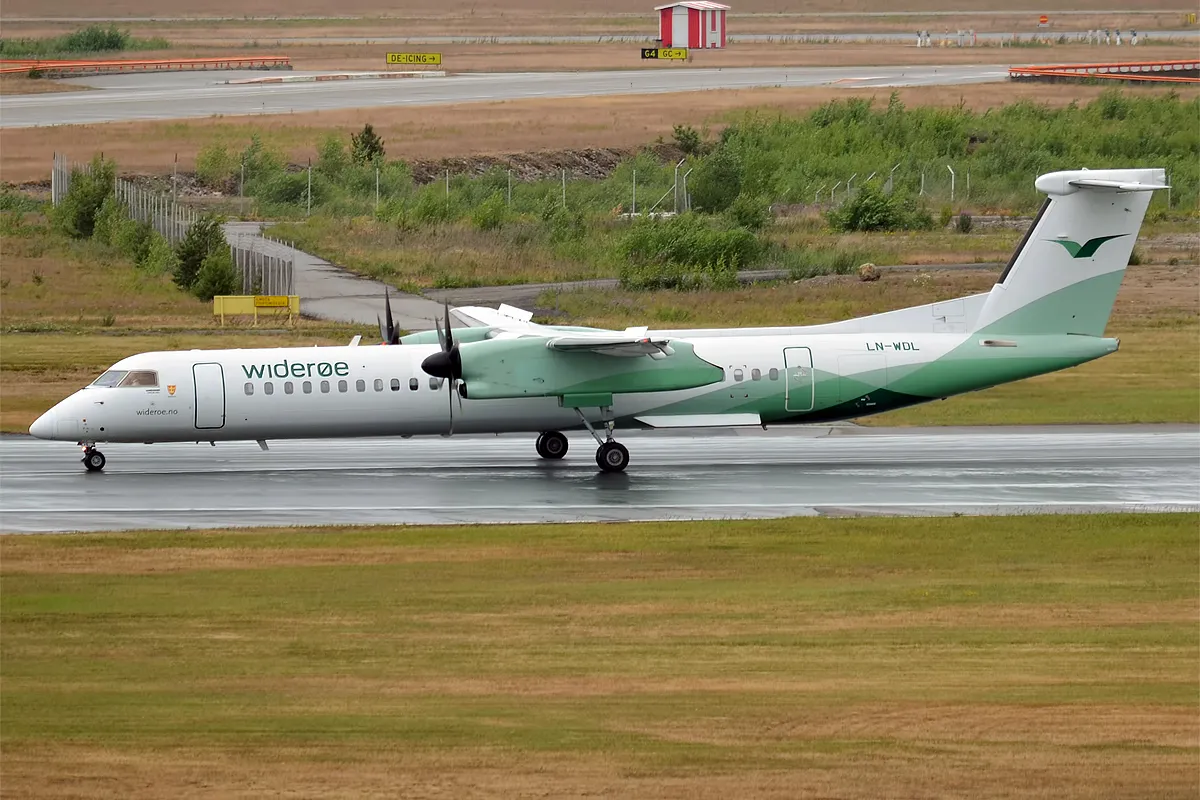
Widerøe Dash 8 Q400 LN-WDL, a long, slim twin turboprop.
Anna Zvereva from Tallinn, Estonia · CC BY-SA 2.0 · Source and credits · 2018-06-19 13:27

View full-size · Original imageResized WebP display copy.

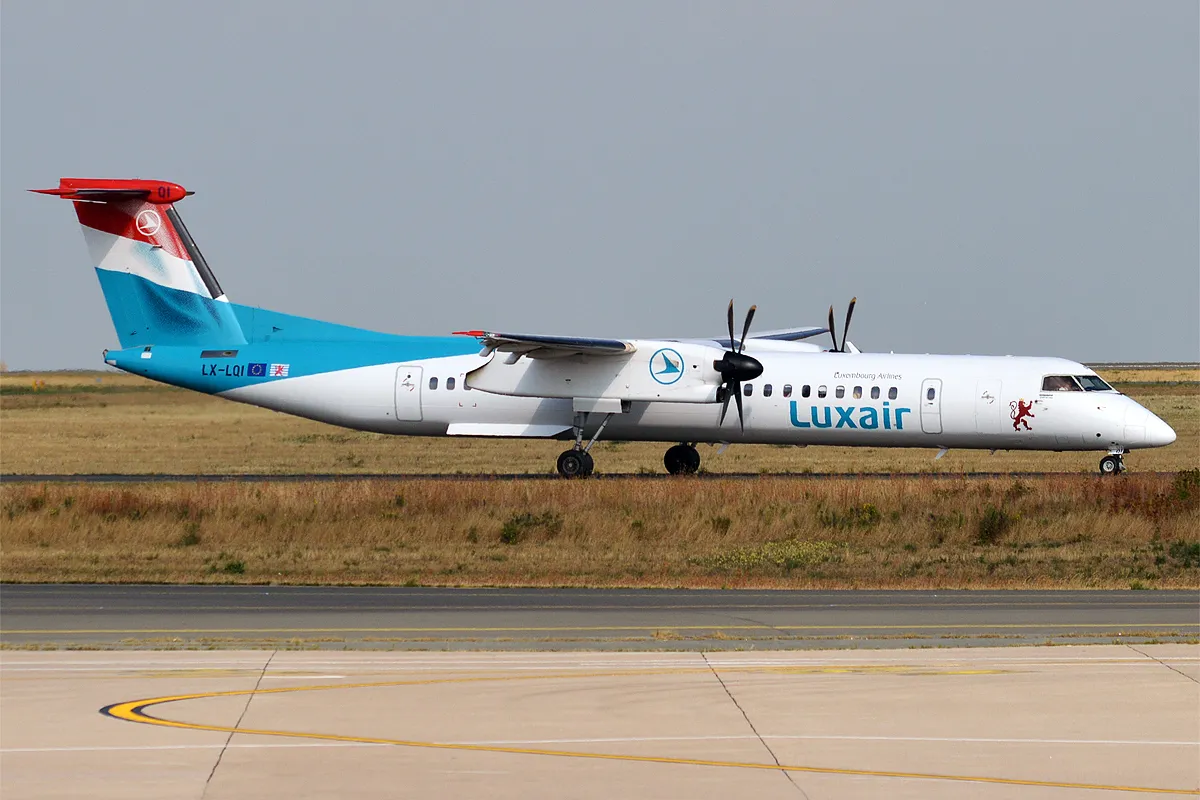
Luxair Dash 8 Q400 LX-LQI, with six-blade propellers on its two engines.
Anna Zvereva from Tallinn, Estonia · CC BY-SA 2.0 · Source and credits · 2018-09-18 12:46

View full-size · Original imageResized WebP display copy.

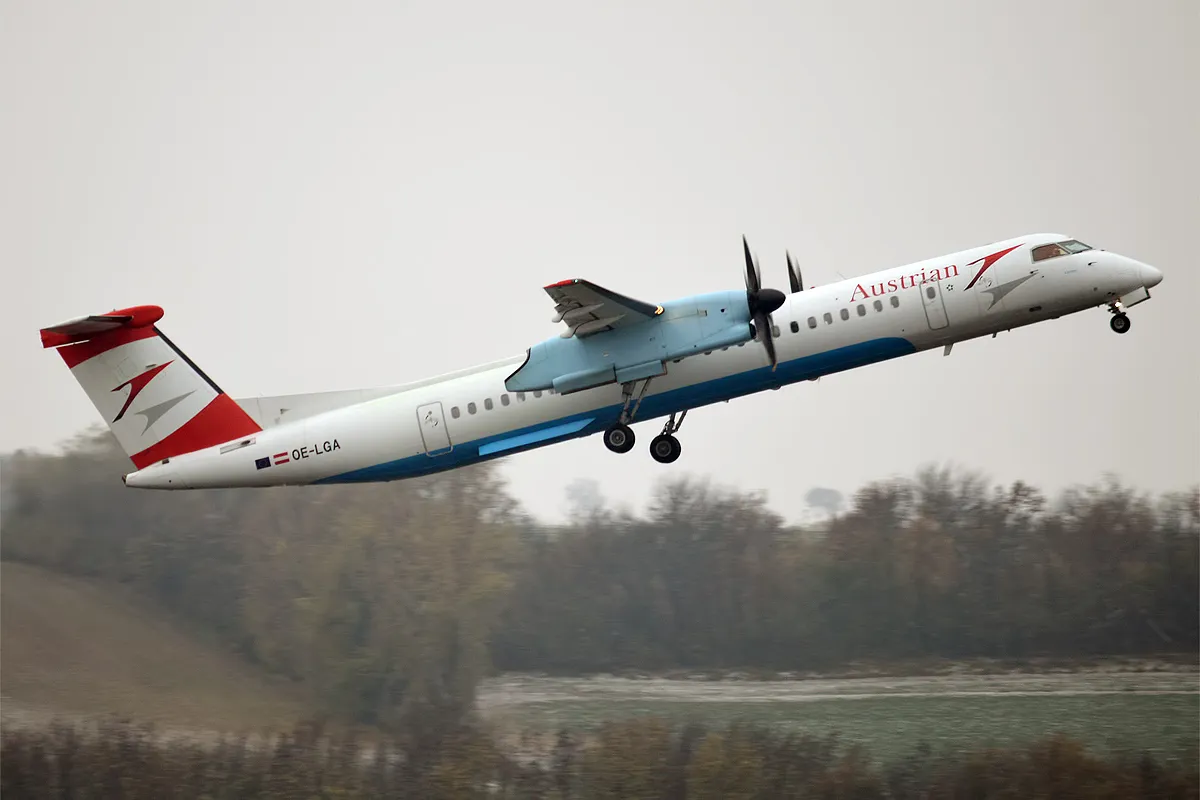
Austrian Airlines Dash 8 Q400 OE-LGA, showing the Q400's long fuselage.
Anna Zvereva from Tallinn, Estonia · CC BY-SA 2.0 · Source and credits · 2016-11-12 12:33

View full-size · Original imageResized WebP display copy.

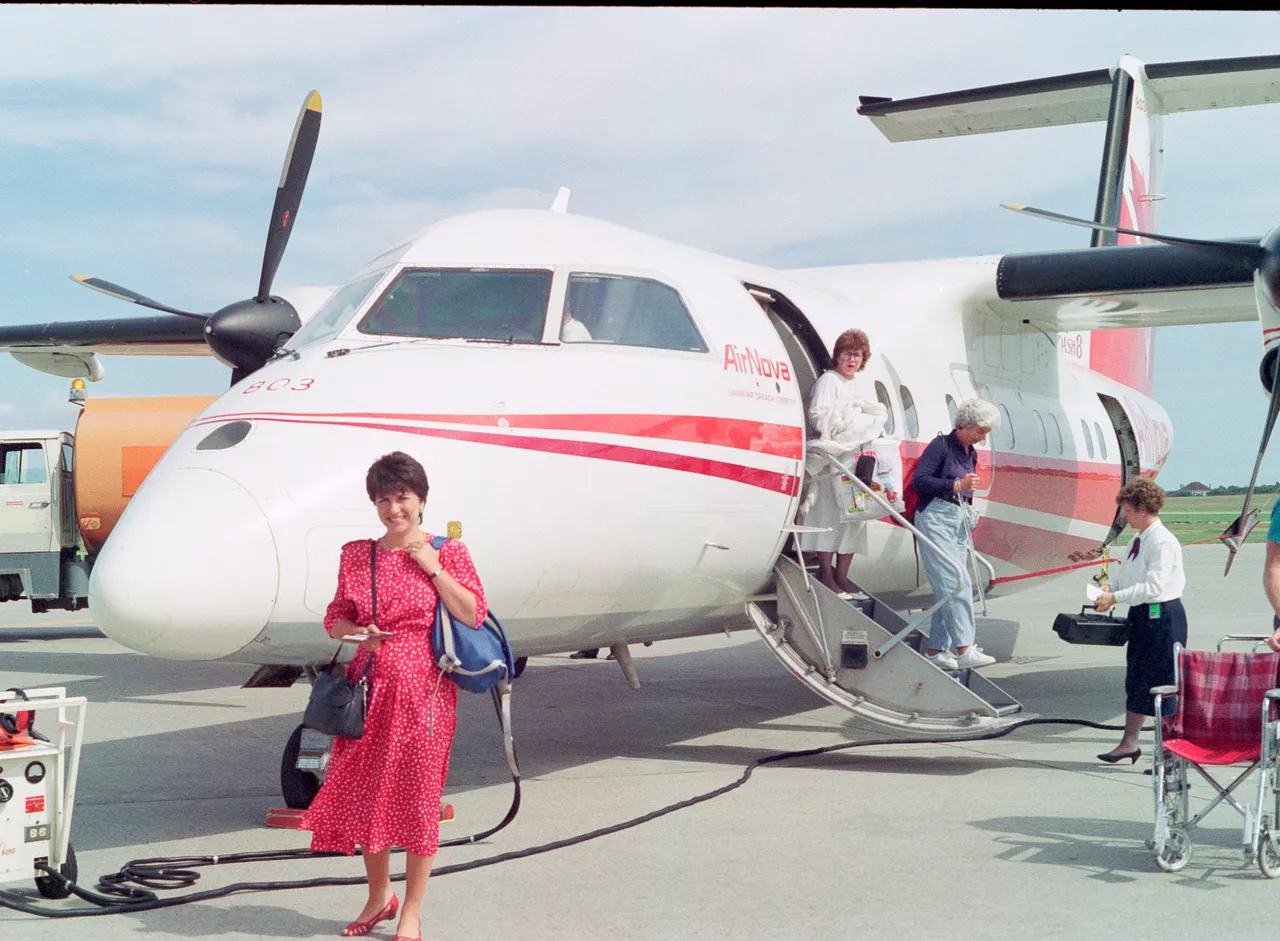
Air Nova DHC-8-102 C-GANS at Yarmouth, Nova Scotia, in August 1990: the short original Series 100.
Andrew Thomas from Shrewsbury, UK · CC BY-SA 2.0 · Source and credits · 2010-03-03 19:02

View full-size · Original imageResized WebP display copy.

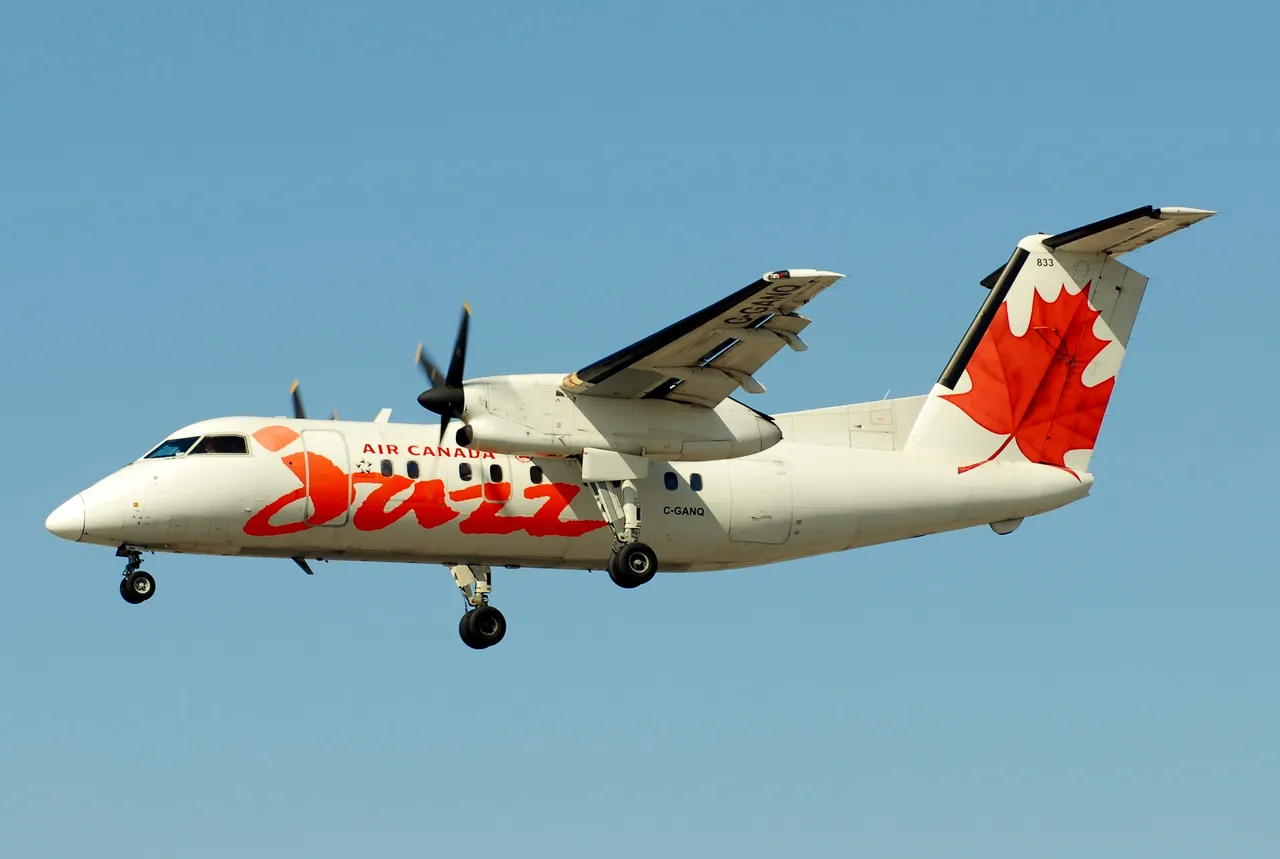
Air Canada Jazz DHC-8-102 C-GANQ, a Series 100, the shortest Dash 8 at 22.25 m.
Lord of the Wings© from Toronto, Canada · CC BY-SA 2.0 · Source and credits · 2012-03-14 14:11

View full-size · Original imageResized WebP display copy.

Drawings and original documents
Bombardier's Dash 8 Series 400 Airport Planning Manual (PSM 1-84-13, revision 4 of 5 December 2014) carries the aircraft's dimensioned drawing as Figure 2-2, Aircraft Dimensions (chapter 2 page 5, PDF page 27). It is published on Bombardier's customer document site, the programme passed to De Havilland Aircraft of Canada in 2019, and reproduction rights stay with the publisher, so the page links the manual rather than copying its drawings.
- Bombardier, Dash 8 Series 400 Airport Planning Manual, PSM 1-84-13, revision 4 of 5 December 2014
Bombardier's airport planning manual for the Dash 8 Series 400 (154 pages). Figure 2-2, Aircraft Dimensions (chapter 2 page 5, PDF page 27), is the dimensioned drawing of the aircraft; Figure 2-3 on the next page shows ground clearances on the general arrangement.
- EASA type certificate data sheet EASA.IM.A.191, DHC-8, issue 16 of 3 February 2023
Europe's type certificate data sheet for the DHC-8 family, held by De Havilland Aircraft of Canada Limited: the certified models from the DHC-8-102 to the DHC-8-402 and the engines approved for each series, from the PW120A to the PW150A.
- BAE Systems Heritage, de Havilland Canada DHC-8 Dash 8
BAE Systems' heritage history of the Dash 8: the first flight of prototype C-GDNK on 20 June 1983, service entry with NorOntair on 23 October 1984, the sale of de Havilland Canada to Boeing in 1986, to Bombardier in 1992 and the programme to Longview Aviation in 2018, with a specification table for the Series 100, 200, 300 and 400.
- De Havilland Aircraft of Canada, Dash 8-400 specification sheet, July 2026
De Havilland's two-page Dash 8-400 specification sheet, dated July 2026: 82 seats at 30-inch pitch as standard and up to 90 in a single class, PW150A engines, Dowty R408 propellers and a 360 kt cruise speed.
See one for yourself
Skylark shows what is flying over Ireland right now, and the iPhone app points you at it. Next time you hear engines, look for the DH8A or DH8B or DH8C or DH8D code.
Sources
Facts checked against these sources on 5 October 2026. Numbers that change over time, such as orders and fleet sizes, are as of the date given beside them.
- de Havilland Canada / Bombardier DHC-8 Dash 8Flugzeuginfo.net
- Bombardier Dash 8 Q200 (DH8B)SKYbrary
- Bombardier Dash 8 Q300 (DH8C)SKYbrary
- Bombardier Dash 8 Q400 (DH8D)SKYbrary
- de Havilland Canada DHC-8 Dash 8BAE Systems Heritage
- Maiden flight: Dash 8Airways Magazine
- Type certificate data sheet EASA.IM.A.191, DHC-8EASA
- De Havilland Aircraft of Canada returns to the skies, 3 June 2019De Havilland Aircraft of Canada
- Dash 8-400 specification sheet, version 11De Havilland Aircraft of Canada
- Spotting the difference: regional aircraftFlightradar24
- ATR 72-600: specs, history and live trackingAviation Geeks
- Dash 8 Series 400 Airport Planning ManualBombardier
- Order JO 7360.1G, Aircraft Type DesignatorsFederal Aviation Administration
- De Havilland to pause Dash 8 production, 500 employees affectedBNN Bloomberg
- MHI takes major share in Dash 8-400 programmeFlight International
How often does Skylark see it?
Read the existing Ireland observation log to see the days each type appeared. This is what Skylark recorded, with the coverage its receivers and providers supplied; it is not a census of Irish aircraft or a prediction of your next sighting.
One aircraft seen on three different days contributes three airframe-days. Repeated reports on the same day count once. Codes are shown separately, without adding them into a family total. A logged day does not mean continuous coverage throughout that day.
Observations load when you request them.