

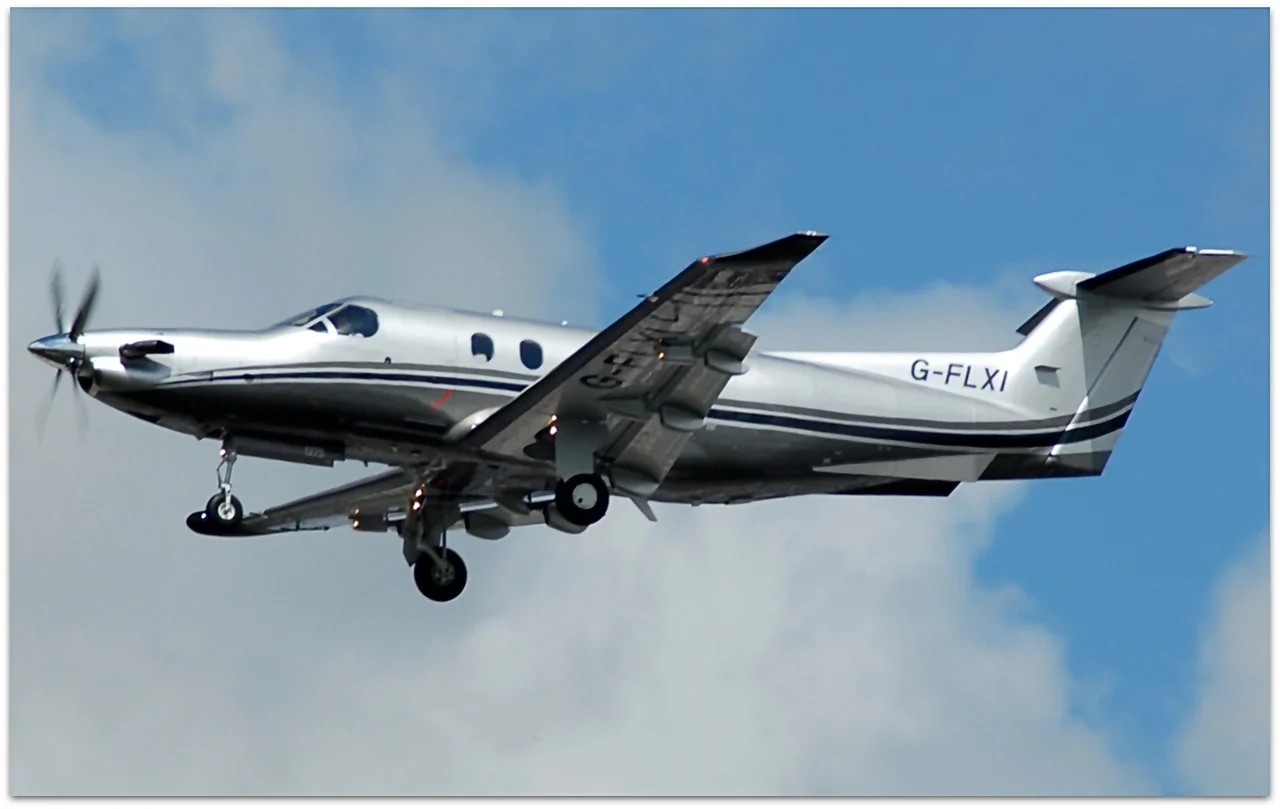


Recognise it overhead
Recognition clues checked 30 September 2026
- Propeller
- One nose-mounted propeller, with no engines on the wings [1]
- Tail
- Horizontal tailplane on top of the fin [1]
- Wing
- Low wing with winglets [1]
Use several visible clues together. If a detail is too far away to see, leave it uncertain.
Key facts
The Pilatus PC-12 has a particularly useful recognition combination: one propeller on the nose, a low wing and a T-tail. EUROCONTROL's PC12 entry identifies those features, together with winglets and retractable tricycle landing gear. Learn the combination and you have a much better starting point than “small private plane”. [1]
It is a pressurised turboprop, as the New Zealand Civil Aviation Authority's type-acceptance report confirms. The same report records approval of the original PC-12 model on 30 March 1994. Its external appearance should not be mistaken for evidence of the cabin configuration or the purpose of an individual flight. [2]
How to spot one
Look for the nose propeller first, then inspect the tail. A T-tail means the horizontal tailplane sits at the top of the vertical fin. The PC-12's wing sits low on the fuselage and has winglets. Its landing gear retracts, unlike that of an ordinary Cessna 172. [1] [8]
As a practical observation technique, give each feature its own confidence level. “One nose propeller seen; tail position uncertain” is useful. “PC-12 because it looks expensive” is not. If the tail is unresolved, leave room for another single-engine turboprop until a better view or independently checked identity becomes available.
Pilatus gives the PC-12 PRO a wingspan of 16.28 m and a length of 14.40 m. Its separate cargo door is 1.35 m wide and 1.32 m high. Those dimensions make sense of a clear side photograph and the aircraft's loading capability; they are not measurements you can recover from an unscaled speck overhead. [3]
For your next pass, try to capture the tail and the whole aircraft in the same frame. Keep an uncropped original if you intend to revisit the identification. Our recommendation is to write down the cues before consulting a suggested model name, so that the label does not become the evidence for itself.
What it can be confused with
Another nose-propeller aircraft is the Daher TBM 960. Daher lists a 12.83 m wingspan, a 10.74 m length and typical accommodation of one pilot plus five passengers. Compare those with the PC-12 PRO's published dimensions: the PC-12 is substantially larger. That is a documented size comparison, not a promise that you can judge size correctly from your garden. [3] [6]
Daher also specifies a five-blade propeller for the TBM 960. The New Zealand authority records five-blade propellers on later PC-12/47E aircraft, including the NGX. A five-blade propeller therefore does not, on its own, settle the distinction. Use the tail and overall layout, and seek a readable registration for confirmation. [2] [6]
The Cessna 172 provides a simpler contrast: its high wing, fixed wheels and conventional tail differ from the PC-12 combination. This is a teaching comparison rather than a claim that the two are close lookalikes. When a view is too distant to distinguish those features, keep the sighting at the broader “single-engine aircraft” level. [1] [8]
Why the cargo door matters
Pilatus describes the PRO as able to operate from short runways and unmade surfaces including grass, gravel and snow. It also describes removable seating for up to nine passengers and the carriage of large parts. That flexibility explains why thinking of every PC-12 as an executive aircraft gives an incomplete picture of the type. [4]
The manufacturer's special-missions page describes air-ambulance configurations accommodating up to three patients with medical equipment, and a large cargo door with an optional loading lift. It also presents surveillance applications. These are documented uses of the aircraft, not evidence that the PC-12 you are watching is performing any of them. [5]
If you see one on an unfamiliar route, the interesting question is “what evidence would establish its role?” A verified operator statement or a documented airframe configuration is stronger than a route that seems suggestive. Keep any observation of the aircraft separate from a story about its passengers or cargo.
A type code is not a generation
The PC-12 family has evolved. The New Zealand report describes the NGX as a development of the PC-12/47E with a PT6E-67XP engine, electronic engine control, revised systems and larger cabin windows. Pilatus's current PRO overview describes a cockpit based on Garmin G3000 Prime. These are generation-specific details, not equipment you should assign to every PC12 contact. [2] [4]
This page's dimensions explicitly name the PRO. A tracker showing the family code gives you a place to begin researching the airframe; it does not establish the engine, avionics, seating layout or installed special-mission equipment. If a claim concerns one particular registration, check documentation for that airframe rather than borrowing the latest brochure.
What the track really tells you
ADS-B reports include GPS position, altitude and ground speed. The FAA also explains that reception depends on radio line of sight and can be obstructed by terrain and other solid objects. A gap in a public track therefore does not by itself prove a landing, a technical fault or an attempt to conceal a flight. [7]
Our practical advice is to keep the recorded trail, any projected position and your own sighting distinct. Write “last received here” when that is what the evidence supports. Do not silently turn it into “landed here”. The type's advertised ability to use a short runway does not identify which runway a particular flight used. [4] [7]
A good PC-12 observation preserves the silhouette cues, the time, the identity evidence and the remaining uncertainty. That is a more valuable record than guessing who might be inside, and it gives the next sighting something concrete to build on.
Original drawings
Pilatus publishes a PC-12 NGX model-building plan with dimensioned views and close-up drawings. It is useful for studying the outline, provided you retain its NGX label and do not mistake it for a PRO-specific document [9].
In photographs
Look closer at the shapes, details and liveries. Every photograph links to its original and credits its creator.
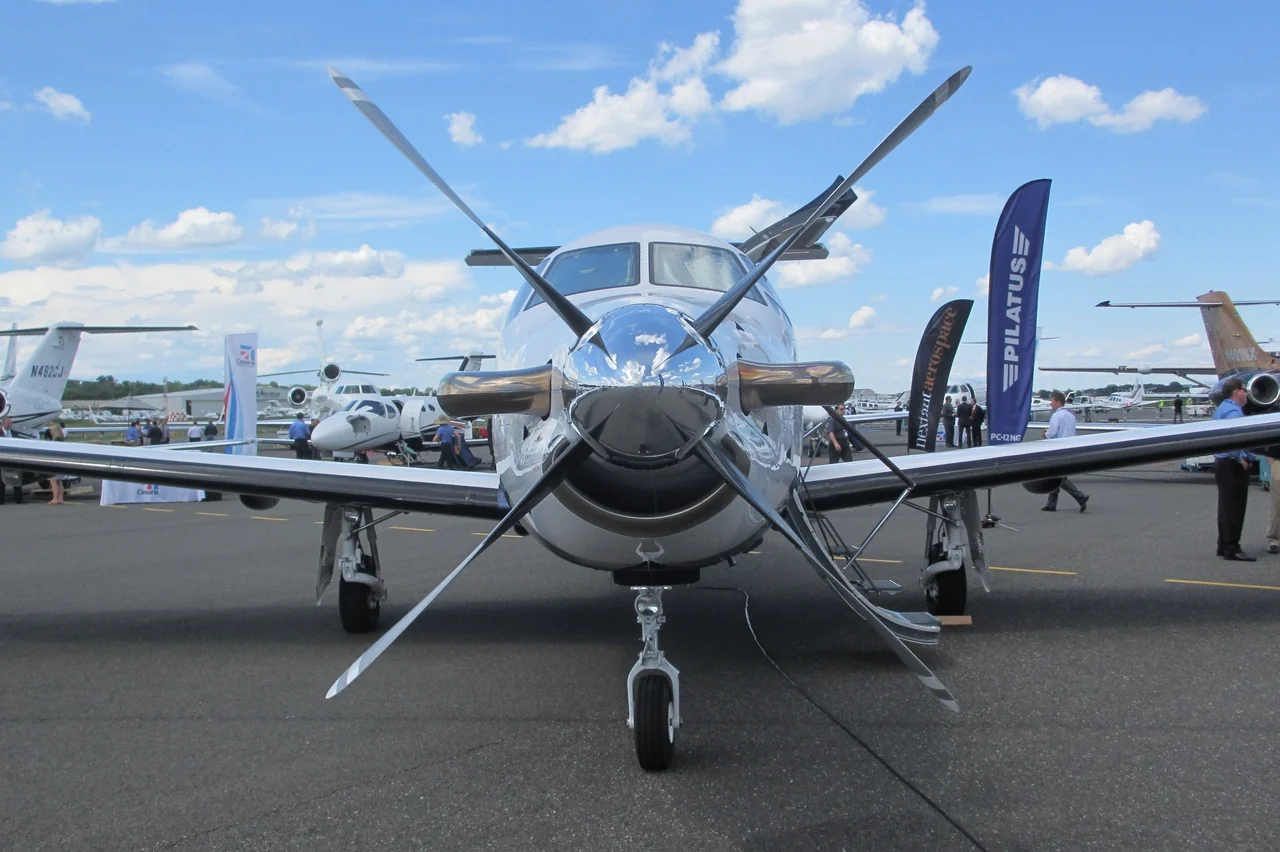
A close view of the PC-12 nose and propeller. Keep this aircraft’s visible propeller configuration separate from later variant specifications.
JetRequest.com · CC BY-SA 3.0 · Source and credits · 2012-06-08 03:34:06

View full-size · Original imageResized WebP display copy.

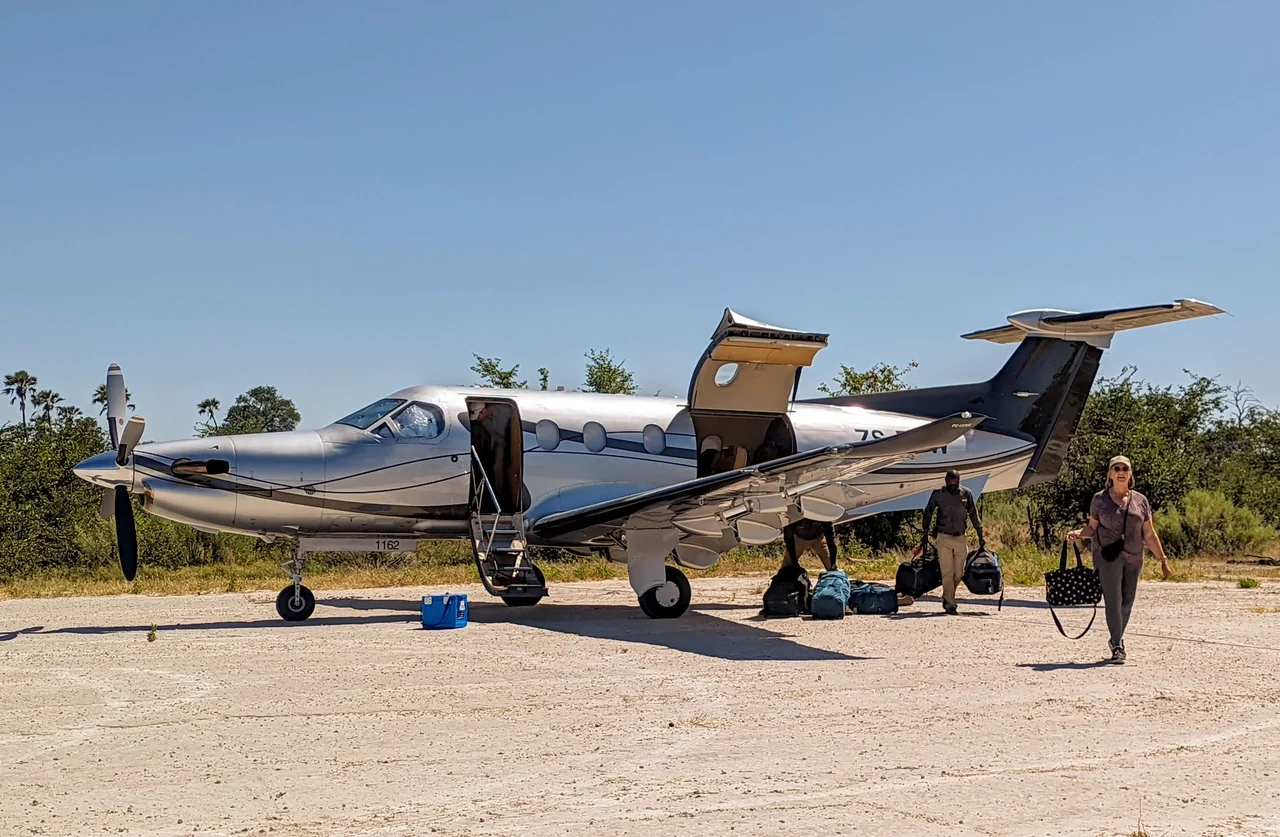
Pilatus PC-12 ZS-TSW at an airstrip near Qorokwe Camp in Botswana. The open door shows this aircraft during loading.
Dicklyon · CC BY-SA 4.0 · Source and credits · 2022-04-28 12:23:14

View full-size · Original imageResized WebP display copy.

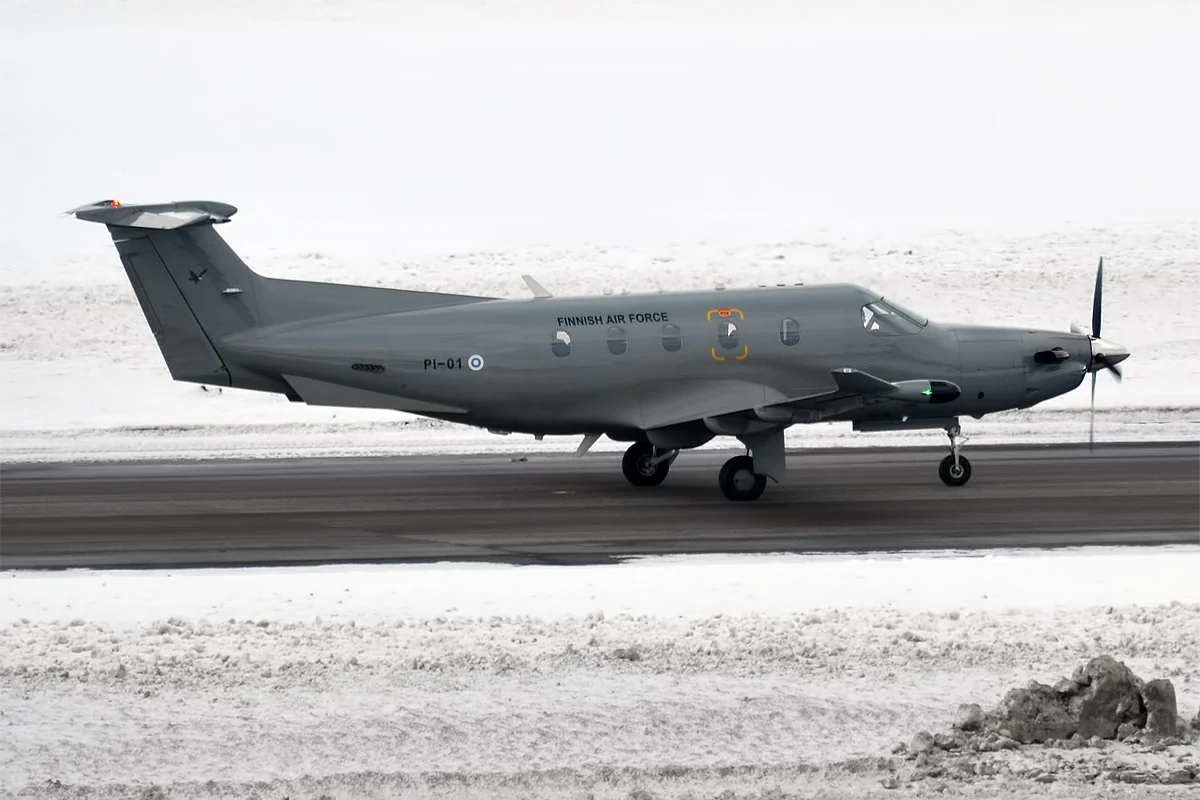
Finnish Air Force PC-12/47 PI-01 on the ground. The T-tail and single nose-mounted propeller are clear in profile.
Anna Zvereva from Tallinn, Estonia · CC BY-SA 2.0 · Source and credits · 2016-02-26 13:48

View full-size · Original imageResized WebP display copy.

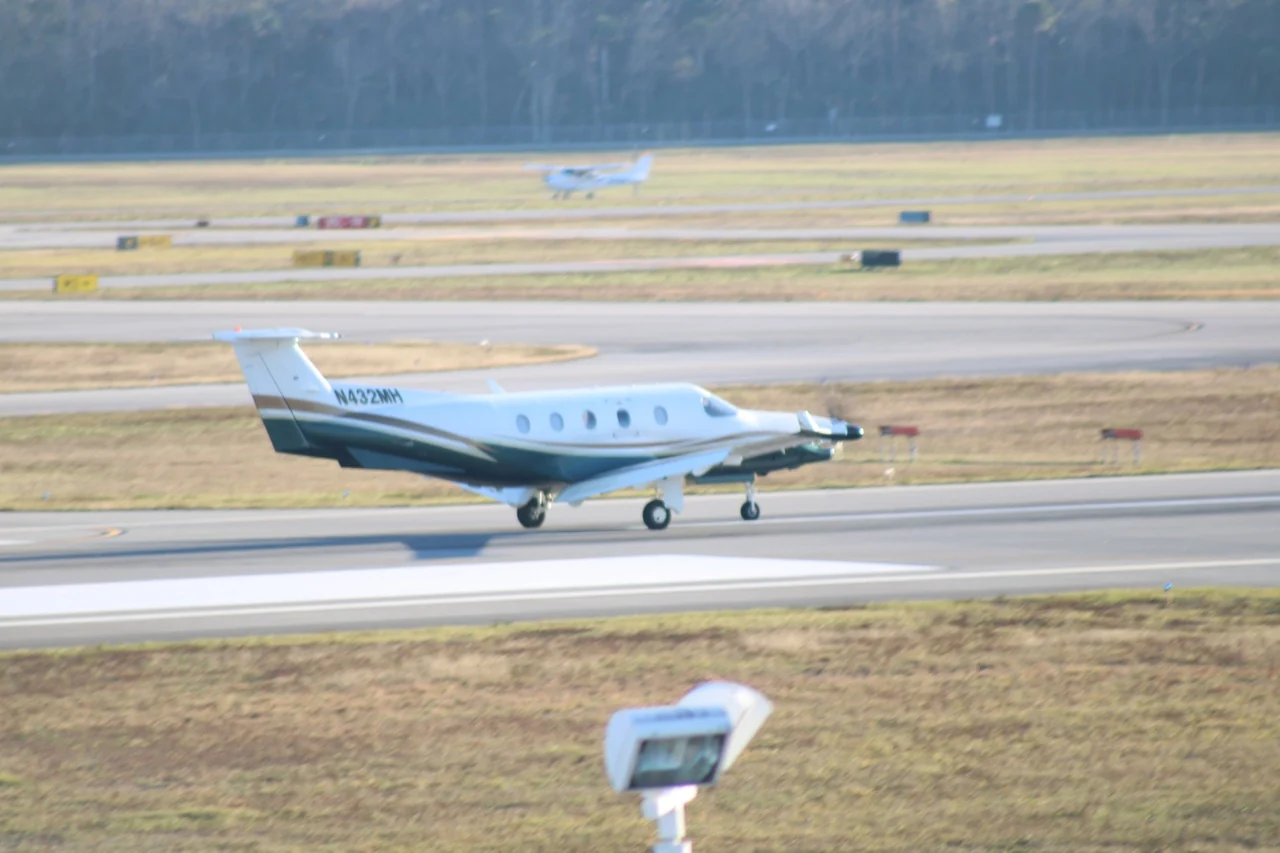
Pilatus PC-12/45 N432MH at Daytona Beach International Airport. The side view shows the low wing and T-tail.
ZLEA · CC BY-SA 4.0 · Source and credits · 2023-01-10

View full-size · Original imageResized WebP display copy.

Drawings and original documents
Pilatus’s model-building plan contains original PC-12 NGX dimension and detail drawings. The original is linked below; retain its NGX variant label, and reproduction rights remain with its publisher.
- Pilatus PC-12 NGX model-building plan
Manufacturer NGX reference drawings, including dimensioned views on PDF page 2 and close-up drawings. This is an NGX document, not a PRO specification.
- Pilatus PC-12 PRO: Just the Facts, 2025
The manufacturer’s PRO facts booklet, with exterior and interior dimensions and stated performance conditions.
See one for yourself
Skylark shows what is flying over Ireland right now, and the iPhone app points you at it. Next time you hear engines, look for the PC12 code.
Sources
Facts checked against these sources on 30 September 2026. Numbers that change over time, such as orders and fleet sizes, are as of the date given beside them.
- Aircraft Performance Database: PC12EUROCONTROL
- Type Acceptance Report: Pilatus PC-12 Series, revision 2, 9 May 2023Civil Aviation Authority of New Zealand
- PC-12 PRO: Just the Facts, 2025Pilatus
- PC-12 PRO overviewPilatus
- PC-12 Special MissionsPilatus
- TBM 960 specificationsDaher
- Ins and Outs: how ADS-B worksFAA
- Aircraft Performance Database: C172EUROCONTROL
- PC-12 NGX model-building planPilatus
How often does Skylark see it?
Read the existing Ireland observation log to see the days each type appeared. This is what Skylark recorded, with the coverage its receivers and providers supplied; it is not a census of Irish aircraft or a prediction of your next sighting.
One aircraft seen on three different days contributes three airframe-days. Repeated reports on the same day count once. Codes are shown separately, without adding them into a family total. A logged day does not mean continuous coverage throughout that day.
Observations load when you request them.