

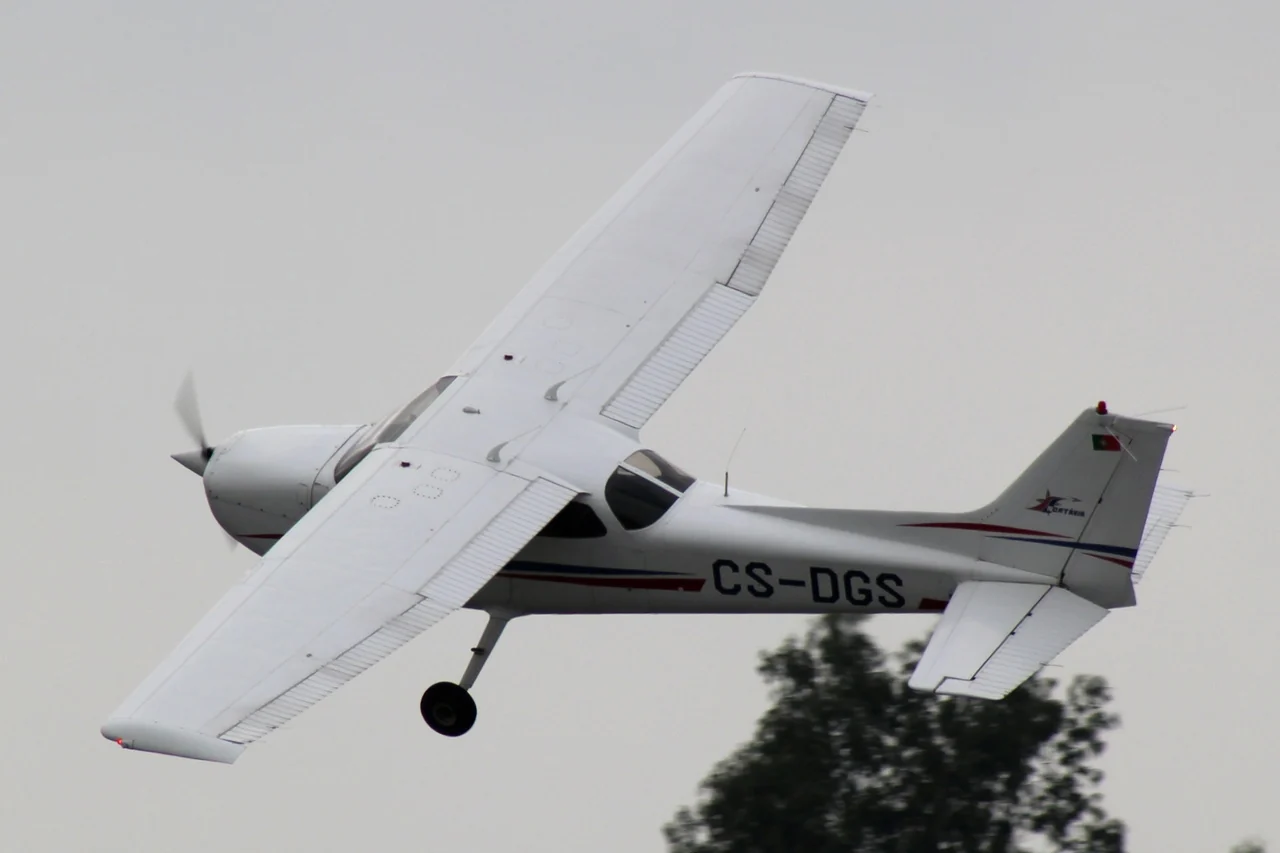


Recognise it overhead
Recognition clues checked 30 September 2026
- Wing
- Above the cabin, supported by diagonal struts [1]
- Wheels
- Fixed nosewheel and two main wheels [1]
- Tail
- Conventional tailplane, below the top of the fin [1]
Use several visible clues together. If a detail is too far away to see, leave it uncertain.
Key facts
The Cessna 172 is worth learning because it makes the small-aircraft world less anonymous. Its recipe is straightforward: a high wing, one nose-mounted engine, fixed wheels and a conventional tail. EUROCONTROL identifies it with the code C172. Those are the useful starting points when something smaller than an airliner crosses your garden. [1]
The Skyhawk first flew in 1955. By April 2025, Textron Aviation reported more than 45,000 deliveries. That figure describes worldwide production, not the number flying over Ireland today. Its long-standing role in pilot training also helps explain why the same basic shape can appear in very different settings. [3]
How to spot one
Begin with the wing. It sits above the cabin, with diagonal supporting struts running down towards the fuselage. Next look for the wheels: the ordinary 172 has fixed tricycle landing gear, so the nosewheel and two main wheels remain outside in flight. The tailplane is below the top of the fin, rather than perched on it as a T-tail. [1]
Our practical recommendation is to look for that combination rather than chase a tiny detail first. On a distant pass, record which features you actually saw. If the wing position is clear but the struts and wheels are unresolved, write “high-wing light aircraft” in your notes and keep the exact identification open. A sensible uncertain identification is more useful than a confident guess.
The current Skyhawk's published dimensions are 11.00 m across the wings and 8.3 m long. Its maximum accommodation is four occupants, including the pilot. Use those figures to understand the scale in a clear photograph; do not treat apparent size in the sky as a measuring tape. Without knowing distance, a small close aircraft and a larger distant aircraft cannot be separated that way. [2]
The Cessna lookalike trap
The Cessna 182 Skylane is a useful warning against identifying every high-wing Cessna as a 172. Textron describes the Skylane's high-wing layout and lists a 10.97 m wingspan, almost the same as the current Skyhawk's 11.00 m. Its quoted length is 8.8 m, compared with 8.3 m for the Skyhawk. These are modest differences for someone looking from the ground. [2] [4]
The current Skylane has a three-blade constant-speed propeller. Textron's April 2025 Skyhawk description specifies a fixed-pitch propeller and a 180 hp Lycoming engine. Those manufacturer specifications are useful when examining a particular model, but they are not permission to identify an unknown aircraft from a blurred propeller disc. [3] [4]
Our suggested order is silhouette first, readable registration second, model documentation third. A photograph that shows a registration can be worth more than several photographs that show only a white cross. Record the letters exactly, including any you could not read, rather than completing a plausible registration from memory.
Why does it keep coming back?
The 172 is a training aircraft, and training does not necessarily mean travelling from one distant airport to another. Textron's Top Hawk programme supplies factory-new Skyhawks to training organisations for student flying and related activities. That documented role gives a useful starting hypothesis for a repeated local sighting, though it does not establish what a particular pilot is doing. [3]
A traffic circuit has recognisable parts: a departure leg, crosswind, downwind, base and final approach. The FAA describes these relationships to the runway, including a downwind leg parallel to it and a final aligned with it. We use that geometry here as an explanation of what a circuit looks like, not as a statement of the rules at an Irish airfield. [5]
As an observation exercise, compare successive passes with the runway direction. Do the turns join a repeated pattern, and does the aircraft return towards the same approach? Describe what the track shows before naming the purpose. The FAA also describes training options including touch-and-go, low approach and full-stop landing; the shape alone does not tell you which was requested. [5]
What tracking can and cannot establish
ADS-B broadcasts position, altitude, ground speed and other information. Its reception is constrained by radio line of sight, and mountains or other solid obstacles can interrupt that path. A disappearing marker therefore does not, by itself, demonstrate a landing or a transmitter being switched off. [6]
For a garden sighting, keep three observations separate: the time you saw the aircraft, the last timestamp on its received position, and the identity attached to the contact. If the position is old, use your own observation as an observation, not as a reason to extend the track and call the extension measured.
The current Skyhawk's advertised maximum cruise speed is 124 knots true airspeed. ADS-B ground speed is a different quantity, so a tracker number should not be used as a direct pass-or-fail test against that specification. Nor does a moving dot identify the occupants, their experience or their destination. [2] [6]
A useful 172 sighting is consequently more than a model name. Note the visible wing and wheels, your confidence, the readable registration if any, and whether a repeated circuit was observed or merely suspected. That turns an ordinary small aircraft into a record you can compare with the next pass.
Original drawings
The Cessna Model 172S NAV III handbook archived by Wayman Aviation has the manufacturer's three-view drawings in Figure 1-1, on printed pages 1-3 and 1-4. They describe that configuration and its normal ground attitude, rather than every generation of the 172 [7].
In photographs
Look closer at the shapes, details and liveries. Every photograph links to its original and credits its creator.
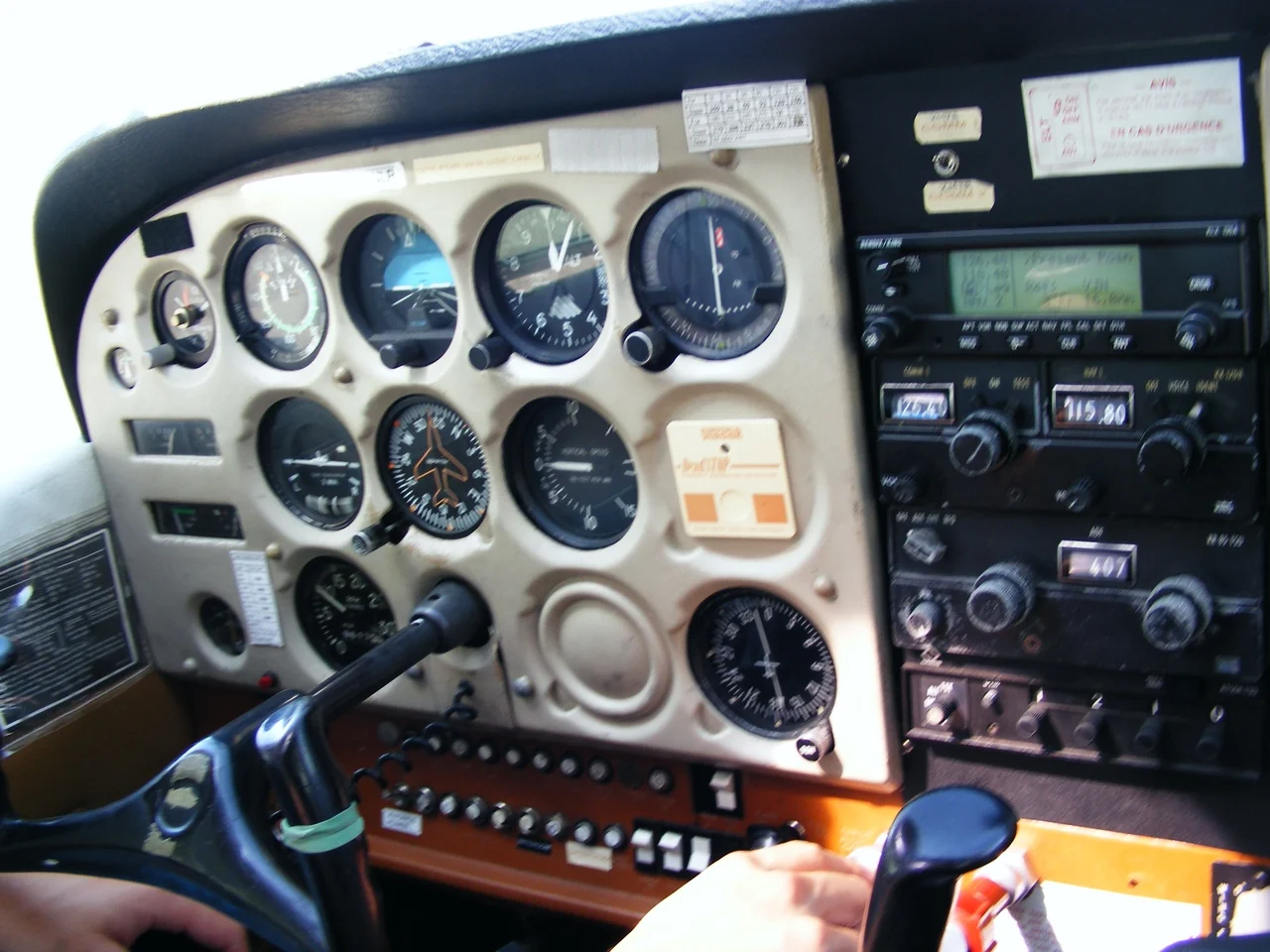
The instrument panel of Cessna 172 C-GNLR. This is one aircraft’s cockpit, rather than a template for every generation.
abdallahh from Montréal, Canada · CC BY 2.0 · Source and credits · 2007-09-20 11:55

View full-size · Original imageResized WebP display copy.

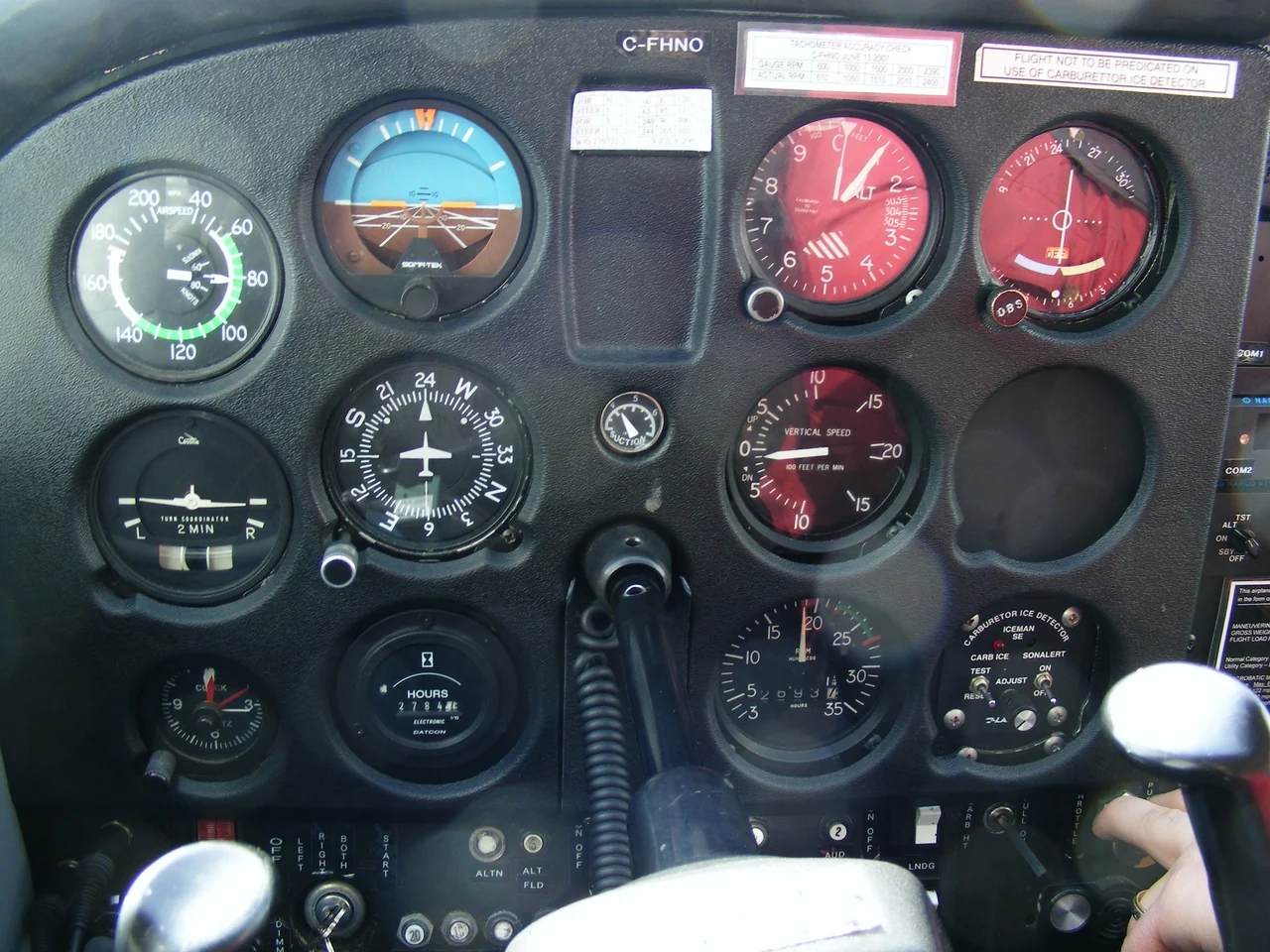
The cockpit of Cessna 172L C-FHNO. Compare its instruments with the other cockpit photograph to see how individual configurations differ.
abdallahh from Montréal, Canada · CC BY 2.0 · Source and credits · 2008-03-18 12:55

View full-size · Original imageResized WebP display copy.

A Cessna 172 Skyhawk photographed in flight. Distant views can leave the small recognition details unresolved.
Firedragon1408 · CC BY-SA 4.0 · Source and credits · 2017-05-20

View full-size · Original imageResized WebP display copy.

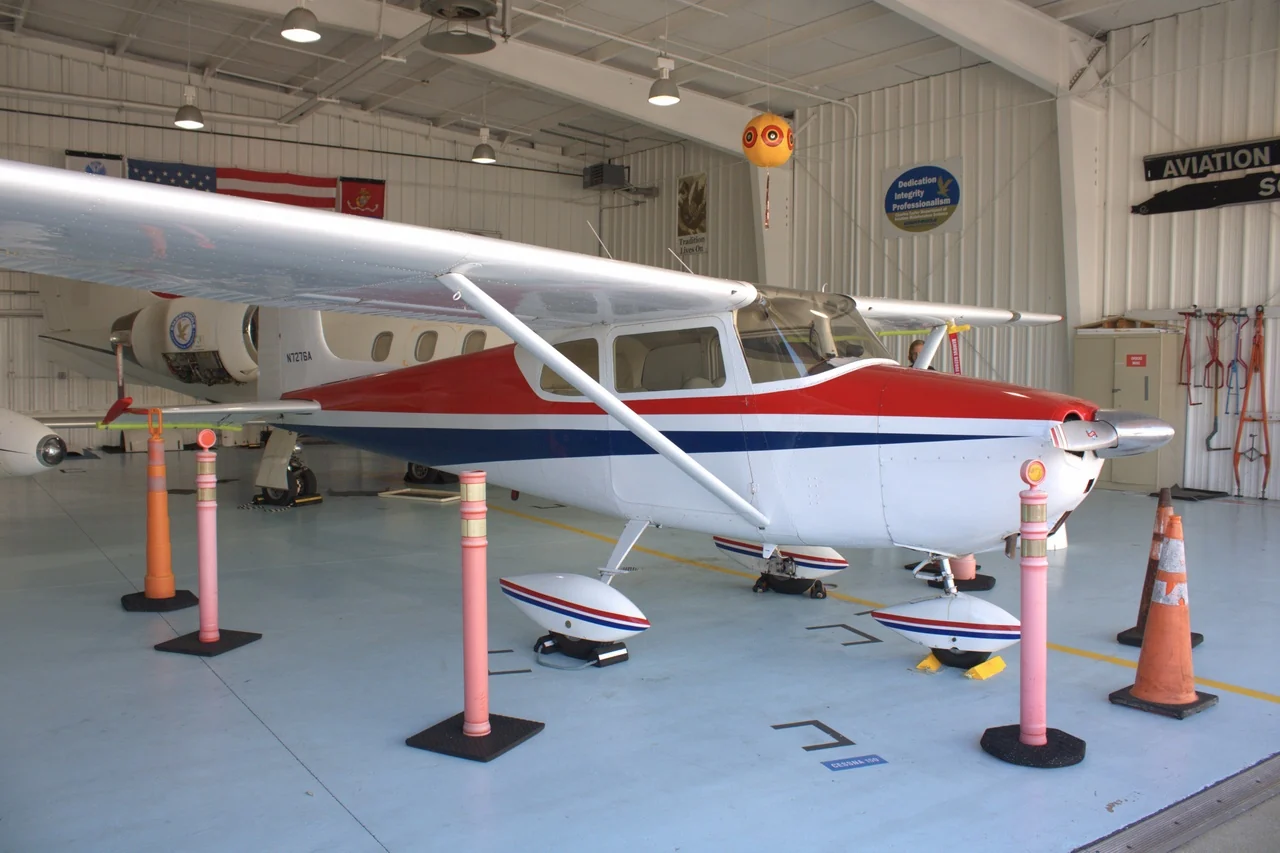
Cessna 172 N7276A at Embry-Riddle Aeronautical University. The high wing, wing strut and fixed tricycle wheels are visible.
ZLEA · CC BY-SA 4.0 · Source and credits · 2024-04-15

View full-size · Original imageResized WebP display copy.

Drawings and original documents
The Cessna Model 172S NAV III handbook archived by Wayman Aviation contains the manufacturer’s three-view drawings. The original is linked below; reproduction rights remain with its publisher.
- Cessna Model 172S NAV III handbook, Wayman archive
Cessna’s original handbook archived by the flight school, with three-view drawings in Figure 1-1 on printed pages 1-3 and 1-4. Its specifications apply to the documented configuration.
- Textron Aviation Skyhawk specifications
Current manufacturer product information and specifications, with separate length, height and wingspan views.
See one for yourself
Skylark shows what is flying over Ireland right now, and the iPhone app points you at it. Next time you hear engines, look for the C172 code.
Sources
Facts checked against these sources on 30 September 2026. Numbers that change over time, such as orders and fleet sizes, are as of the date given beside them.
- Aircraft Performance Database: C172EUROCONTROL
- Cessna Skyhawk specificationsTextron Aviation
- Ten years of the Top Hawk programme, 2 April 2025Textron Aviation
- Cessna Skylane specificationsTextron Aviation
- Aeronautical Information Manual: airport operations and traffic patternsFAA
- Ins and Outs: how ADS-B worksFAA
- Model 172S NAV III Pilot's Operating Handbook, 172SPHBUS-00Cessna, archived by Wayman Aviation
How often does Skylark see it?
Read the existing Ireland observation log to see the days each type appeared. This is what Skylark recorded, with the coverage its receivers and providers supplied; it is not a census of Irish aircraft or a prediction of your next sighting.
One aircraft seen on three different days contributes three airframe-days. Repeated reports on the same day count once. Codes are shown separately, without adding them into a family total. A logged day does not mean continuous coverage throughout that day.
Observations load when you request them.