

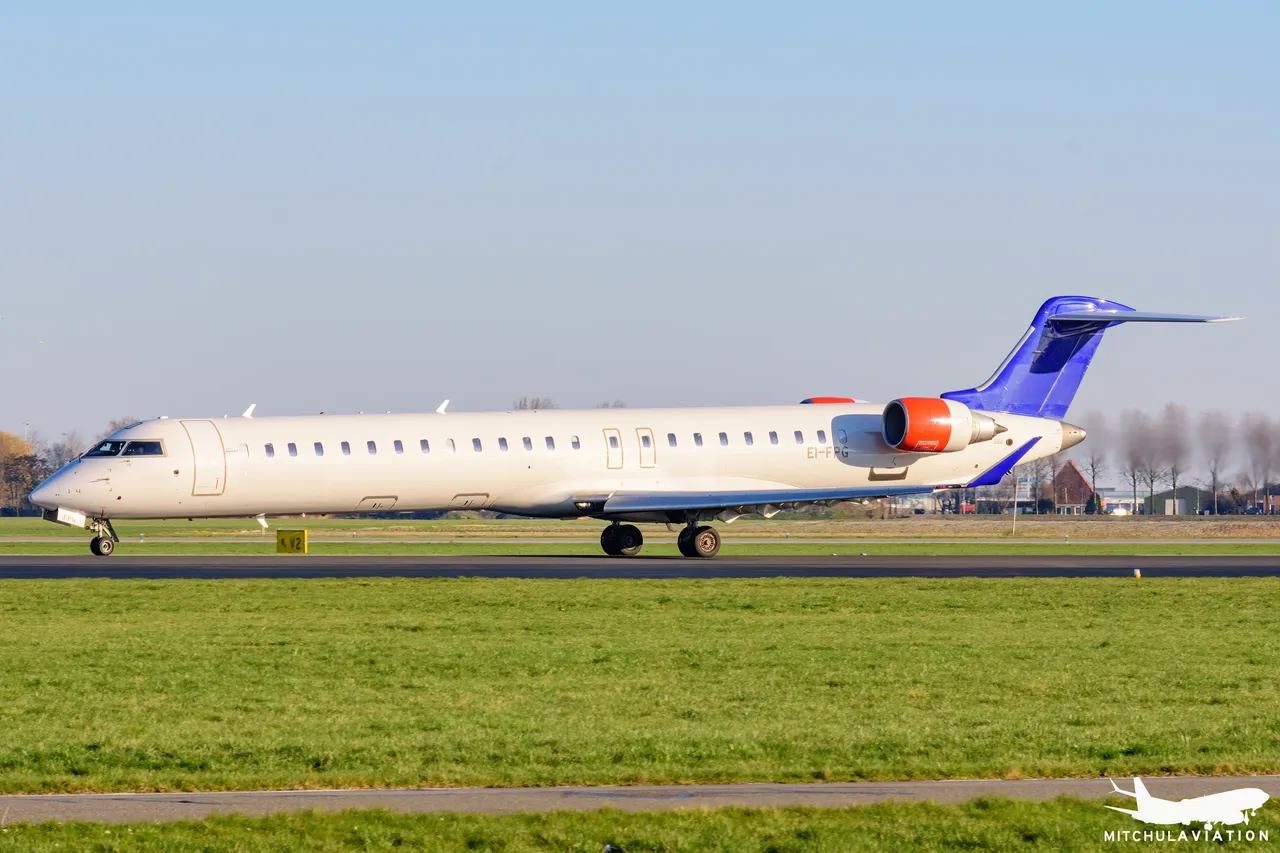


Recognise it overhead
Recognition clues checked 5 October 2026
- Tail
- T-tail, with the tailplane on top of the fin (CRJ700) [5]
- Wing
- Low wing with winglets (CRJ700) [5]
- Engines
- Not under the wings: Flightradar24 counts the E-Jets as the only regional jets in its guide with underwing engines rather than engines beside the tail [15]
- Fuselage
- Slim: the Challenger's fuselage was lengthened, not widened [2]
Use several visible clues together. If a detail is too far away to see, leave it uncertain.
Could also be: Embraer E-Jets
Key facts
The CRJ is a business jet that grew up to carry airline passengers. Canadair took its Challenger corporate jet, lengthened the fuselage and turned it into a 50-seat airliner [2] [3]. Bombardier then stretched it again and again, until the last version seated 100 [11]. Between 1991 and 2021 it built 1,945 of them [13].
From business jet to airliner
Bombardier bought Canadair from the Canadian government in 1986 [2]. Canadair was already building the CL-600 Challenger corporate jet, and that became the starting point for the airliner [2].
The Regional Jet programme was launched on 31 March 1989 [2]. The first aircraft, registered C-FCRJ, took off from Montreal on 10 May 1991 with chief test pilot Doug Atkins and co-pilot Don Stephen at the controls. They flew for an hour and 25 minutes and climbed to 12,000 feet [3].
Transport Canada certified the jet on 31 July 1992 [2]. Lufthansa CityLine, the launch customer, took its first aircraft in October 1992 and flew the first passenger service, Frankfurt to Barcelona, on 2 November 1992 [3]. That first model, the CRJ100, had 50 seats [2].
Building from a business jet had a catch. The fuselage could be made longer, but not wider [2], so every CRJ keeps the slim cabin of its corporate parent. The CRJ200 followed from 1995 with more efficient engines [2], General Electric CF34-3B1s that cut fuel burn [3].
Stretching the family
The CRJ700 first flew from Montreal on 27 May 1999, a 70-seat follow-on to the original jet [4]. Brit Air, for Air France, took the first one in January 2001 [2]. It has a low wing with winglets, a T-tail and GE CF34-8C1 engines [5].
The CRJ900 came next. Announced in 1999, it is a CRJ700 with two extra fuselage sections, one ahead of the wing and one behind it [6]. It first flew from Mirabel on 21 February 2001, and Mesa Airlines, with 25 on firm order, took the first in February 2003 [6]. Airlines usually fit 86 seats, with a maximum of 90 [6].
The last and longest was the CRJ1000, launched on 19 February 2007 [9]. It first flew on 3 September 2008 [8]. Flight testing was halted by a fault in the rudder controls and resumed in February 2010 [9]. Transport Canada and the European Aviation Safety Agency approved it on 10 November 2010, and the first two were handed over to Air Nostrum of Spain and Brit Air of France in December 2010 [9]. At 39.10 m long it seats up to 100 [11]. Aviacionline counts only 65 built [10].
The air traffic system sorts the family into five type designators [1]:
- CRJ1: the CRJ100.
- CRJ2: the CRJ200 and the CRJ440, plus Challenger 800 and 850 business versions.
- CRJ7: the CRJ700, CRJ701 and CRJ550, plus the Challenger 870.
- CRJ9: the CRJ900 and CRJ705, plus the Challenger 890.
- CRJX: the CRJ1000.
The end of the line
In June 2020 Mitsubishi Heavy Industries completed its purchase of the CRJ programme from Bombardier for US$550 million, also taking on about US$200 million of related debt [12]. It got the type certificates and the maintenance, support, refurbishment, marketing and sales business, while Bombardier agreed to assemble the 15 jets left in the order book through the second half of 2020 [12].
The final CRJ, a CRJ900 registered N840SK for Delta Air Lines and flown by SkyWest Airlines, came off the assembly line at Mirabel, AirlineGeeks reported on 2 March 2021 [13]. AirlineGeeks put the total at 1,945 aircraft over 30 years [13]. Mitsubishi bought the programme to support the jets already flying, not to keep building them [13].
Worth knowing
- In the official type list every model is a CL-600, the same model number as the Challenger business jet, and most are still listed under the Canadair name [1].
- The prototype C-FCRJ was lost on a test flight near Byers, Kansas, on 26 July 1993, when its crew lost control [19]. All three people on board were killed [3] [20].
- Bombardier publishes an airport planning manual for the CRJ Series on its customer document site, the place to look for the manufacturer's dimensioned drawings [21].
- The CRJ1000s are already leaving service. Air Nostrum retired its first on 14 February 2024, after about 13 years [10].
An Irish airline's CRJs
The CRJ has a Dublin connection through CityJet, which has its headquarters at Dublin Airport [14]. On 1 October 2015 SAS Scandinavian Airlines announced agreements to wet-lease aircraft from CityJet [17], and on 1 February 2017 Bombardier and CityJet finalised a purchase agreement for up to 10 CRJ900s [18].
Those jets work far from Ireland, though. When we read it in October 2026, CityJet's own history page placed its CRJ900s at Copenhagen and Stockholm, flying for SAS [14]. We have not found a source that puts a CRJ on a regular Irish route, so we cannot say how often one passes over.
How to spot one
Start with the engines. If they hang under the wings, it is not a CRJ: Flightradar24 notes that among the regional aircraft in its guide, only the Embraer E-Jets carry their engines under the wing rather than beside the tail [15]. Then look up at the tail. The CRJ700 has a T-tail, with the tailplane perched on top of the fin, and a low wing tipped with winglets [5].
The body is the other clue. Because the CRJ was stretched from a business jet without being widened [2], it looks long and thin, and the longer versions exaggerate it: the CRJ200 is 26.8 m long [16], the CRJ900 36.20 m [7] and the CRJ1000 39.10 m [11].
CRJ or E-Jet? The Embraer E-Jet does a similar job with a similar number of seats, but its engines sit under the wings [15]. That one difference is often visible from the ground.
CRJ or ERJ 145? Embraer's ERJ 145 family is the other small jet to rule out; the Embraer ERJ 145 article sets out the cues for telling the two apart.
Which CRJ? Telling a CRJ700 from a CRJ900 by eye is hard, because the 900 is the same aircraft with two plugs added [6]. The type code on a flight tracker is the easier route [1].
In photographs
Look closer at the shapes, details and liveries. Every photograph links to its original and credits its creator.
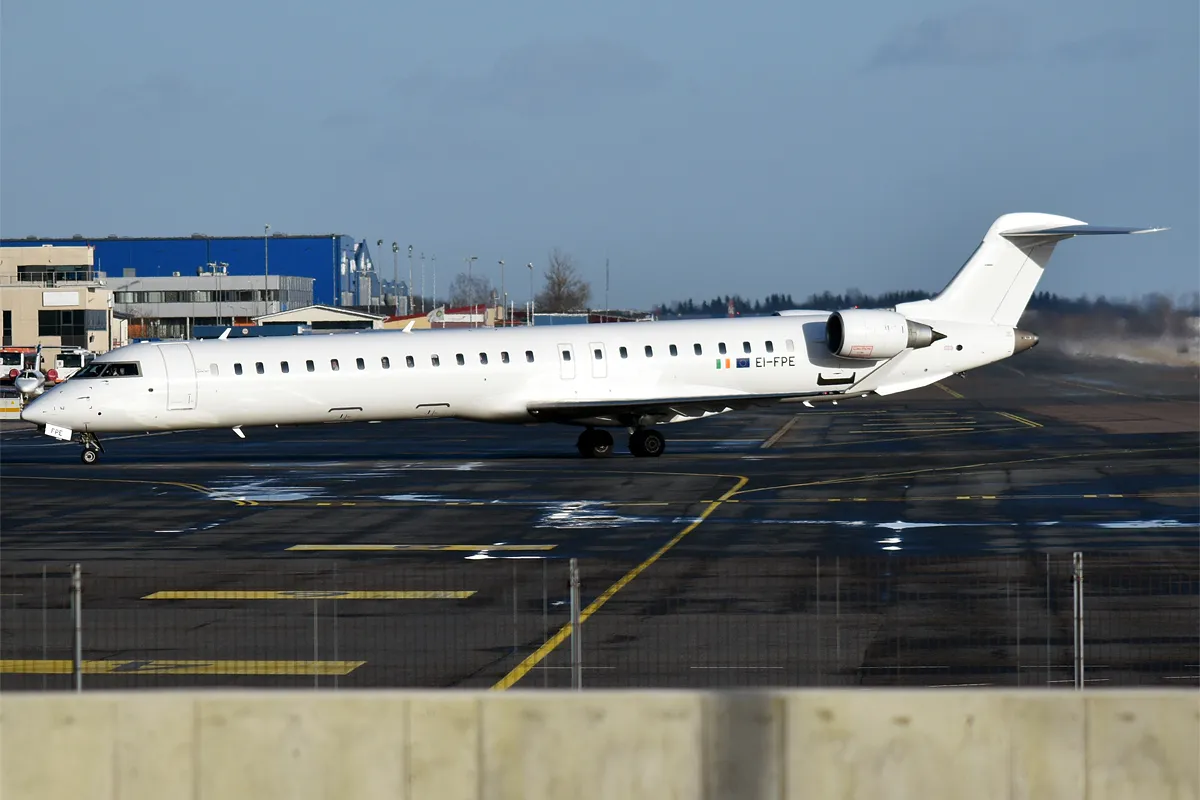
CityJet CRJ-900LR EI-FPE; the CRJ900 is a CRJ700 lengthened with two fuselage plugs.
Anna Zvereva · CC BY-SA 2.0 · Source and credits · 2020-03-02 16:47

View full-size · Original imageResized WebP display copy.

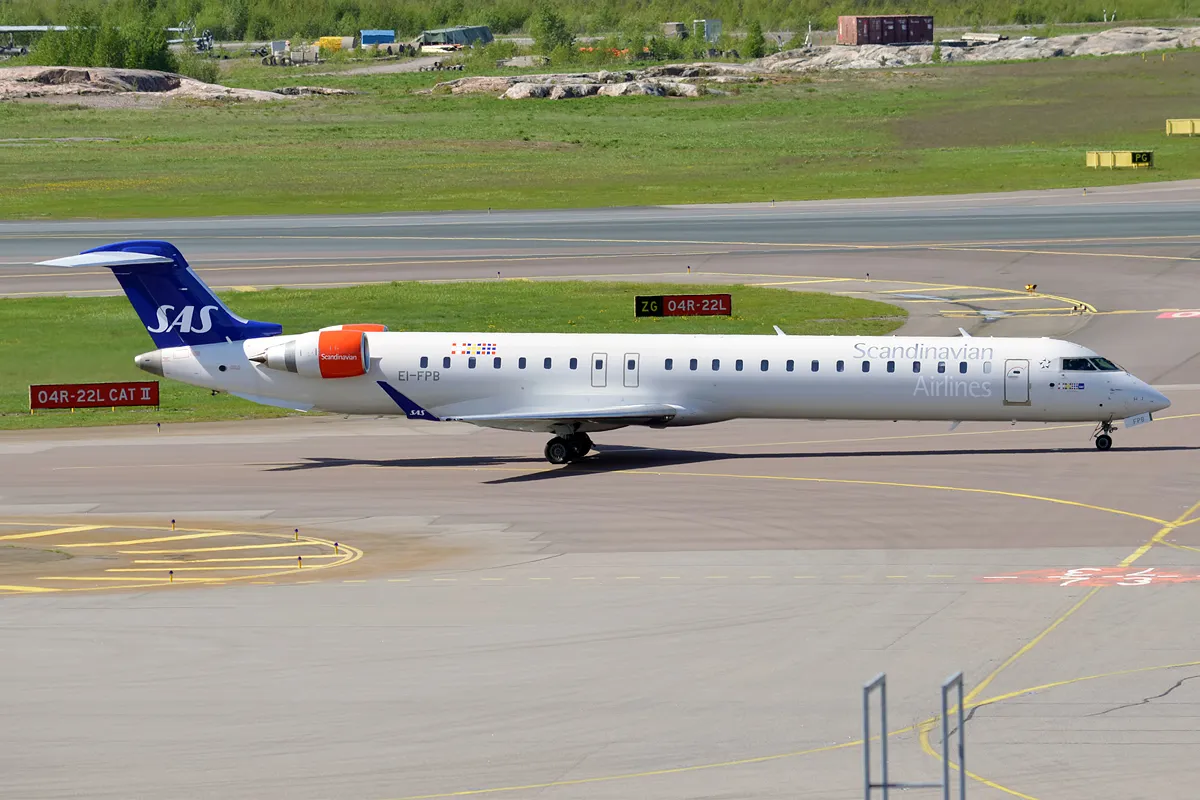
SAS CRJ-900LR EI-FPB, a type known for its slim fuselage and T-tail.
Anna Zvereva from Tallinn, Estonia · CC BY-SA 2.0 · Source and credits · 2016-05-16 15:12

View full-size · Original imageResized WebP display copy.

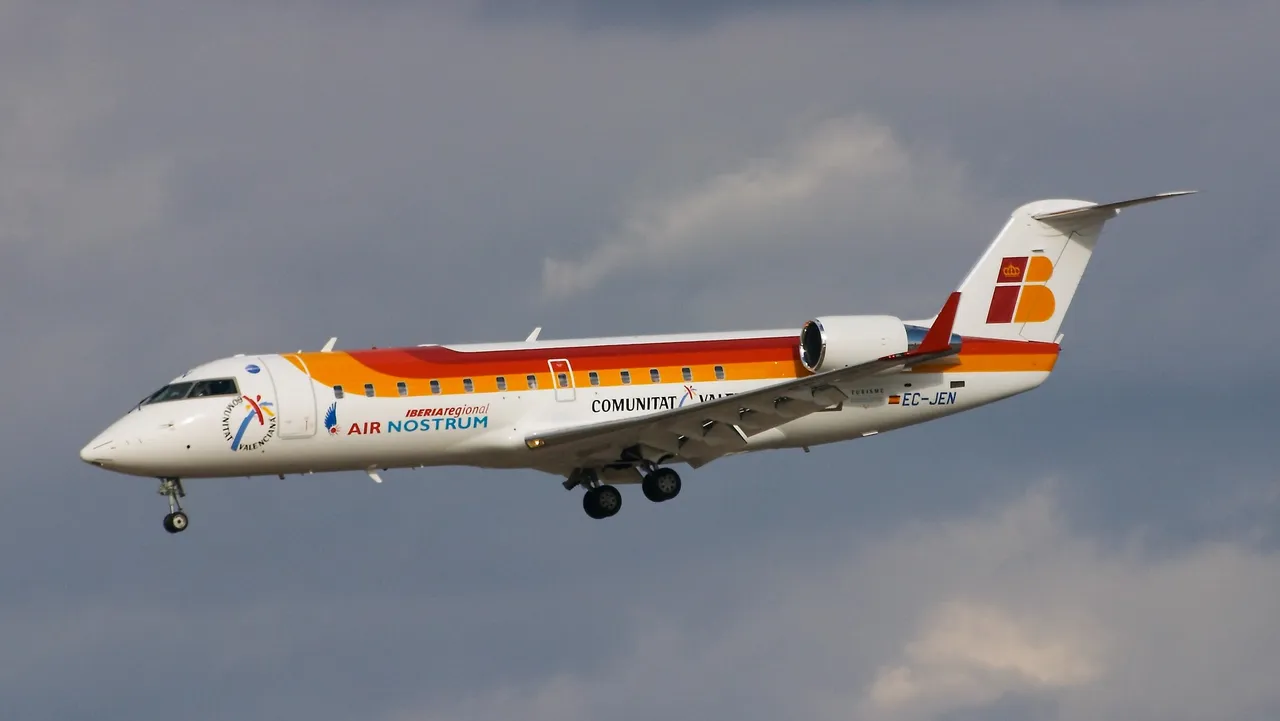
Air Nostrum CRJ-200ER EC-JEN, flying as Iberia Regional, at Madrid in 2005; note the slim Challenger-derived fuselage.
w:es:Usuario:Barcex · CC BY-SA 3.0 · Source and credits · 5 March 2005

View full-size · Original imageResized WebP display copy.

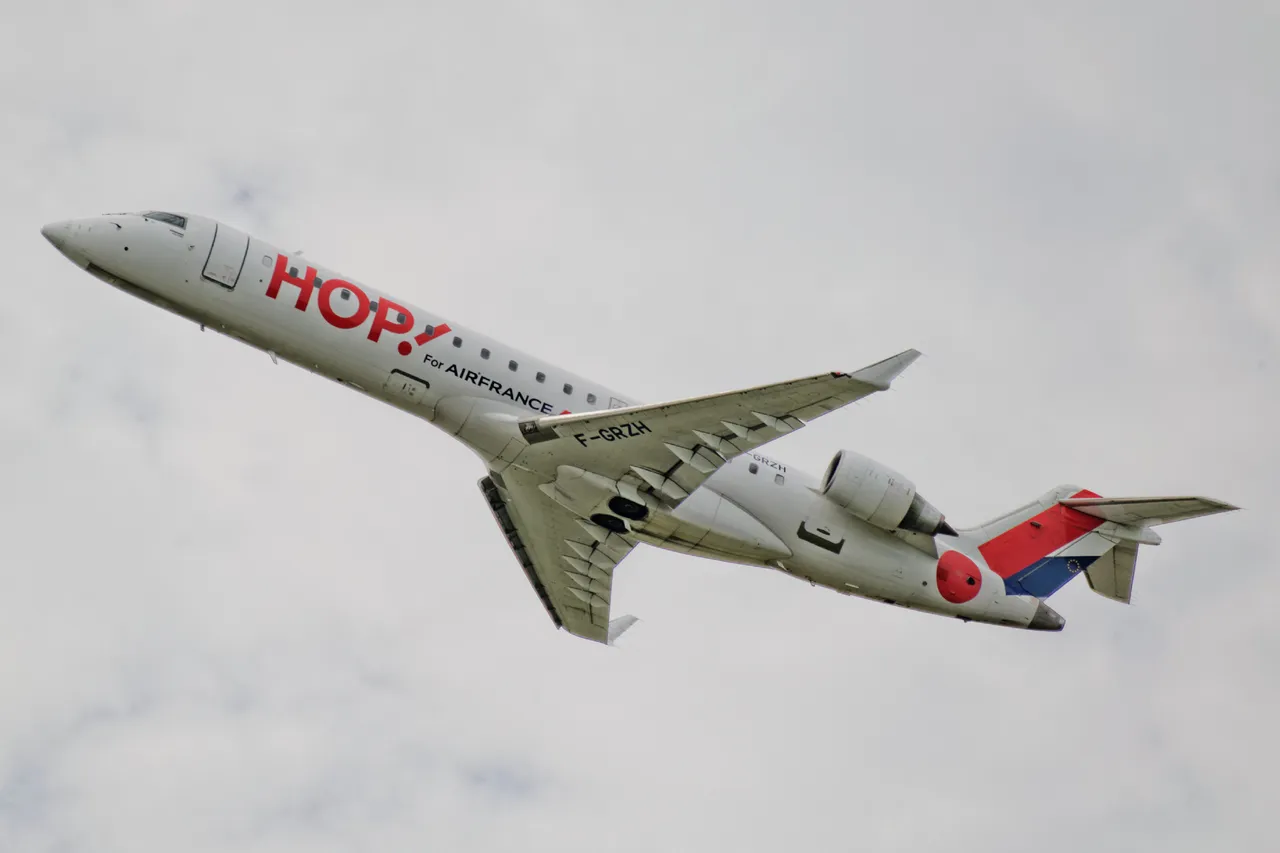
HOP! CRJ700 F-GRZH; the 70-seat CRJ700 has a low wing with winglets and a T-tail.
Dylan Agbagni (CC0) from Bordeaux, France · CC0 1.0 · Source and credits · 2018-06-08 16:49

View full-size · Original imageResized WebP display copy.

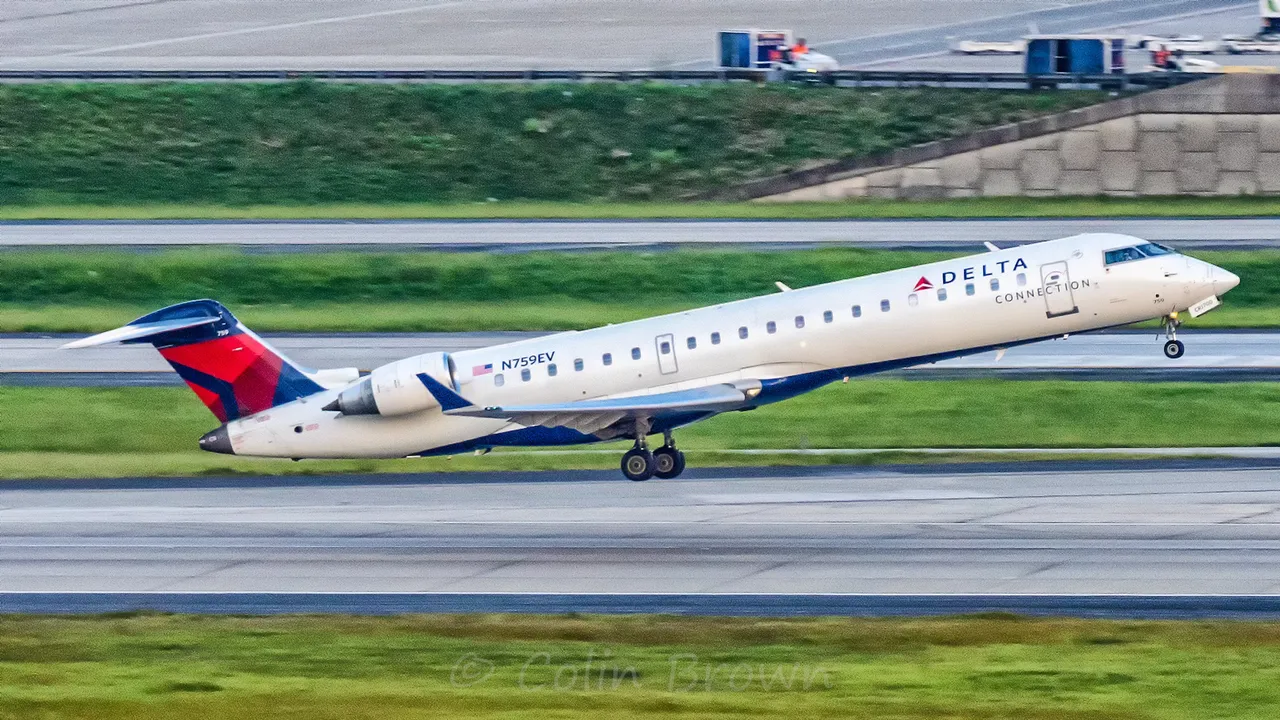
Delta Connection CRJ-700 N759EV, a type known for its T-tail and winglets.
Colin Brown Photography · CC BY 2.0 · Source and credits · 2015-07-12

View full-size · Original imageResized WebP display copy.

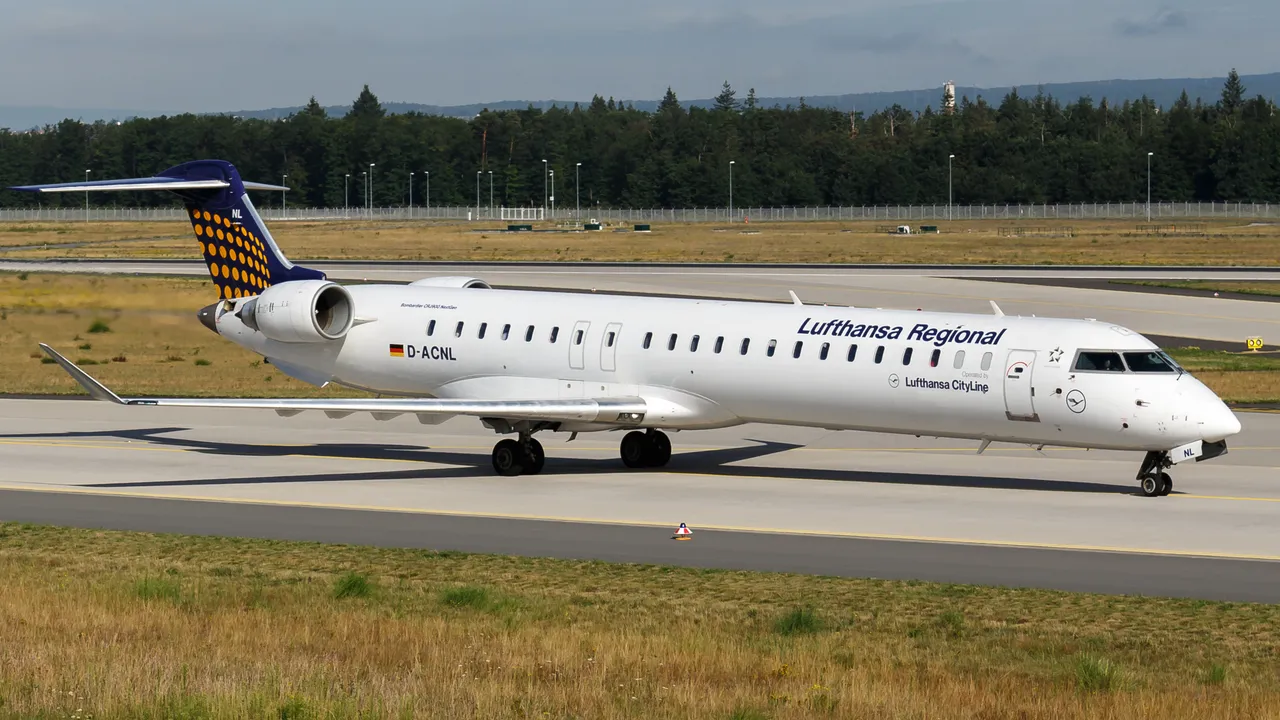
Lufthansa CityLine CRJ-900 D-ACNL at Frankfurt Airport, showing the stretched body of the CRJ900.
tjdarmstadt · CC BY 2.0 · Source and credits · 2017-08-02 09:08

View full-size · Original imageResized WebP display copy.

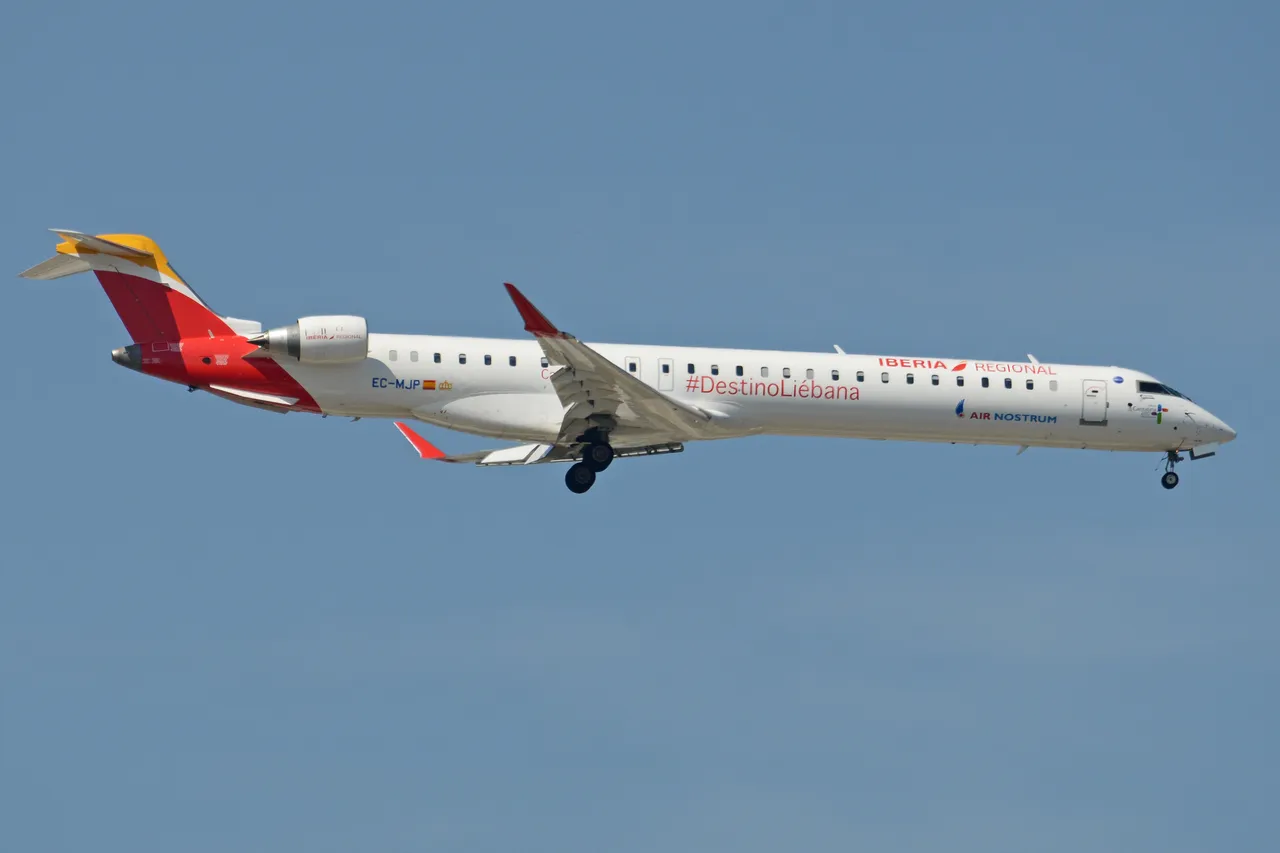
Iberia Regional CRJ-1000 EC-MJP, the longest member of the family at about 39 m.
Alan Wilson from Stilton, Peterborough, Cambs, UK · CC BY-SA 2.0 · Source and credits · 2016-05-21 10:26

View full-size · Original imageResized WebP display copy.

Drawings and original documents
The drawing source is Bombardier's CRJ900 Airport Planning Manual (CSP C-020, revision 11 of 17 December 2015) on its customer document site: section 00-02-02, Dimensions, carries the dimensioned drawings in Figure 1 (PDF pages 31 and 32) and Figure 4 (PDF pages 38 and 39). It covers the CRJ900 only. Reproduction rights stay with Bombardier and with Mitsubishi Heavy Industries, which bought the CRJ programme in 2020, so the page links the document rather than copying its drawings.
- Maiden flight of the CRJ100, 10 May 1991
Airways Magazine's account of the first flight of prototype C-FCRJ from Montreal, with its crew and duration, Lufthansa CityLine's first service from Frankfurt to Barcelona, and the 1993 loss of the prototype in testing.
- Bombardier CRJ900 regional jet project profile
Airport Technology's profile of the CRJ900: its 1999 announcement, first flight at Mirabel on 21 February 2001, the two fuselage plugs added to the CRJ700, the CF34-8C5 engines and the first delivery to Mesa Airlines in 2003.
- Bombardier CRJ900 Airport Planning Manual, CSP C-020, revision 11 of 17 December 2015
Bombardier's airport planning manual for the CRJ900 (172 pages). Section 00-02-02, Dimensions, gives the general dimensions and dimensioned drawings: Figure 1 (PDF pages 31 and 32) for aircraft 15001 to 15035, 15038, 15039 and 15042, and Figure 4 (PDF pages 38 and 39) for aircraft 15036 onwards.
See one for yourself
Skylark shows what is flying over Ireland right now, and the iPhone app points you at it. Next time you hear engines, look for the CRJ1 or CRJ2 or CRJ7 or CRJ9 or CRJX code.
Sources
Facts checked against these sources on 5 October 2026. Numbers that change over time, such as orders and fleet sizes, are as of the date given beside them.
- ICAO aircraft type designators: Canadair and Bombardier CL-600 entriesdoc8643.com
- Canadair Regional JetGlobalSecurity.org
- 5/10/1991: Maiden flight of the CRJ100Airways Magazine
- Bombardier flies CRJ700, 31 May 1999Aviation Week
- Bombardier Regional Jet CRJ-700SKYbrary
- Bombardier CRJ900Airport Technology
- Bombardier Regional Jet CRJ-900SKYbrary
- CRJ1000 takes flight, 3 September 2008AIN Online
- Bombardier celebrates the delivery of the first two CRJ1000s to Air Nostrum and Brit AirWorld Airline News
- Air Nostrum retired its first CRJ 1000 after only 13 years of serviceAviacionline
- Bombardier Regional Jet CRJ-1000SKYbrary
- Mitsubishi completes acquisition of Bombardier's CRJ programAir Data News
- Final Bombardier CRJ leaves assemblyAirlineGeeks
- Our historyCityJet
- Spotting the difference: regional aircraftFlightradar24
- CANADAIR CL-600 Challenger 800, CRJ2doc8643.com
- SAS enters into agreements with Cityjet for wet lease and sale of Blue1, 1 October 2015SAS via GlobeNewswire
- Bombardier and CityJet finalize purchase agreement for up to 10 CRJ900 aircraft, 1 February 2017Bombardier via GlobeNewswire
- Loss of control accident, Canadair CL-600-2B19 Regional Jet CRJ-100 C-FCRJ, 26 July 1993Aviation Safety Network
- Crash of a Canadair RegionalJet CRJ-100ER in Byers: 3 killedBureau of Aircraft Accidents Archives
- CRJ Series airport planning manual (customer document site PDF)Bombardier
How often does Skylark see it?
Read the existing Ireland observation log to see the days each type appeared. This is what Skylark recorded, with the coverage its receivers and providers supplied; it is not a census of Irish aircraft or a prediction of your next sighting.
One aircraft seen on three different days contributes three airframe-days. Repeated reports on the same day count once. Codes are shown separately, without adding them into a family total. A logged day does not mean continuous coverage throughout that day.
Observations load when you request them.