

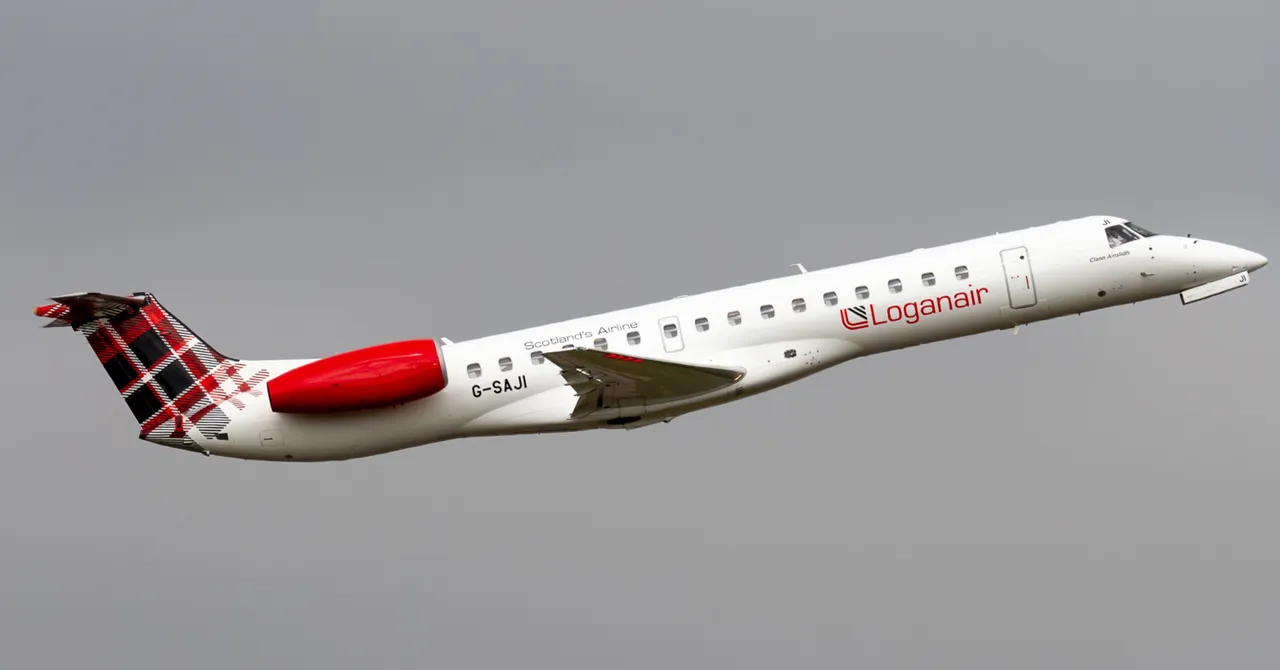


Recognise it overhead
Recognition clues checked 5 October 2026
- Nose
- A long, pointed nose cone stretching ahead of four cockpit windows [12]
- Fin
- A triangular fillet on the leading edge of the fin; a CRJ has an air inlet at the base of its fin instead [14]
Use several visible clues together. If a detail is too far away to see, leave it uncertain.
Could also be: Embraer E-Jets
Key facts
- Built
- More than 1,200 by August 2025 [7]
If a small jet goes over with its two engines tucked at the back, a tail shaped like a T and a nose that seems to go on a bit too long, there is a fair chance it is one of Embraer's ERJ family. The ERJ 135, ERJ 140 and ERJ 145 were built for busy short routes with between 37 and 50 seats [7], and the first of them launched Embraer into the regional jet market [7].
From turboprop to jet
Embraer's starting point was its own EMB 120 Brasilia turboprop. The new aircraft was launched at the Paris Air Show in 1989, and the idea was a Brasilia with a fuselage about 18 feet (5.5 m) longer and jet engines, carrying up to 50 people three abreast [6]. That three-abreast cabin layout carried over from the Brasilia [8].
The first drawings looked very like a stretched Brasilia [7]. The engineers first hung the engines under the wing, but that meant very tall landing gear to keep them clear of the ground [7]. In 1991 the engines moved to the rear fuselage [6], under a T-tail [7]. Embraer's manuals list the production aircraft with two Rolls-Royce AE 3007 turbofans [4] [5].
The first ERJ 145 flew on 11 August 1995 [6] [7]. The first delivery went to ExpressJet, flying as Continental Express, in December 1996 [6] [11].
Stretched, shrunk and stretched again
Once the 50-seat ERJ 145 was flying, Embraer made it smaller rather than bigger. The 37-seat ERJ 135 entered service in 1999, with a fuselage 26.33 m long against the 145's 29.87 m [4] [5] [8].
The 44-seat ERJ 140 came about because of a pilots' contract. American Airlines pilots had rejected a deal that would have lifted the cap on how many 50-seat jets its regional partner could fly, so in October 2000 American Eagle launched the smaller ERJ 140 with an order for 130 [9]. It entered service in mid-2001 [8]. The three sizes share about 95% of their parts and systems, with cross-type ratings for pilots [8].
Then came longer legs. The ERJ 145XR added an extra fuel tank, winglets and more powerful AE3007A1E engines [10]. ExpressJet took the first eight [10]. The winglets stretch its span to 21.00 m, against 20.04 m on the other versions [4].
Worth knowing
- The air traffic system files the family under three codes. E135 covers the ERJ 135 and ERJ 140 [1] [2]; E145 is the ERJ 145 [1] [3]; E45X is the ERJ 145XR [1]. The Legacy 600 and 650 business jets have a code of their own, E35L [17]. A code on a tracker is what the operator reported, so treat it as a strong hint about the variant rather than proof.
- The same airframe became the Legacy 600 and Legacy 650 business jets, and military versions for airborne early warning, remote sensing and maritime patrol [7].
- Harbin Embraer, a joint venture in China, assembled the ERJ 145 there from 2003 [8] [11].
- SKYbrary gives the ERJ 145 a cruise of about Mach 0.78 and a ceiling of 37,000 ft [3].
- More than 1,200 of the family had been built by August 2025 [7].
How to spot one
Start with the engines. Two jet engines on the back of the fuselage, a low wing and a T-tail on top of the fin narrow it down to the rear-engined regional jets [3] [12]. That is a short list, and the ERJ's main rival on it is the Bombardier CRJ.
ERJ or CRJ? Look at the nose. The ERJ has a long, pointed nose cone that sticks out well ahead of its four cockpit windows [12], while the CRJ's cockpit windows are slim and of constant height [13]. Then look at the very back: the ERJ's tail cone is pointed and the exhaust pipe of its auxiliary power unit pokes out of the end [12] [13]. The ERJ's engines also lack the CRJ's separate fan exhaust, and its dorsal fin is bigger [13]. With a good photo, check the fin: the ERJ has a triangular section on its leading edge, where the CRJ has a ram air inlet at the bottom of its fin [14]. The ERJ's tail looks a lot like the Brasilia's, which is no accident [12].
ERJ 135, 140 or 145? They differ mainly in length. The ERJ 135 is about 3.5 m shorter than the ERJ 145 [4] [5], so it looks noticeably stubbier, and the ERJ 140 sits in between [8]. Winglets point to an ERJ 145XR [10].
ERJ or E-Jet? Embraer's later E-Jets are built quite differently. The E-Jets hang their engines under the wing, the only aircraft in Flightradar24's regional guide to do so, while the ERJ carries its engines beside the tail [12]. If you can see engines under the wing, it is not an ERJ.
Over Ireland
Loganair has flown its Embraer 145s to the island of Ireland. In February 2019 it announced routes from Derry to London Stansted and to Manchester with a 49-seat Embraer 145 [15]. In June 2021 it announced an Aberdeen to Dublin service from September 2021, flown with the same 49-seat Embraer 145 jets [16]. Routes and fleets change, so treat those as dated examples rather than a timetable.
Original drawings
Embraer's airport planning manuals have the manufacturer's dimensioned three-view drawings. The ERJ 145 manual shows the standard aircraft in Figure 2.2.1 on page 2-4 and the longer-span 145XR in Figure 2.2.2 on page 2-5 [4]. The ERJ 135 manual has its general dimensions in Figure 2.2.1 on page 2-3 [5].
In photographs
Look closer at the shapes, details and liveries. Every photograph links to its original and credits its creator.
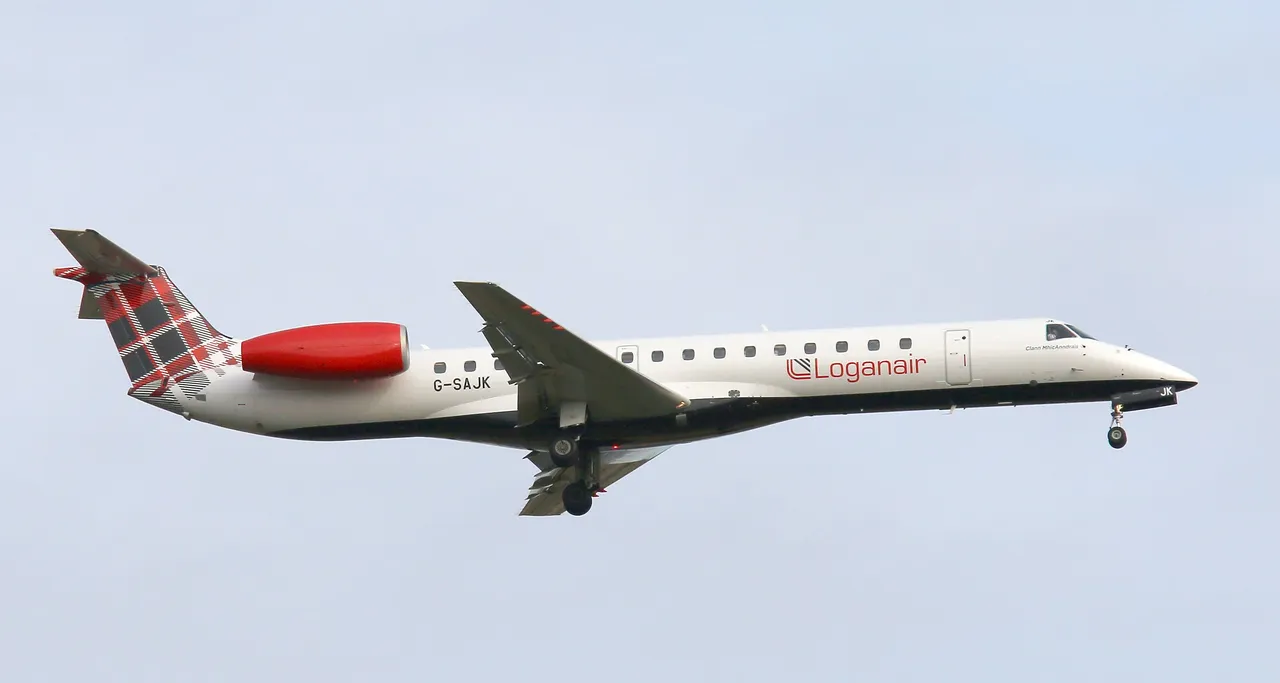
Loganair Embraer ERJ 145EP G-SAJK at London Stansted.
kitmasterbloke · CC BY 2.0 · Source and credits · 2020-07-29

View full-size · Original imageResized WebP display copy.


Loganair Embraer ERJ 145 G-SAJO, photographed in September 2023.
DaHuzyBru · CC BY-SA 4.0 · Source and credits · 2023-09-26 15:53:43

View full-size · Original imageResized WebP display copy.


American Eagle Embraer ERJ 135, the 37-seat member of the family.
Cory W. Watts from Madison, Wisconsin, United States of America · CC BY-SA 2.0 · Source and credits · 2009-02-03 18:53

View full-size · Original imageResized WebP display copy.


bmi Embraer ERJ 135 G-RJXK at Brussels.
Ad Meskens · CC BY-SA 4.0 · Source and credits · 2018-07-13 09:38:09

View full-size · Original imageResized WebP display copy.


United Express Embraer ERJ 145XR N14171 at Houston George Bush Intercontinental Airport on 24 September 2013.
Colin Brown · CC BY 2.0 · Source and credits · 2013-09-24

View full-size · Original imageResized WebP display copy.

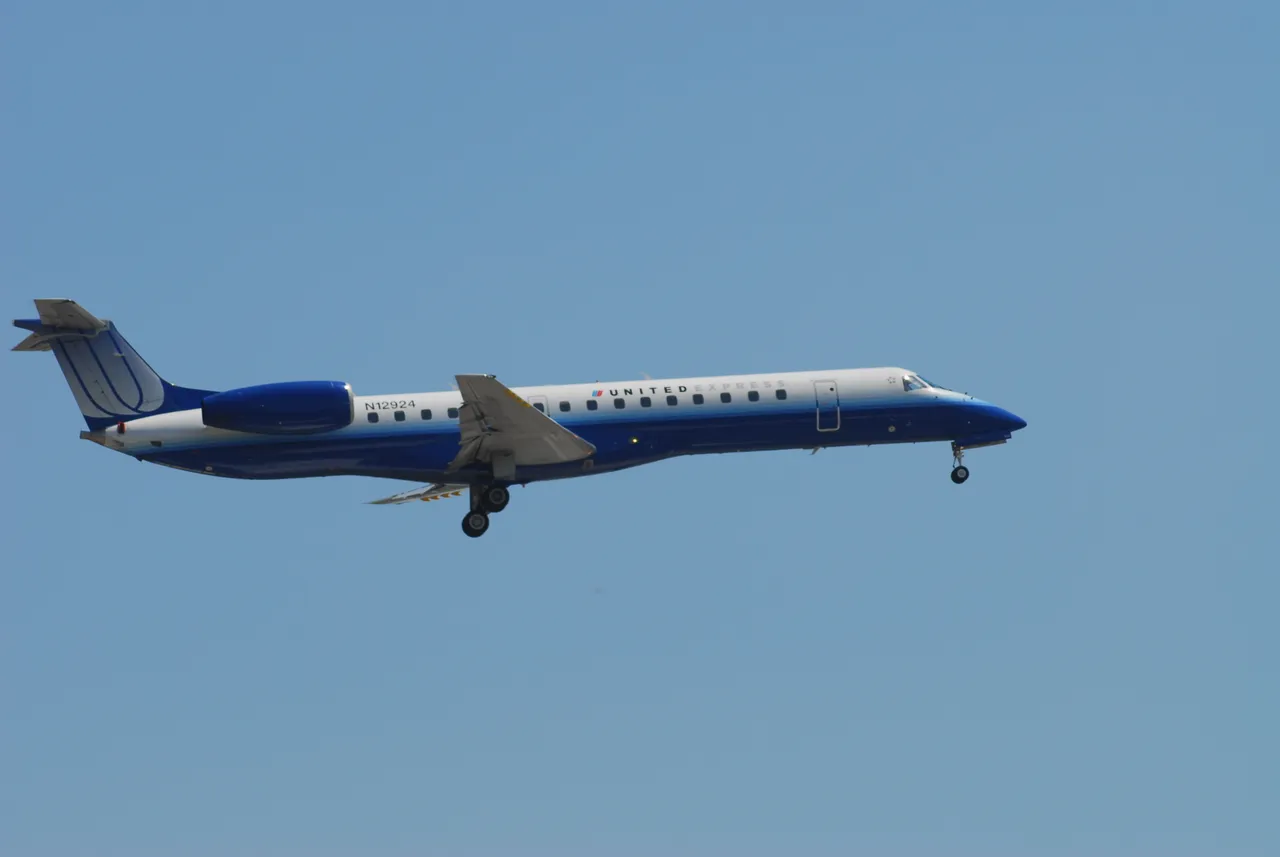
Continental Express Embraer ERJ 145LR N12924, flown by ExpressJet.
Lord of the Wings© from Toronto, Canada · CC BY-SA 2.0 · Source and credits · 2012-06-10 14:18

View full-size · Original imageResized WebP display copy.

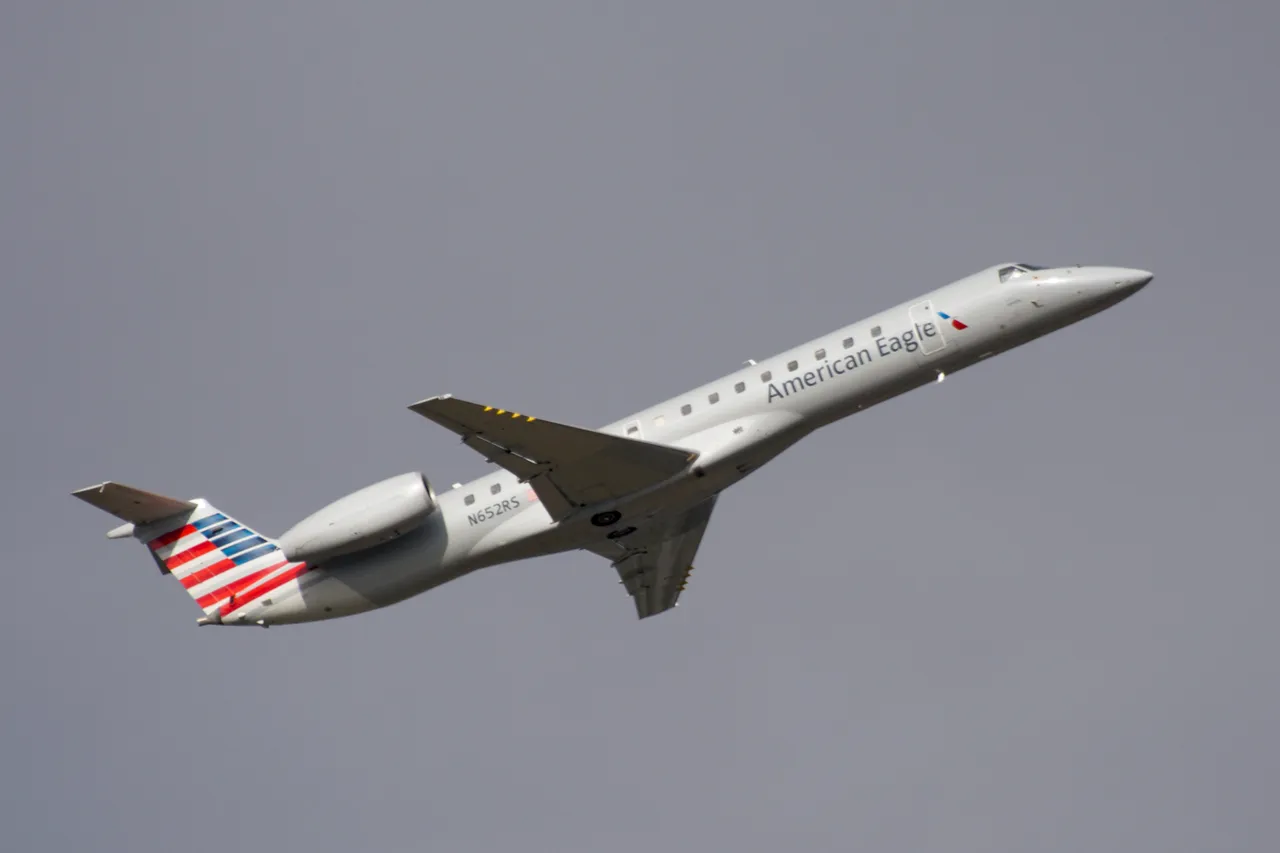
American Eagle Embraer ERJ 145 N652RS.
User:PlanespotterA320 · CC BY-SA 4.0 · Source and credits · 21 November 2015, 13:32:03

View full-size · Original imageResized WebP display copy.

Drawings and original documents
Embraer's EMB-145 Airport Planning Manual (APM-145/1100, revision N) holds the manufacturer's dimensioned three-view drawings of the ERJ 145 in Figure 2.2.1, page 2-4, and of the ERJ 145XR in Figure 2.2.2, page 2-5; the ERJ 135 manual has its own in Figure 2.2.1, page 2-3. Both are published by Embraer, which keeps the reproduction rights, so the drawings are linked rather than copied.
- Embraer EMB-145 Airport Planning Manual, APM-145/1100, revision N (29 January 2007)
Embraer's airport planning manual for the EMB-145EP, ER, EU, MP, MK, LR, LU and XR. Section 2.2 has dimensioned three-view general arrangement drawings: Figure 2.2.1 on page 2-4 for the standard aircraft (20.04 m span, 29.87 m long) and Figure 2.2.2 on page 2-5 for the 145XR with its 21.00 m span.
- Embraer EMB-135 Airport Planning Manual, APM-145/1238, revision L (28 January 2008)
Embraer's airport planning manual for the 37-seat EMB-135ER and EMB-135LR, with plan, front and side views in Figure 2.2.1, Airplane General Dimensions, on page 2-3 (26.33 m long, 20.04 m span).
- Aircraft Commerce issue 61: ERJ-135, -140 and -145 family specifications (December 2008/January 2009)
A trade magazine owner's guide comparing every ERJ variant's seats, weights, range and AE3007 engine version, with the family's EMB 120 Brasilia heritage, 95% parts commonality and the Harbin Embraer joint venture.
See one for yourself
Skylark shows what is flying over Ireland right now, and the iPhone app points you at it. Next time you hear engines, look for the E135 or E145 or E45X code.
Sources
Facts checked against these sources on 5 October 2026. Numbers that change over time, such as orders and fleet sizes, are as of the date given beside them.
- Order JO 7340.2, Contractions, chapter 5 section 1: aircraft type designators, manufacturers EFederal Aviation Administration
- EMBRAER ERJ-135 (E135)SKYbrary
- EMBRAER ERJ-145 (E145)SKYbrary
- EMB-145 Airport Planning Manual, APM-145/1100, revision N, 29 January 2007Embraer
- EMB-135 Airport Planning Manual, APM-145/1238, revision L, 28 January 2008Embraer
- 8/11/1995: Maiden flight of the Embraer ERJ-145Airways Magazine
- 30 years ago, the ERJ 145's first flight launched Embraer into the regional jet market, 11 August 2025Air Data News
- ERJ-135, -140 and -145 family specifications, issue 61, December 2008/January 2009Aircraft Commerce
- American launches ERJ-140 with order for 130, 3 October 2000FlightGlobal
- XRs arrive, 12 November 2002FlightGlobal
- ERJ-145 regional jetAirport Technology
- Spotting the difference: regional aircraftFlightradar24
- Canadair Regional JetAircraft Recognition Guide
- Spotting narrow-body jet airliners with two engines at the rear of the fuselageAirlinerSpotter
- Loganair to operate routes from Derry to London and Manchester, 22 February 2019UK Aviation News
- Loganair launches Aberdeen-Dublin air link, 24 June 2021ADS Group
- EMBRAER Legacy 600/650 (E35L)SKYbrary
How often does Skylark see it?
Read the existing Ireland observation log to see the days each type appeared. This is what Skylark recorded, with the coverage its receivers and providers supplied; it is not a census of Irish aircraft or a prediction of your next sighting.
One aircraft seen on three different days contributes three airframe-days. Repeated reports on the same day count once. Codes are shown separately, without adding them into a family total. A logged day does not mean continuous coverage throughout that day.
Observations load when you request them.